Q.Which of the following compounds is most reactive towards nucleophilic addition reactions?
Concept understanding — Nucleophilic Addition
Nucleophilic Addition – From Intuition to Precision
Imagine you have a molecule with a carbon–oxygen double bond — a carbonyl group (C=O). That oxygen is greedy for electrons; it pulls them away from carbon, leaving the carbon slightly positive (δ+) and the oxygen slightly negative (δ−). Now, if you bring a species that is rich in electrons (a nucleophile, meaning "nucleus-loving"), it will naturally be attracted to that electron-deficient carbon. The nucleophile attacks the carbon, the π bond breaks, and the oxygen picks up a proton (or some other electrophile) to become stable. That, in a nutshell, is nucleophilic addition.
The key idea: a nucleophile adds across a polar multiple bond (usually C=O or C≡N), breaking the π bond and forming two new sigma bonds.
The Precise Statement
Nucleophilic addition is a reaction in which a nucleophile (an electron-rich species) forms a sigma bond with an electrophilic carbon atom of a polar multiple bond (typically a carbonyl group, C=O, or a nitrile, C≡N), while the π bond breaks. The resulting intermediate then captures a proton (or another electrophile) to give a neutral product.
In general form:
RX2C=O+NuX−HX+RX2C(OH)Nu
The nucleophile (NuX−) attacks the carbonyl carbon; the oxygen becomes negatively charged; then a proton (HX+) from the medium attaches to the oxygen, yielding an alcohol.
Why It Happens – The Driving Force
The carbonyl carbon is electrophilic because:
- Oxygen is more electronegative than carbon, so the C=O bond is polarised: CXδ+=OXδ−.
- The π bond is weaker than a σ bond, so it can break relatively easily.
A nucleophile (like OHX−, CNX−, or NHX3) has a lone pair or a negative charge. It seeks positive centres. The attack forms a new σ bond, and the π electrons move entirely to oxygen, creating an alkoxide ion (RX2C−OX−). This intermediate is then quenched by a proton.
A common mistake: thinking the nucleophile attacks the oxygen. No — oxygen is already electron-rich; the nucleophile goes to the carbon because it is electron-deficient.
A Concrete Example – Addition of HCN to a Ketone
Take acetone (CHX3COCHX3) and hydrogen cyanide (HCN). In the presence of a base, CNX− (the nucleophile) attacks the carbonyl carbon:
CHX3COCHX3+CNX−CHX3C(OX−)(CN)CHX3
The alkoxide intermediate then picks up a proton from HCN (or from water) to give a cyanohydrin:
CHX3C(OX−)(CN)CHX3+HX+CHX3C(OH)(CN)CHX3
The product is acetone cyanohydrin. Notice: two new sigma bonds formed (C−CN and O−H), and the π bond is gone.
What Makes a Good Nucleophile?
Strong nucleophiles are usually negatively charged or have lone pairs:
- OHX−, CNX−, NHX2X−, CHX3OX−, HX− (from hydride reagents like NaBHX4 or LiAlHX4)
- Neutral but polarisable: NHX3, HX2O (weaker, but can add under acidic conditions)
In exams, remember: hydride ion (HX−) is a nucleophile in reductions (e.g., NaBHX4 reduces aldehydes/ketones to alcohols via nucleophilic addition).
The Big Picture – Why This Matters
Nucleophilic addition is the fundamental reaction of carbonyl compounds. It is how:
- Aldehydes and ketones form alcohols (with NaBHX4 or LiAlHX4)
- Cyanohydrins are made (important in organic synthesis)
- Grignard reagents (RMgX) add to carbonyls to form new carbon–carbon bonds
- Hemiacetals and acetals form (key in carbohydrate chemistry)
Every time you see a C=O group, think: this carbon is a target for nucleophiles.
Final Answer
Nucleophilic addition is a reaction where an electron-rich nucleophile attacks the electrophilic carbon of a polar multiple bond (typically C=O or C≡N), breaking the π bond and forming two new sigma bonds — one to the nucleophile and one to a proton (or other electrophile). The driving force is the polarity of the C=O bond and the stability gained by forming stronger sigma bonds.
Nucleophilic addition is a foundational mechanism in the NCERT Class 12 Chemistry chapter on Aldehydes, Ketones and Carboxylic Acids, and ‘nucleophilic addition reaction mechanism’ or ‘nucleophilic addition class 12 chemistry’ are common searches among students preparing for CBSE boards, JEE Main and NEET. Understanding why carbonyl carbons are electrophilic is the key idea tested across most important questions on this chapter.
Why this formula?
Nucleophilic Addition: Why the Mechanism Works the Way It Does
Let's build this from first principles — understanding why nucleophilic addition happens, not just memorising the steps.
1. The Core Problem: Why Does Addition Happen at All?
A carbonyl group (C=O) has a polarised double bond:
- Oxygen is more electronegative than carbon → it pulls electron density toward itself.
- This creates a partial positive charge on carbon (δ+) and a partial negative charge on oxygen (δ−).
CXδ+=OXδ−
Key insight: The carbon is electron-deficient — it wants electrons. A nucleophile (Nu⁻) is electron-rich — it wants to give electrons. This is a natural match.
2. The Two-Step Mechanism (Why Two Steps?)
Step 1: Nucleophilic Attack (Slow, Rate-Determining)
The nucleophile donates its lone pair to the electrophilic carbonyl carbon.
NuX−+C=O[Nu−C−O]X−
Why this happens:
- The π bond between C and O breaks — the electrons move entirely to oxygen.
- Oxygen now has a full negative charge (alkoxide ion).
- The carbon changes from sp2 (trigonal planar) to sp3 (tetrahedral).
This step is slow because the π bond must break — it requires energy.
Step 2: Protonation (Fast)
The negatively charged oxygen picks up a proton (HX+) from the solvent or acid.
[Nu−C−O]X−+HX+Nu−C−OH
Why this happens:
- The alkoxide ion is a strong base — it wants to neutralise its charge.
- Protonation gives a stable neutral alcohol product.
3. The Key Formula: Rate Law Derivation
For a general nucleophilic addition:
NuX−+RX2C=Okproducts
The rate law comes from the slow step (Step 1):
Rate=k[Nu−][RX2C=O]
Why this form?
- The reaction is bimolecular — two species must collide with correct orientation.
- Doubling either concentration doubles the rate (first order in each).
- This is second order overall.
Exam tip: This is why nucleophilic addition is often called addition-elimination when followed by loss of a leaving group (like in acyl substitution), but here it's just addition.
4. Why the Tetrahedral Intermediate Forms (And Why It's Unstable)
The intermediate is tetrahedral (sp3 hybridised carbon):
- Bond angles: ~109.5°
- Four groups around carbon: Nu, R, R', O⁻
Why it's unstable:
- The negative charge on oxygen is high-energy.
- The tetrahedral geometry is sterically crowded (especially with bulky R groups).
- The intermediate collapses quickly — either back to starting materials or forward to product.
Reversibility: If the nucleophile is a poor leaving group (like OHX−), the addition is reversible. If it's a good leaving group (like CNX− in cyanohydrin formation), the equilibrium favours product.
5. Why Different Nucleophiles Give Different Products
| Nucleophile | Product Type | Why? |
|---|---|---|
| HX− (from NaBH₄) | Alcohol | Hydride adds, then protonation |
| CNX− | Cyanohydrin | CN⁻ adds, stable C-CN bond |
| ROX− | Hemiacetal | Alkoxide adds, then protonation |
| NHX3 | Imine (after water loss) | N adds, then elimination of H₂O |
The pattern: The nucleophile always attacks the same carbon — the product differs only in what group is attached.
6. The "Why" in One Sentence
Nucleophilic addition happens because the carbonyl carbon is electron-deficient (δ+) and the nucleophile is electron-rich — they attract, the π bond breaks, and the resulting negative charge on oxygen is neutralised by protonation.
Quick Exam Checklist
- ✓ Rate depends on both [Nu⁻] and [carbonyl] — second order
- ✓ Carbon changes hybridisation: sp2→sp3
- ✓ Tetrahedral intermediate is key — unstable, short-lived
- ✓ Protonation is fast — always the second step
- ✓ Reversibility depends on nucleophile — poor leaving groups make it reversible
The key idea is that nucleophilic addition at a carbonyl carbon is favoured when the carbonyl carbon is more electrophilic (less sterically hindered and less stabilised by resonance).
Step 1: Compare the two aliphatic compounds. CH3CHO (acetaldehyde) has one alkyl group, while CH3COCH3 (acetone) has two. Alkyl groups are electron-donating (+I effect) and also cause greater steric hindrance. Both effects reduce reactivity toward nucleophiles. So CH3CHO is more reactive than CH3COCH3.
Step 2: Compare the two aromatic compounds. In C6H5CHO (benzaldehyde) and C6H5COCH3 (acetophenone), the carbonyl group is conjugated with the benzene ring. This resonance stabilises the carbonyl and reduces its electrophilicity. Additionally, the phenyl group is bulky. Both aromatic compounds are less reactive than aliphatic ones.
Step 3: Between the two aliphatic compounds, CH3CHO has the least steric hindrance and the least electron donation, making its carbonyl carbon the most electrophilic.
The most reactive compound is CH3CHO (option (i)).
The reactivity in nucleophilic addition depends on the electrophilicity of the carbonyl carbon. Acetaldehyde (CH3CHO) is the most reactive because it has the least steric hindrance and the strongest electron-withdrawing effect from the alkyl group, making option (i) correct.
Nucleophilic addition to a carbonyl compound is all about how easily a nucleophile can attack the electrophilic carbon of the C=O group. The key factors are: (1) the electron density on the carbonyl carbon (more positive = more reactive), and (2) the steric hindrance around it (less bulky = easier attack). Let’s see how each compound stacks up.
-
Compare the substituents on the carbonyl carbon.
In CH3CHO (acetaldehyde), one side is a hydrogen atom and the other is a methyl group (CH3). Hydrogen is small and doesn’t donate electrons much, so the carbonyl carbon remains fairly electron-deficient.
In CH3COCH3 (acetone), both sides are methyl groups. Methyl groups are electron-donating via hyperconjugation and inductive effect, which reduces the positive charge on the carbonyl carbon. Plus, two methyl groups create more steric bulk, making it harder for a nucleophile to approach.
-
Now look at the aromatic compounds.
C6H5CHO (benzaldehyde) has a phenyl ring attached. The phenyl ring can delocalize the positive charge on the carbonyl carbon through resonance — the lone pair on oxygen can be pushed into the ring, but more importantly, the ring’s π electrons can interact with the carbonyl. This resonance stabilizes the carbonyl group, making it less electrophilic.
C6H5COCH3 (acetophenone) has both a phenyl ring and a methyl group. The phenyl ring still provides resonance stabilization, and the methyl group adds electron donation and steric hindrance. So it’s even less reactive.
-
Rank them by reactivity.
The general order for nucleophilic addition reactivity is:
HCHO>CH3CHO>C6H5CHO>CH3COCH3>C6H5COCH3
(formaldehyde is not in the options, but it’s the most reactive).
Among the given, CH3CHO has the smallest substituent (H) on one side and only one electron-donating methyl group, so it’s the most electrophilic and least hindered.
A common mistake is to think that the phenyl ring withdraws electrons (it does inductively), but its resonance donation actually decreases the carbonyl’s electrophilicity. So benzaldehyde is less reactive than acetaldehyde, not more.
Remember: For nucleophilic addition, less substitution on the carbonyl carbon means higher reactivity. Aldehydes (with at least one H) are generally more reactive than ketones (two alkyl/aryl groups). Among aldehydes, those with smaller alkyl groups are more reactive.
- Confirm with a classic example. In the reaction with HCN or NaHSO3, acetaldehyde reacts readily, acetone reacts slowly, and benzaldehyde reacts even slower. Acetophenone is the least reactive of the lot.
The most reactive compound towards nucleophilic addition is (i) CH3CHO.
Method: Steric and Electronic Effect Analysis for Nucleophilic Addition Reactivity
Concept First (Why this method works)
Nucleophilic addition to a carbonyl group depends on two factors:
- Steric hindrance around the carbonyl carbon — less hindrance = easier attack
- Electronic effects (inductive and resonance) — more positive carbonyl carbon = faster attack
Steps
Step 1: Identify the carbonyl compounds
| Compound | Type |
|---|---|
| CH3CHO | Aliphatic aldehyde |
| CH3COCH3 | Aliphatic ketone |
| C6H5CHO | Aromatic aldehyde |
| C6H5COCH3 | Aromatic ketone |
Step 2: Compare steric hindrance
- Aldehydes (RCHO) have one alkyl/aryl group → less crowded
- Ketones (RCOR′) have two groups → more crowded
So: aldehydes > ketones (sterically)
Step 3: Compare electronic effects
- In C6H5CHO and C6H5COCH3, the phenyl ring donates electrons via resonance → reduces carbonyl carbon's positive charge → decreases reactivity
- In CH3CHO and CH3COCH3, alkyl groups donate electrons inductively (+I effect) but less effectively than phenyl's resonance donation
Step 4: Combine both factors
- Least hindered + least electron donation = most reactive
- CH3CHO has: smallest steric hindrance + weakest electron donation
Final Answer
Most reactive: (A) CH3CHO (acetaldehyde)
Quick Comparison Table
| Compound | Steric hindrance | Electronic deactivation | Reactivity rank |
|---|---|---|---|
| CH3CHO | Low | Low | 1st |
| C6H5CHO | Low | High (resonance) | 2nd |
| CH3COCH3 | High | Low | 3rd |
| C6H5COCH3 | High | High (resonance) | 4th |
Here is a breakdown of the common mistakes students make on this question, along with the correct reasoning to avoid them.
The Core Concept: Why Reactivity Varies
Nucleophilic addition to a carbonyl group (C=O) is controlled by electrophilicity of the carbonyl carbon. The more positive (electron-deficient) this carbon is, the faster a nucleophile will attack.
The key factors are:
- Inductive Effect: Electron-withdrawing groups (EWG) make the carbon more positive (more reactive). Electron-donating groups (EDG) make it less positive (less reactive).
- Steric Hindrance: Bulky groups attached to the carbonyl carbon physically block the nucleophile from attacking.
Mistake #1: Ignoring Steric Hindrance (The Most Common Error)
The Mistake: Students often rank reactivity based only on inductive effects, forgetting that a bulky group physically blocks the attack.
Example: They might think CH3COCH3 (acetone) is more reactive than CH3CHO (acetaldehyde) because two methyl groups donate more electron density, but they forget the size issue.
The Correct Reasoning:
- CH3CHO (Acetaldehyde): Has one small H and one CH3 group. Very little steric hindrance.
- CH3COCH3 (Acetone): Has two CH3 groups. This creates significant steric hindrance, making it less reactive than acetaldehyde.
How to Avoid: Always draw the structure. If the carbonyl carbon is attached to two large groups (like two alkyl groups or an aromatic ring), expect low reactivity due to steric hindrance, even if the inductive effect is favorable.
Mistake #2: Misjudging the Inductive Effect of the Phenyl Ring (C6H5)
The Mistake: Students assume the phenyl ring is a strong electron-withdrawing group (like a nitro group) and therefore makes the carbonyl carbon very positive.
The Correct Reasoning:
- The phenyl ring is electron-withdrawing by induction (due to its sp2 carbons being more electronegative than sp3).
- However, it is electron-donating by resonance. The π electrons of the ring can delocalize into the carbonyl group, partially neutralizing the positive charge on the carbonyl carbon.
- Net effect: The resonance donation is stronger than the inductive withdrawal. This makes the carbonyl carbon in C6H5CHO (benzaldehyde) less electrophilic than in CH3CHO (acetaldehyde).
How to Avoid: Remember the "Resonance Rule": If a group can donate electrons via resonance into the carbonyl, it decreases reactivity towards nucleophilic addition. The phenyl ring does this.
Mistake #3: Forgetting the "Ketone vs. Aldehyde" Rule
The Mistake: Students treat all ketones and aldehydes as having similar reactivity.
The Correct Reasoning:
- Aldehydes (RCHO) are generally more reactive than ketones (RCOR′) because:
- Sterics: Aldehydes have one small H atom, ketones have two alkyl/aryl groups.
- Electronics: The H atom is not electron-donating, while alkyl groups are. This makes the carbonyl carbon in aldehydes more positive.
How to Avoid: Memorize the general trend: Aldehyde > Ketone (for similar alkyl groups). This immediately tells you that CH3CHO is more reactive than CH3COCH3.
Applying the Logic to the Options
Let's rank them from most to least reactive:
-
CH3CHO (Acetaldehyde): Aldehyde. One small H, one CH3. Least steric hindrance, no resonance donation. Most reactive.
-
C6H5CHO (Benzaldehyde): Aldehyde. One small H, one phenyl ring. The phenyl ring causes resonance stabilization of the carbonyl, making it less reactive than acetaldehyde.
-
CH3COCH3 (Acetone): Ketone. Two CH3 groups. Steric hindrance and electron donation from two alkyl groups make it less reactive than both aldehydes.
-
C6H5COCH3 (Acetophenone): Ketone. One CH3, one phenyl ring. Maximum steric hindrance (two bulky groups) and maximum resonance stabilization (from the phenyl ring). Least reactive.
Final Answer: (A) CH3CHO is the most reactive.
Quick Cheat Sheet to Avoid Mistakes
| Compound | Type | Steric Hindrance | Resonance Stabilization | Reactivity Rank |
|---|---|---|---|---|
| CH3CHO | Aldehyde | Low | None | 1 (Highest) |
| C6H5CHO | Aldehyde | Low | High (from ring) | 2 |
| CH3COCH3 | Ketone | High | None | 3 |
| C6H5COCH3 | Ketone | Very High | High (from ring) | 4 (Lowest) |
The Golden Rule: When comparing reactivity, Steric Hindrance > Resonance > Inductive Effect in most cases for this specific reaction.
Showing the 12 most recent of 33 on this concept.
- AP EAPCET 2026Set eng-2026-05-13-FN1 markMCQQ.What are X and Y respectively in the following set of reactions? C6H5CNXA , C6H5CNYB ; A,BH+C6H5−C(CH3)=N−CH2C6H5 (A) H2/cat ; (CH3)2Cd (B) Na/C2H5OH ; CH3MgBr,H2O (C) DIBAL−H,H2O ; CH3MgBr,H2O (D) LiAlH4,H2O ; (CH3)2Cd
›Reveal solutionSolution
The final imine comes from condensing acetophenone with benzylamine. Benzonitrile is reduced by Na/C₂H₅OH to give benzylamine (A), and reacted with CH₃MgBr then hydrolysed to give acetophenone (B); acid catalyses their condensation to the imine.
Concept and Intuition
Nitriles (R−C≡N) are versatile precursors to both amines and ketones depending on the reagent used:
- Full reduction of a nitrile (e.g. dissolving-metal reduction with sodium in ethanol, or catalytic H2/LiAlH₄) adds four hydrogens across the triple bond, converting −C≡N directly into a primary amine, −CH2NH2.
- Grignard addition to a nitrile gives a metallated imine salt, R−C(=NMgBr)−R′, which on aqueous acidic hydrolysis (H2O/H3O+) is hydrolysed straight through to the ketone R−CO−R′ (releasing ammonia).
A ketone and a primary amine then condense under acid catalysis (loss of water) to form an imine (C=N−R) — exactly the target product here.
Step-by-Step Solution
- Target imine: C6H5−C(CH3)=N−CH2C6H5. Break the C=N bond conceptually: the C6H5−C(CH3)= portion comes from a ketone, C6H5−CO−CH3 (acetophenone); the =N−CH2C6H5 portion comes from a primary amine, C6H5CH2−NH2 (benzylamine).
- Route to A (benzylamine) from C6H5CN: full reduction of the nitrile using sodium and ethanol (a dissolving-metal / nascent-hydrogen reduction) directly gives C6H5CH2NH2.
- Route to B (acetophenone) from C6H5CN: react with the Grignard reagent CH3MgBr, then hydrolyse with H2O (aqueous acid workup) to give C6H5COCH3.
- A (amine) + B (ketone) condense under H+ catalysis, losing water, to give the target imine.
- So X (→A) = Na/C2H5OH and Y (→B) = CH3MgBr,H2O — matching option (B).
Common Mistakes
- Using DIBAL-H (a partial reducing agent) in place of a full-reduction reagent — DIBAL-H on a nitrile with aqueous workup stops at the aldehyde stage, not the amine, so it cannot supply the −CH2NH2 needed here.
- Trying to use (CH3)2Cd on the nitrile directly — dimethylcadmium reacts characteristically with acid chlorides to give ketones, not with nitriles.
✓Final answerThe correct option is (B) — Na/C2H5OH ; CH3MgBr,H2O.
ANSWER: B
- AP EAPCET 2026Set eng-2026-05-18-AN1 markMCQQ.Which of the following are the correct statements about D-glucose? I. It forms oxime with hydroxyl amine II. It forms addition product with NaHSO3 III. It forms cyanohydrin with HCN IV. It forms saccharic acid with bromine water The correct answer is (A) II & III only (B) I & III only (C) II & IV only (D) III & IV only
›Reveal solutionSolution
Glucose's structural-elucidation reactions: it does form an oxime and a cyanohydrin (confirming the aldehyde group exists in equilibrium with the ring form), but it does NOT form a bisulphite addition product, and bromine water oxidises it only to gluconic acid, not saccharic acid.
Concept and Intuition
Even though glucose predominantly exists as a cyclic hemiacetal, a small equilibrium amount of the open-chain aldehyde form is always present. This small amount is enough to react with small, reactive nucleophiles like HCN and NH2OH (whose reactions pull the equilibrium forward), giving cyanohydrin and oxime respectively. But bulkier/other characteristic aldehyde tests (like the bisulphite addition with NaHSO3, or Schiff's test) fail for glucose — this mismatch between "should behave like an aldehyde" and "doesn't give all aldehyde tests" was itself key historical evidence for glucose's cyclic hemiacetal structure.
Step-by-Step Solution
- Statement I: Glucose + NH2OH→ glucose oxime (via the open-chain −CHO). This reaction is well-documented and used as evidence for the carbonyl group. True.
- Statement II: Glucose does not give the NaHSO3 addition product — a well-known NCERT fact distinguishing glucose from typical aldehydes despite having a carbonyl group in its open form. False.
- Statement III: Glucose + HCN → glucose cyanohydrin (nucleophilic addition at the carbonyl carbon), again evidence for the −CHO group. True.
- Statement IV: Bromine water (a mild oxidant) oxidises only the aldehyde end of glucose to a carboxylic acid, giving gluconic acid (monocarboxylic acid), not saccharic acid. Saccharic acid (glucaric acid, dicarboxylic) requires oxidation of BOTH the −CHO and the terminal −CH2OH, which needs the stronger oxidant dilute HNO3. False as stated (wrong reagent–product pairing).
- So only statements I and III are correct.
Common Mistakes
- Assuming any reagent that normally reacts with aldehydes will react with glucose (some diagnostic reactions like NaHSO3 addition and Schiff's test famously fail).
- Confusing gluconic acid (from bromine water) with saccharic acid (from dilute HNO3) — different oxidants oxidise different ends of the glucose molecule.
✓Final answerThe correct option is (B) — I & III only.
ANSWER: B
- AP EAPCET 2026Set ap-2026-05-20-AN1 markMCQQ.What are B and C respectively in the given sequence of reactions? Bromocyclohexane Mg ∣ dryether A; A CH3CH2OH B; A (i) HCHO(ii) H3O+ C (A) Cyclohexanol , Cyclohexylmethanol (B) Cyclohexane , Cyclohexylmethanol (C) Cyclohexane , Ethylcyclohexane (D) C2H6 , Ethoxycyclohexane (cyclohexane ring bearing an −OCH2CH3 substituent)
›Reveal solutionSolution
Tests Grignard reagent formation and its two contrasting fates: quenching by an acidic O-H gives the alkane; addition to formaldehyde gives a one-carbon-homologated primary alcohol.
Concept and Intuition
A Grignard reagent (R-MgX) is a strong carbanion-like nucleophile and an extremely strong base. It reacts instantly with any acidic proton (even a weak one like the O-H of an alcohol) faster than it can do anything else — this simply protonates the carbanion and regenerates R-H. Only when there is no acidic proton available (e.g. with a carbonyl compound like HCHO) does the Grignard get the chance to act as a nucleophile and add across the C=O bond, building a new C-C bond and a new alcohol after the acidic workup.
Step-by-Step Solution
- Bromocyclohexane + Mg in dry ether → cyclohexylmagnesium bromide (A), by oxidative insertion of Mg into the C-Br bond.
- A + CH3CH2OH: the O-H proton of ethanol quenches the Grignard immediately (acid-base reaction), giving cyclohexane (B) + CH3CH2OMgBr. No new C-C bond forms.
- A + (i) HCHO (ii) H3O+: the nucleophilic cyclohexyl carbon attacks the electrophilic carbonyl carbon of formaldehyde, forming an alkoxide; aqueous acid workup protonates it to the primary alcohol cyclohexylmethanol (C), i.e. C6H11−CH2OH.
Common Mistakes
- Forgetting that alcohols (even though "just" weak acids) destroy Grignard reagents instantly — many students expect an ether or addition product instead.
- Miscounting the extra carbon contributed by HCHO and naming C as cyclohexanol instead of cyclohexylmethanol.
✓Final answerThe correct option is (B) — Cyclohexane, Cyclohexylmethanol.
ANSWER: B
- AP EAPCET 2025Set eng-2025-05-21-FN1 markMCQQ.Consider the following sequence of reactions Isopropyl benzene O2XH+H2O phenol +Z The incorrect statement about z is (A) z gives yellow precipitate of CHI3 with NaOH + I2 solution (B) z gives isopropyl alcohol on reduction with H2 in the presence of Pd catalyst (C) z on reaction with CH3MgBr followed by hydrolysis gives 2° alcohol (D) z does not give positive test with Fehling's reagent
›Reveal solutionSolution
Tests the cumene-to-phenol process and acetone's reactions; the answer is (C), since a ketone + Grignard reagent gives a tertiary (not secondary) alcohol.
Concept and Intuition
The industrial cumene process converts isopropylbenzene to phenol in two steps: air oxidation to cumene hydroperoxide (X), followed by acid-catalysed hydrolytic rearrangement to give phenol and acetone (Z) as co-product:
CumeneO2Cumene hydroperoxide (X)H+H2OPhenol+Acetone (Z)
So Z = acetone, (CH3)2C=O, a ketone. To find the incorrect statement, we check each of acetone's known reactions:
- Iodoform test: acetone has a CH3−CO− group, so it gives a positive iodoform test (yellow CHI3 precipitate) with NaOH/I2 — true.
- Catalytic hydrogenation: ketones are reduced to secondary alcohols by H2/Pd; acetone → isopropyl (2°) alcohol — true.
- Grignard addition: a ketone reacting with a Grignard reagent, upon hydrolysis, gives a tertiary alcohol (since the ketone carbon already bears two alkyl/aryl groups, and the Grignard's R group adds a third) — acetone + CH3MgBr → 2-methylpropan-2-ol (tert-butanol), a tertiary alcohol, NOT secondary. This makes the given statement false.
- Fehling's test: ketones (other than special reducing sugars) generally do not give a positive Fehling's test since it requires an oxidisable aldehyde-type group; acetone gives a negative result — true.
Step-by-Step Solution
- Deduce Z = acetone from the cumene process.
- Check (A): acetone + iodoform test → positive (true statement, so not the answer).
- Check (B): acetone + H2/Pd → isopropyl alcohol (true statement, so not the answer).
- Check (C): acetone (a ketone, R2C=O with two alkyl groups) + Grignard reagent → after hydrolysis, the product alcohol carbon bears three alkyl/aryl groups → tertiary alcohol, not secondary. This statement is FALSE — this is the incorrect statement asked for.
- Check (D): acetone does not reduce Fehling's solution (true statement, so not the answer).
Common Mistakes
- Forgetting the general rule that aldehydes + Grignard → secondary alcohols, while ketones + Grignard → tertiary alcohols (except formaldehyde + Grignard → primary alcohol) — mixing these up leads to picking the wrong option here.
✓Final answerThe correct option is (C) — z on reaction with CH3MgBr followed by hydrolysis gives 2° alcohol.
ANSWER: C
- AP EAPCET 2025Set eng-2025-05-22-FN1 markMCQQ.The correct statement about the product of the following reaction is CH3CHO(i) C2H5MgBr(ii) H2Oproduct (A) It undergoes dehydration with 20% H3PO4 at 358 K (B) It gives ketone on oxidation with CrO3 (C) It does not give positive iodoform test (D) It is a vinylic alcohol
›Reveal solutionSolution
Tests identifying the Grignard-addition product (a secondary alcohol) and its correct chemical behaviour on oxidation, dehydration, and the iodoform test.
Concept and Intuition
An aldehyde plus a Grignard reagent adds the alkyl group to the carbonyl carbon; after aqueous workup this gives a SECONDARY alcohol (aldehyde + RMgX → 2° alcohol; ketone + RMgX → 3° alcohol). Once the product's structure is nailed down, each option can be checked against that structure's real chemistry.
Step-by-Step Solution
- CH3CHO+C2H5MgBr→CH3−CH(OMgBr)−C2H5; hydrolysis with H2O gives CH3−CH(OH)−CH2CH3 = butan-2-ol, a secondary alcohol.
- Secondary alcohols are oxidised by chromium(VI) reagents such as CrO3 to ketones (here, butan-2-one, CH3COCH2CH3) — this statement is straightforwardly true.
- Checking (C): butan-2-ol has the fragment CH3−CH(OH)− (a methyl group directly on the carbinol carbon) — this is exactly the structural requirement for a POSITIVE iodoform test, so the claim that it does "not" give one is false.
- Checking (D): the molecule is a fully saturated secondary alcohol, not an enol/vinylic alcohol — false.
- So the only statement that is factually correct about the product is (B).
Common Mistakes
- Missing that butan-2-ol, despite being a "simple" secondary alcohol, still satisfies the methyl-carbinol pattern needed for a positive iodoform test.
- Assuming any alcohol with an –OH not on a terminal carbon is somehow atypical for CrO₃ oxidation; the 1°/2°/3° rule (2° → ketone) applies cleanly here.
✓Final answerThe correct option is (B) — it gives a ketone on oxidation with CrO3.
ANSWER: B
- AP EAPCET 2025Set ap-2025-05-20-FN1 markMCQQ.Glucose on reaction with HCN forms a compound 'A'. Acid hydrolysis of A gives B. The molecular formula of B is (A) C7H14O8 (B) C6H14O7 (C) C7H14O6 (D) C7H12O5
›Reveal solutionSolution
Glucose's cyanohydrin (from HCN addition) hydrolyses its nitrile group to a carboxylic acid, giving B with molecular formula C7H14O8.
Concept and Intuition
This is the classic 'glucose chain-length extension' sequence used historically (Kiliani–Fischer style logic) to probe glucose's structure: HCN adds across the free aldehyde group to form a cyanohydrin (adding one carbon), and subsequent acid hydrolysis converts the newly added nitrile into a carboxylic acid group, adding two oxygens (from two water molecules) while releasing ammonia.
Step-by-Step Solution
- Glucose (open-chain aldose): C6H12O6, with a free −CHO group.
- Reaction with HCN: nucleophilic addition of HCN across the aldehyde carbonyl adds the entire HCN unit to the molecule, forming cyanohydrin A: A=C6H12O6+HCN=C7H13NO6.
- Acid hydrolysis of the nitrile group in A: R−C≡N+2H2O→R−COOH+NH3.
- Applying atom balance: C7H13NO6+2H2O→B+NH3.
- Left side atoms: C7H13+4N1O6+2=C7H17NO8.
- Subtracting NH3 (the byproduct): B=C7H17NO8−NH3=C7H14O8.
Common Mistakes
- Forgetting that nitrile hydrolysis to a carboxylic acid consumes 2 water molecules (not 1) and releases NH₃, not just adding one oxygen.
- Miscounting hydrogens when the ammonia byproduct is subtracted.
✓Final answerThe correct option is (A) — C7H14O8.
ANSWER: A
- AP EAPCET 2025Set eng-2025-05-23-AN1 markMCQQ.An alkyl bromide X(C5H11Br) undergoes hydrolysis in a two step mechanism. X is converted to Grignard reagent and then reacted with CO2 in dry ether followed by acidification gave Y. What is Y? (A) (CH3)2CH−CH2−CH2−COOH (skeletal structure: a branched chain with a methyl branch, then two CH2 groups, ending in COOH) (B) CH3−CH2−CH2−CH2−CH2−COOH (skeletal structure: an unbranched chain ending in COOH) (C) CH3−CH2−CH(CH3)−CH2−COOH (skeletal structure: a chain with a methyl branch nearer the COOH end) (D) (CH3)3C−CH2−COOH (skeletal structure: a gem-dimethyl branched carbon adjacent to CH2COOH)
›Reveal solutionSolution
This tests the difference between a rearranging SN1 hydrolysis and a rearrangement-free Grignard carboxylation of the same neopentyl-type halide. Answer: (CH3)3C−CH2−COOH (D).
Concept and Intuition
The phrase "hydrolysis in a two-step mechanism" is the giveaway for identifying X: among the C5H11Br isomers, neopentyl bromide, (CH3)3C−CH2−Br, is the standard example of a primary halide that is nevertheless forced into an SN1 (two-step: ionisation, then nucleophilic capture) pathway on hydrolysis, because the bulky tert-butyl group next to the leaving carbon blocks backside SN2 attack. Once ionised, the resulting primary carbocation is so unstable that it instantly rearranges by a 1,2-methyl shift to a tertiary carbocation, so hydrolysis of X actually gives a rearranged tertiary alcohol.
But the question does not hydrolyse X directly — it first converts X to its Grignard reagent. Formation of a Grignard reagent (insertion of Mg metal into the C–Br bond) is a concerted/radical-pair process at the original carbon and does not proceed through a free carbocation, so no rearrangement occurs; the alkyl skeleton of the Grignard reagent is identical to that of X. Reaction of a Grignard reagent with CO2 (dry ether) forms a magnesium carboxylate at that same carbon, and acidification liberates the carboxylic acid — effectively inserting one new carbon (COOH) onto the unrearranged skeleton.
Step-by-Step Solution
- Identify X: C5H11Br whose hydrolysis is a two-step (carbocation, rearranging) process ⇒ neopentyl bromide, (CH3)3C−CH2−Br.
- Form the Grignard reagent: (CH3)3C−CH2−Br+Mgdry ether(CH3)3C−CH2−MgBr — no rearrangement, skeleton preserved.
- React with dry-ice CO2: (CH3)3C−CH2−MgBr+CO2→(CH3)3C−CH2−COOMgBr.
- Acidify: (CH3)3C−CH2−COOMgBr+H3O+→(CH3)3C−CH2−COOH (Y), i.e. 3,3-dimethylbutanoic acid.
- This exactly matches option (D)'s gem-dimethyl carbon adjacent to CH2COOH.
Common Mistakes
- Assuming that because hydrolysis of X would rearrange, the Grignard route must also give a rearranged product — it does not, since Grignard formation avoids the carbocation altogether.
- Picking a straight-chain or differently-branched acid (options A, B, C) that would correspond to a different C5H11Br isomer, ignoring the two-step-hydrolysis clue that pins down neopentyl bromide specifically.
✓Final answerThe correct option is (D) — (CH3)3C−CH2−COOH.
ANSWER: D
- AP EAPCET 2025Set eng-2025-05-23-AN1 markMCQQ.What is A in the following reaction? CH3−CH=CH−CH2−CH2−CN1) AlH(i−Bu)22) H2O(A) (A) CH3−CH=CH−CH2−CH2−CH2−NH2 (B) CH3−CH2−CH2−CH2−CH2−CH2−NH2 (C) CH3−CH=CH−CH2−CH2−CHO (D) CH3−CH2−CH2−CH2−CH2−CHO
›Reveal solutionSolution
DIBAL-H stops nitrile reduction at the aldehyde stage (via an imine intermediate hydrolysed on work-up) and leaves alkenes untouched. Answer: (C).
Concept and Intuition
DIBAL-H, AlH(i−Bu)2, delivers a single hydride. When it attacks a nitrile (R−C≡N), the hydride adds once to give a stable metalated imine (an aluminium–nitrogen chelate) that does not collapse further at low temperature because the aluminium coordinates and "locks" the intermediate. Aqueous hydrolysis of this imine/enamine–aluminium complex during work-up then releases the corresponding aldehyde, R−CHO. This is the standard method for stopping a nitrile reduction one oxidation level short of the amine that full reduction (e.g. with LiAlH4 or catalytic hydrogenation) would give. DIBAL-H is also a mild, chemoselective hydride source that does not reduce ordinary isolated alkene double bonds, so the CH3−CH=CH− portion of the substrate is unaffected.
Step-by-Step Solution
- Substrate: CH3−CH=CH−CH2−CH2−C≡N.
- Step 1, AlH(i−Bu)2 (1 equivalent, controlled conditions): hydride adds once to the nitrile carbon, forming the imine–aluminium adduct CH3−CH=CH−CH2−CH2−CH=NAl(i−Bu)2 (conceptually); the alkene is untouched throughout.
- Step 2, H2O work-up: hydrolyses the imine/aluminium complex to the aldehyde, releasing NH3 (as ammonium salts) and giving CH3−CH=CH−CH2−CH2−CHO.
- This matches option (C) exactly — same carbon count, double bond retained, terminal group is −CHO not −CH2NH2.
Common Mistakes
- Assuming any hydride reduction of a nitrile goes all the way to the primary amine (true for LiAlH4/H2/catalyst, but not for controlled DIBAL-H).
- Forgetting DIBAL-H leaves the isolated alkene alone and mistakenly reducing/hydrating the double bond as well.
✓Final answerThe correct option is (C).
ANSWER: C
- AP EAPCET 2025Set eng-2025-05-24-FN1 markMCQQ.What are X and Y in the following reaction sequence? C6H5N2+Cl−XC6H5CN(i) CH3MgBr (ii) H2OY (A) KCN; C6H5COCH3 (B) KCN; C6H5C(OH)(CH3)2 (C) CuCN|KCN; C6H5CH(OH)CH3 (D) CuCN|KCN; C6H5COCH3
›Reveal solutionSolution
Diazonium → nitrile is a Sandmeyer reaction (CuCN|KCN); a Grignard reagent adding to a nitrile and then hydrolysing gives a ketone, not an alcohol — so Y=C6H5COCH3.
Concept and Intuition
Sandmeyer-type reactions replace the −N2+ group of a diazonium salt with a nucleophile delivered via a copper(I) catalyst; with cyanide (as CuCN, generated from CuCN|KCN) this installs −CN directly onto the aromatic ring, retaining the ring intact — a route to aryl nitriles that plain KCN alone (without Cu(I)) does not reliably achieve on an aryl diazonium.
A nitrile's carbon is only singly electrophilic toward a Grignard: one equivalent of RMgX adds across the C≡N triple bond to give a metalated imine (an imino-magnesium salt). This does not react further with a second equivalent of Grignard (unlike an ester, which can go on to a tertiary alcohol) because the intermediate is stable to the reaction conditions until workup. Aqueous acidic hydrolysis of that imine salt then gives a ketone, not an alcohol.
Step-by-Step Solution
- C6H5N2+Cl−CuCN|KCNC6H5CN — Sandmeyer reaction; X=CuCN|KCN.
- C6H5CNCH3MgBrC6H5C(=NMgBr)CH3 (Grignard adds once across the nitrile).
- Aqueous workup hydrolyses the imine-magnesium salt to the ketone:
Y=C6H5COCH3(acetophenone)
Common Mistakes
- Using plain KCN without Cu and expecting the same clean aryl nitrile (Sandmeyer specifically needs the Cu(I) catalytic cycle).
- Assuming Grignard + nitrile gives a tertiary alcohol like it would with an ester or two Grignard equivalents on a ketone — it stops at the ketone stage after hydrolysis.
✓Final answerThe correct option is (D) — CuCN|KCN; C6H5COCH3.
ANSWER: D
- AP EAPCET 2025Set eng-2025-05-26-FN1 markMCQQ.What are X and Y respectively in the following reaction sequence? (g = వాయువు, dil = విలీన) 4-O2N-C6H4-CHOC2H5OHHCl(g)Xdil. HClY (A) X=4-O2NC6H4CH(OC2H5)2 (diethyl acetal) ; Y=4-O2NC6H4CHO (the aldehyde) (B) X=4-O2NC6H4CH(OH)(OC2H5) (hemiacetal, OH and OC2H5 on the same carbon) ; Y=4-O2NC6H4CH(OC2H5)2 (diethyl acetal) (C) X=4-O2NC6H4CH(OC2H5)2 (diethyl acetal) ; Y=4-O2NC6H4CH(OH)(OC2H5) (hemiacetal) (D) X=4-O2NC6H4CH(OH)(OC2H5) (hemiacetal) ; Y=4-O2NC6H4CH2OH (the benzylic alcohol)
›Reveal solutionSolution
This tests acetal formation (protection) and its acid hydrolysis (deprotection) of an aldehyde. The answer is (A): X is the diethyl acetal, and Y is the regenerated aldehyde.
Concept and Intuition
Aldehydes react with excess alcohol under anhydrous acidic conditions (e.g. dry HCl gas) to form acetals, RCH(OR′)2, via a hemiacetal intermediate that is not isolated under these forcing (excess alcohol, anhydrous acid, often with removal of water) conditions — the reaction proceeds essentially straight through to the acetal. Acetals are a classic protecting group for the carbonyl: they are stable under basic and neutral conditions but are cleaved by aqueous acid, regenerating the original aldehyde plus the alcohol (acetal hydrolysis is simply the reverse of acetal formation, driven by the presence of water).
Step-by-Step Solution
- Step 1 (aldehyde → X): 4-nitrobenzaldehyde reacts with excess ethanol in the presence of dry HCl gas. Under these anhydrous, acid-catalyzed, excess-alcohol conditions, the aldehyde is converted all the way to its diethyl acetal: X=4-O2NC6H4CH(OC2H5)2.
- Step 2 (X → Y): treating the acetal X with dilute (aqueous) HCl reverses acetal formation — water attacks and the acetal hydrolyzes back to the free aldehyde, releasing 2 equivalents of ethanol: Y=4-O2NC6H4CHO, i.e., the original 4-nitrobenzaldehyde is regenerated.
- So overall this sequence is simply 'protect the aldehyde as its acetal, then deprotect it back' — X is the acetal, Y is the aldehyde again.
- This matches option (A) exactly, ruling out (B)/(C) (which reverse the order or insert a hemiacetal where an isolable acetal/aldehyde is expected) and (D) (which wrongly reduces the aldehyde to a benzylic alcohol — no reducing agent is present in either step).
Common Mistakes
- Assuming the hemiacetal is the isolated product of step 1 — under anhydrous conditions with excess alcohol and HCl gas as catalyst, the reaction proceeds to the full acetal, not the hemiacetal.
- Thinking dilute HCl (aqueous) would do anything other than hydrolyze the acetal back to the carbonyl compound — there is no reducing or other functional-group-changing agent present.
✓Final answerThe correct option is (A) — X=4-O2NC6H4CH(OC2H5)2 (diethyl acetal); Y=4-O2NC6H4CHO (the aldehyde).
ANSWER: A
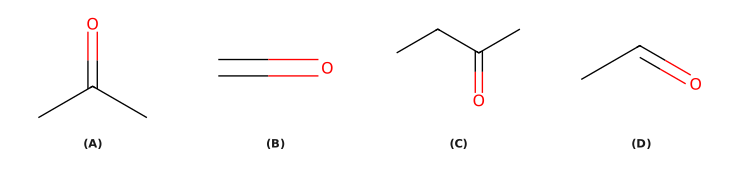
- AP EAPCET 2025Set eng-2025-05-27-FN1 markMCQQ.An alcohol, X (C5H12O) in the presence of Cu/573K gives Y (C5H10). The reactants required for the preparation of X are (A) acetone, CH3COCH3 (drawn as a skeletal structure with the carbonyl O at the bottom), and C2H5MgBr (B) HCHO, (CH3)3CMgBr (C) [FIGURE] (a five-carbon ketone: an ethyl group and a branched, isopropyl-type group attached to a central carbonyl carbon), and C2H5MgBr (D) acetone, CH3COCH3 (drawn as a skeletal structure with the carbonyl O at the top), and (CH3)2CHMgBr
›Reveal solutionSolution
X loses H2O (not H2) over Cu/573K to give C5H10, which is the signature of a tertiary alcohol undergoing dehydration; only acetone + C2H5MgBr builds a tertiary C5H12O alcohol. Answer: (A).
Concept and Intuition
Over copper at 573 K, alcohols react differently depending on their class:
- 1° alcohols dehydrogenate (lose H2) to give aldehydes.
- 2° alcohols dehydrogenate (lose H2) to give ketones.
- 3° alcohols have no H on the carbinol carbon to remove for dehydrogenation, so instead they undergo dehydration (lose H2O) to give alkenes.
Here, X (C5H12O) gives Y (C5H10). Checking the atom balance: C5H12O−H2O=C5H10 — mass balance fits loss of water, confirming X must be a tertiary alcohol.
A tertiary alcohol is made by adding a Grignard reagent to a ketone (not an aldehyde, which gives a secondary alcohol): R2C=O+R′MgX→R2C(OH)R′. We need the resulting alcohol to have exactly 5 carbons.
Step-by-Step Solution
- Determine X's alcohol class from the reaction Cu/573K: since Y=C5H10 (loss of H2O from X, not H2), X must be a tertiary alcohol giving an alkene by dehydration.
- Test option (A): acetone (CH3)2C=O (3 carbons) + C2H5MgBr (2 carbons) → (CH3)2C(OH)C2H5 = 2-methyl-2-butanol, a tertiary alcohol with 5 carbons, formula C5H12O. ✓ Matches on both carbon count and alcohol class.
- Test option (D): acetone (3C) + (CH3)2CHMgBr (isopropyl, 3C) → (CH3)2C(OH)CH(CH3)2 = 2,3-dimethyl-2-butanol, which has 6 carbons (C6H14O) — too many carbons, rejected.
- Test option (B): HCHO + (CH3)3CMgBr → (CH3)3C−CH2OH (neopentyl alcohol), which is a primary alcohol (C5H12O by formula) — but a 1° alcohol would dehydrogenate to an aldehyde (losing H2, giving C5H10O), not match Y=C5H10. Rejected.
- Test option (C): the drawn 5/6-carbon ketone + C2H5MgBr adds too many total carbons (well beyond 5). Rejected.
- Only (A) gives a tertiary C5H12O alcohol consistent with dehydration to C5H10.
Common Mistakes
- Forgetting that Cu/573K behaves differently for 1°/2°/3° alcohols — treating all alcohols as simply "dehydrogenating" would wrongly point to options that give aldehydes/ketones instead of alkenes.
- Not checking total carbon count carefully in the Grignard addition — options (C) and (D) fail purely on carbon-count grounds.
✓Final answerThe correct option is (A) — acetone, CH3COCH3, and C2H5MgBr.
ANSWER: A
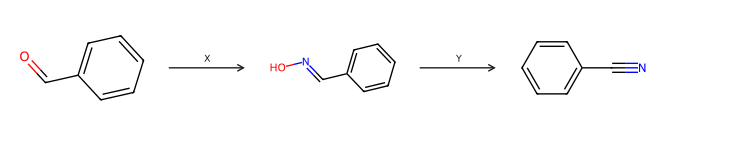
- AP EAPCET 2024Set eng-2024-05-18-FN1 markMCQQ.What are X and Y respectively in the following reaction sequence? [FIGURE] (benzaldehyde X Oxime Y benzonitrile) (A) NH2NH2, C6H5SO2Cl / Pyridine (B) NH2NH2, (CH3CO)2O (C) NH2OH, C6H5SO2Cl / Pyridine (D) NH2OH, (CH3CO)2O
›Reveal solutionSolution
Aldehyde → oxime needs hydroxylamine; oxime → nitrile needs a dehydrating agent, classically acetic anhydride — X, Y = NH2OH, (CH3CO)2O, option (D).
Concept and Intuition
This is the standard two-step laboratory route from an aldehyde to the one-carbon-longer nitrile (useful because nitriles hydrolyse further to carboxylic acids, or reduce to amines):
- Oxime formation: aldehydes and ketones condense with hydroxylamine (NH2OH) to form oximes (C=N−OH), releasing water. This is a standard carbonyl condensation, analogous to hydrazone/semicarbazone formation.
- Dehydration of the oxime to a nitrile: removing a molecule of water from the oxime (−CH=N−OH→−C≡N+H2O) requires a dehydrating agent. The reagent commonly cited in NCERT-level organic chemistry for this step is acetic anhydride, (CH3CO)2O (it also works with reagents like P2O5, SOCl2, or tosyl chloride/pyridine in more advanced contexts, but the textbook-standard answer is acetic anhydride).
Step-by-Step Solution
- Benzaldehyde (C6H5CHO) reacts with NH2OH to give benzaldoxime, C6H5CH=N−OH: this identifies X = NH2OH.
- The oxime is dehydrated to benzonitrile, C6H5C≡N, using acetic anhydride, (CH3CO)2O, as the standard reagent: this identifies Y = (CH3CO)2O.
- Matching X = NH2OH and Y = (CH3CO)2O to the options gives option (D).
Common Mistakes
- Swapping which step needs hydroxylamine vs which needs the dehydrating agent.
- Confusing hydrazine (NH2NH2, used for hydrazones/Wolff-Kishner reduction) with hydroxylamine (NH2OH, used for oximes) — they look similar but serve different purposes.
✓Final answerThe correct option is (D) — X = NH2OH, Y = (CH3CO)2O.
ANSWER: D
🎓Unlock everything free for 14 days
- ✓Full step-by-step solutions
- ✓Concept-first explanations
- ✓Methods, shortcuts & mistakes
- ✓PYQ mapping + timed mock tests
Full access for 14 days. No credit card required.