Q.How do you explain the amphoteric behaviour of amino acids?
🔒You're viewing a preview — the full solution, concept, methods & PYQ mapping are locked.
🔒 Start your 14-day free trial to unlock the full solution →Concept understanding — Amino Acid Classification
Amino Acid Classification: From Intuition to Precision
Imagine you're building with LEGO blocks. You have many different pieces — some are long, some are short, some have bumps on the side, some are flat. But all of them have one thing in common: they all click onto the same base plate. That's exactly what amino acids are like. They are the building blocks of proteins, and every single one of them shares a common "base plate" — a core structure — but differs in a side chain that gives each its unique personality.
The Common Core: What Every Amino Acid Shares
Every amino acid has a central carbon atom (called the α-carbon) bonded to four groups:
- An amino group (−NH2)
- A carboxyl group (−COOH)
- A hydrogen atom (−H)
- A variable side chain (called the R group)
The R group is what makes each of the 20 standard amino acids different. It's like the unique shape and colour of each LEGO piece. The classification of amino acids is really just a way of grouping them based on what their R groups are like.
The Big Picture: Why Classify?
You classify things to understand their behaviour. In a crowded room, you might group people by height, or by what they're wearing. Similarly, amino acids are classified to predict how they will behave in water, how they interact with each other, and what role they play in a protein's structure. The most fundamental classification is based on polarity — essentially, how the R group interacts with water.
The Five Major Classes (with Intuition)
1. Nonpolar (Hydrophobic) Amino Acids
Intuition: These R groups are like oil. They hate water. They prefer to hide inside a protein, away from the watery environment of the cell.
What they look like: Their R groups are made mostly of carbon and hydrogen — no charged or polar groups. They are "greasy."
Examples: Glycine (the smallest, just a hydrogen), Alanine, Valine, Leucine, Isoleucine, Methionine, Proline (has a ring that connects back to the amino group), Phenylalanine, Tryptophan.
Proline is unique — its R group forms a ring that includes the amino nitrogen, making it rigid and often causing "kinks" in protein chains.
2. Polar, Uncharged Amino Acids
Intuition: These R groups are like sugar. They dissolve in water but carry no net electric charge. They are "friendly" with water but don't have a full positive or negative charge.
What they look like: Their R groups contain oxygen, nitrogen, or sulfur atoms that can form hydrogen bonds with water.
Examples: Serine, Threonine, Cysteine (has a sulfur atom that can form disulfide bonds), Asparagine, Glutamine.
Cysteine is often grouped here, but its sulfur atom can form a special covalent bond (disulfide bridge) with another cysteine. This is a strong, permanent link — not a weak interaction like hydrogen bonds.
3. Positively Charged (Basic) Amino Acids
Intuition: These R groups carry a positive charge at physiological pH (around 7.4). They are like magnets with a "+" sign — they attract negatively charged things.
What they look like: Their R groups contain an extra amino group (−NH2) that picks up a proton (H+) to become −NH3+.
Examples: Lysine, Arginine, Histidine.
Histidine is special — its charge changes near physiological pH. This makes it a common player in enzyme active sites where it can act as a proton donor or acceptor.
4. Negatively Charged (Acidic) Amino Acids
Intuition: These R groups carry a negative charge at physiological pH. They are like magnets with a "−" sign — they attract positively charged things.
What they look like: Their R groups contain an extra carboxyl group (−COOH) that loses a proton to become −COO−.
Examples: Aspartic acid, Glutamic acid.
5. Aromatic Amino Acids
Intuition: These have a ring structure (a benzene ring) in their R group. They absorb ultraviolet light — a property used to measure protein concentration.
What they look like: They contain a planar, ring-shaped structure.
Examples: Phenylalanine, Tyrosine, Tryptophan.
Tyrosine and Tryptophan absorb UV light at 280 nm. This is how scientists measure protein concentration in a lab — a quick and dirty method.
--- …
Why this formula?
Amino Acid Classification: Why the Groupings Make Sense
Amino acids are the building blocks of proteins, and their classification isn't arbitrary — it's based on the chemical properties of their side chains (R-groups). Understanding why these groups behave as they do is key to mastering biochemistry for exams.
The Core Idea: The R-Group Dictates Everything
Every amino acid has a common backbone:
- Amino group (NH2)
- Carboxyl group (COOH)
- Hydrogen atom (H)
- Variable side chain (R)
The R-group determines:
- Polarity
- Charge at physiological pH (~7.4)
- Hydrogen bonding ability
- Hydrophobicity/hydrophilicity
The Five Major Classes (and Why They Exist)
1. Nonpolar, Aliphatic (Hydrophobic) R-Groups
Examples: Glycine, Alanine, Valine, Leucine, Isoleucine, Methionine, Proline
Why they're nonpolar:
- The R-group consists of only carbon and hydrogen (hydrocarbon chains).
- Carbon and hydrogen have similar electronegativity (χC≈2.55, χH≈2.20), so no significant dipole forms.
- Water is polar; "like dissolves like" — these side chains avoid water and cluster in protein interiors.
Key exam point: Methionine has a sulfur atom, but the CH3SCH2CH2− group is still nonpolar because the C–S bond is nearly nonpolar.
2. Aromatic R-Groups
Examples: Phenylalanine, Tyrosine, Tryptophan
Why they're special:
- Contain benzene rings (conjugated π systems).
- The delocalized electrons make them planar and rigid.
- Phenylalanine is purely hydrophobic (no polar groups on ring).
- Tyrosine has an –OH group → can form hydrogen bonds (partially polar).
- Tryptophan has an indole ring with a nitrogen — can donate H-bonds.
Why they absorb UV light: The conjugated π system has a small HOMO-LUMO gap, absorbing at ~280 nm — used to measure protein concentration.
3. Polar, Uncharged R-Groups
Examples: Serine, Threonine, Cysteine, Asparagine, Glutamine
Why they're polar but uncharged:
- Contain electronegative atoms (O, N, S) that create partial charges.
- Serine/Threonine: –OH group can donate and accept hydrogen bonds.
- Cysteine: –SH group can form disulfide bonds (–S–S–) — critical for protein structure.
- Asparagine/Glutamine: –CONH2 group has both carbonyl oxygen (H-bond acceptor) and amide hydrogen (H-bond donor).
Why they're uncharged at pH 7: The –OH, –SH, and –CONH2 groups do not ionize significantly at physiological pH.
4. Positively Charged (Basic) R-Groups
Examples: Lysine, Arginine, Histidine
Why they're basic (proton acceptors):
- Lysine: Has an ϵ-amino group (–CH2CH2CH2CH2NH2). The lone pair on nitrogen accepts a proton: –NH2+H+⇌–NH3+ pKa ≈ 10.5 → protonated at pH 7.
- Arginine: Guanidino group (–NH–C(NH2)=NH) is resonance-stabilized when protonated — extremely basic (pKa ≈ 12.5).
- Histidine: Imidazole ring has pKa ≈ 6.0 — unique because it can be neutral or positively charged near physiological pH, making it a key catalytic residue in enzymes.
5. Negatively Charged (Acidic) R-Groups
Examples: Aspartic Acid, Glutamic Acid
Why they're acidic (proton donors):
- Contain a second carboxyl group (–COOH).
- At pH 7, the carboxyl group loses its proton: –COOH⇌–COO−+H+ …
Concept: Amphoteric behaviour — amino acids contain both an acidic carboxyl group (−COOH) and a basic amino group (−NH2) in the same molecule, and in aqueous solution they exist mainly as the dipolar zwitterion, H3N+−CHR−COO−.
- Towards acids the zwitterion acts as a base — its carboxylate group (−COO−) accepts a proton (the amino group is already protonated as −NH3+):
H3N+−CHR−COO−+H+→H3N+−CHR−COOH
- Towards bases it acts as an acid — its ammonium group (−NH3+) donates a proton: H3N+−CHR−COO−+OH−→H2N−CHR−COO−+H2O …
Amino acids are amphoteric because they contain both an acidic carboxyl group (−COOH) and a basic amino group (−NH2). In solution, they can act as either an acid (donating a proton) or a base (accepting a proton), depending on the pH. This dual nature leads to the formation of a zwitterion at a specific pH called the isoelectric point (pI).
The key to understanding amphoteric behaviour lies in the structure of an amino acid itself. Every standard amino acid has a central carbon (the α-carbon) bonded to four groups: an amino group (−NH2), a carboxyl group (−COOH), a hydrogen atom, and a variable side chain (R-group). The carboxyl group is a relatively strong acid (pKa around 2), while the amino group is a weak base (pKa around 9-10). This built-in acid-base pair is the entire story.
In pure water or a neutral solution, the carboxyl group readily donates its proton to the amino group. This internal proton transfer creates a zwitterion — a molecule that is overall neutral but carries both a positive and a negative charge. The zwitterion is the dominant form of a free amino acid in the solid state and in neutral aqueous solution.
Here is how the amphoteric behaviour plays out step-by-step as the pH changes:
-
At low pH (acidic conditions): The solution has an excess of H+ ions. The carboxylate group (−COO−) of the zwitterion is a strong base and gets protonated. The amino group (−NH3+) remains protonated because the environment is already rich in protons. The net result is a molecule with a positive charge (the cation form: H3N+−CHR−COOH). In an electric field, it migrates toward the cathode (negative electrode).
-
At high pH (basic conditions): The solution has an excess of OH− ions. The ammonium group (−NH3+) is a weak acid and loses its proton to become a free amino group (−NH2). The carboxylate group (−COO−) remains deprotonated. The net result is a molecule with a negative charge (the anion form: H2N−CHR−COO−). In an electric field, it migrates toward the anode (positive electrode). …
Method: Zwitterion Formation & pH-Dependent Ionisation
This method explains amphoteric behaviour by showing how the same amino acid molecule can act as either an acid or a base depending on the pH of the solution.
Step 1 – Recall the structure of an amino acid
Every standard amino acid has:
- A carboxyl group (−COOH) — acidic, can lose H+
- An amino group (−NH2) — basic, can gain H+
- A variable R group (side chain)
Step 2 – Understand the zwitterion form (at neutral pH)
In water (near neutral pH), the carboxyl group donates its proton to the amino group:
neutral formH2N−CHR−COOH⇌zwitterion+H3N−CHR−COO−
- The molecule now has both a positive and a negative charge — net charge = 0.
- This dipolar ion is called a zwitterion.
Step 3 – Show acidic behaviour (low pH)
In acidic solution (excess H+):
- The COO− group accepts a proton → becomes −COOH
- The NH3+ remains unchanged
+H3N−CHR−COO−+H+→+H3N−CHR−COOH
- Net charge becomes +1 — the molecule acts as a base (accepts H+).
Step 4 – Show basic behaviour (high pH)
In basic solution (excess OH−):
- The NH3+ group loses a proton → becomes −NH2
- The COO− remains unchanged …
Common Mistakes: Amphoteric Behaviour of Amino Acids
Students often lose marks on this concept due to a few recurring errors. Here's what to watch out for — and how to get it right.
Mistake 1: Stating "Amphoteric" Without Showing How
The error:
Students write "amino acids are amphoteric" as a memorised label, without connecting each behaviour to the specific group of the zwitterion that is responsible for it. A bare definition earns little credit.
The correction:
- Amphoteric means the substance acts as both an acid and a base — and for amino acids this is precisely because, in the zwitterionic form, they can both donate and accept protons.
- Base behaviour: the −COO− group of the zwitterion accepts a proton (giving −COOH).
- Acid behaviour: the −NHX3X+ group of the zwitterion donates a proton (giving −NHX2).
- (You may also meet the term amphiprotic — able to both donate and accept protons. For amino acids both descriptions apply; "amphoteric" is the term the NCERT text uses, so use it in board answers.)
How to avoid:
Never stop at the label. Always name the group: base = −COO− accepts HX+; acid = −NHX3X+ donates HX+. That one sentence is what converts a definition into full marks.
Mistake 2: Forgetting the Zwitterion Form at Isoelectric Point
The error:
Students describe the amino acid as neutral only when it has no charge — but that's wrong. At the isoelectric point (pI), the molecule has equal positive and negative charges, making it a zwitterion (net charge = 0).
The correction:
- At low pH: NHX3X+ and COOH → net positive.
- At high pH: NHX2 and COOX− → net negative.
- At pI: NHX3X+ and COOX− → zwitterion, net zero.
How to avoid:
Draw the three forms: acidic, zwitterion, basic. Label the charges explicitly. The zwitterion is not uncharged — it's dipolar.
Mistake 3: Misidentifying Which Groups Are Involved
The error:
Students think only the −NHX2 group acts as a base and only −COOH acts as an acid. They forget that the side chain (R group) can also participate.
The correction:
- For neutral amino acids (e.g., glycine, alanine): only the α-amino and α-carboxyl groups matter.
- For acidic amino acids (aspartic acid, glutamic acid): the side chain has an extra −COOH that can donate a proton.
- For basic amino acids (lysine, arginine, histidine): the side chain has an extra −NHX2 or −NH− that can accept a proton.
How to avoid:
Classify the amino acid first (neutral, acidic, basic). Then identify all ionizable groups — including the R group. Write the full ionization steps.
Mistake 4: Writing Incomplete Ionization Equations
The error:
Students write only one step:
HX2N−CHR−COOHHX3NX+−CHR−COOX−
This misses the two-step proton transfer.
The correction:
The full amphoteric behaviour involves two equilibria of the zwitterion:
-
As an acid (proton donor) — the −NHX3X+ group gives up a proton (this is what happens in basic solution):
NHX3X+−CHR−COOX−NHX2−CHR−COOX−+HX+
-
As a base (proton acceptor) — the −COO− group accepts a proton, forming the cation (this is what happens in acidic solution):
NHX3X+−CHR−COOX−+HX+NHX3X+−CHR−COOH
How to avoid:
Write both reactions explicitly. Show the amino acid acting as an acid in one and as a base in the other. Use arrows to indicate equilibrium.
Mistake 5: Confusing pKa and pI
The error:
Students say "at pI, the amino acid is neutral" — which is true — but then they incorrectly calculate pI as the average of all pKa values.
The correction:
- For neutral amino acids: pI=2pKa1+pKa2
- For acidic amino acids: pI=2pKa1+pKaR (where pKaR is the side chain's pKa) …
Showing the 12 most recent of 26 on this concept.
- AP EAPCET 2026Set eng-2026-05-12-FN1 markMCQQ.Match the following List - I (Name of the amino acid) | List - II (Description) A. Tyrosine | I. Basic amino acid B. Lysine | II. Optically inactive amino acid C. Glycine | III. Sulphur containing amino acid D. Cysteine | IV. Aromatic amino acid The correct answer is (A) A - II, B - I, C - IV, D - III (B) A - IV, B - III, C - II, D - I (C) A - IV, B - I, C - II, D - III (D) A - III, B - IV, C - I, D - II
›Reveal solutionSolution
Tyrosine → aromatic, Lysine → basic, Glycine → optically inactive, Cysteine → sulphur-containing, giving option (C).
Concept and Intuition
Amino acids differ only in their side chains, which set their properties: an aromatic ring (tyrosine), an extra basic amino group (lysine), no chiral centre when both alpha substituents are H (glycine), and a thiol group (cysteine).
Step-by-Step Solution
- Tyrosine has a p-hydroxyphenyl side chain ⇒ aromatic amino acid ⇒ IV.
- Lysine has a second −NH2 on its side chain ⇒ basic amino acid ⇒ I.
- Glycine's alpha carbon bears two H atoms, so it is not chiral ⇒ optically inactive ⇒ II.
- Cysteine has a −CH2−SH side chain ⇒ sulphur-containing ⇒ III. …
- AP EAPCET 2026Set eng-2026-05-12-AN1 markMCQQ.Amino acids containing hetero aromatic ring are I. Pro II. His III. Tyr IV. Trp The correct answer is (A) I, III only (B) II, IV only (C) I, II only (D) III, IV only
›Reveal solutionSolution
Only His (imidazole) and Trp (indole) carry an aromatic ring containing a heteroatom; Pro's ring is saturated and Tyr's ring is aromatic but carbocyclic (no heteroatom in the ring).
Concept and Intuition
"Heteroaromatic" needs both conditions at once: the ring must be aromatic (planar, cyclic, conjugated, obeying Hückel's rule) AND contain at least one heteroatom (N, O, S, …) in the ring itself.
Step-by-Step Solution
- Proline (Pro): its side chain forms a pyrrolidine ring fused to the α-amino group — this ring is fully saturated, not aromatic. Excluded.
- Histidine (His): side chain has an imidazole ring — a 5-membered aromatic ring with two nitrogens in the ring. Aromatic + heteroatom = heteroaromatic. Included.
- Tyrosine (Tyr): side chain is a phenol ring (benzene ring with an -OH) — aromatic, but the ring itself is all carbon; the heteroatom (O) is a substituent, not a ring member. Not heteroaromatic. Excluded. …
- AP EAPCET 2026Set eng-2026-05-14-FN1 markMCQQ.Match the following List - I (Name of amino acid): A. Alanine B. Leucine C. Serine D. Cysteine List - II (R part of H2N−CH(R)−COOH): I. −CH2−CH(CH3)2 II. −CH2−OH III. −CH3 IV. −CH2SH The correct answer is (A) A-III, B-IV, C-I, D-II (B) A-III, B-I, C-II, D-IV (C) A-II, B-I, C-IV, D-III (D) A-IV, B-III, C-I, D-II
›Reveal solutionSolution
Matching each amino acid to its side chain (R group) gives A-III, B-I, C-II, D-IV.
Concept and Intuition
Every standard amino acid has the general structure H2N−CH(R)−COOH, differing only in the R group. Recognizing these R groups is a matter of recalling each amino acid's characteristic side chain.
Step-by-Step Solution
- Alanine: simplest amino acid after glycine, R = −CH3 → matches III.
- Leucine: branched aliphatic side chain, R = −CH2−CH(CH3)2 (isobutyl) → matches I.
- Serine: hydroxyl-bearing side chain, R = −CH2−OH → matches II.
- Cysteine: thiol-bearing side chain, R = −CH2−SH → matches IV. …
- AP EAPCET 2026Set eng-2026-05-18-FN1 markMCQQ.In addition to −NH2 and −COOH groups, the functional group present in the amino acid, serine is X and the functional group present in the amino acid cysteine is Y. X and Y are respectively (A) −C(=O)NH2 , −SH (B) −OH , −SH (C) −SH , −OH (D) −OH , −C(=O)NH2
›Reveal solutionSolution
This tests recall of amino acid side-chain functional groups: serine carries a hydroxyl (−OH) side group and cysteine carries a thiol (−SH) side group, so X, Y = −OH, −SH.
Concept and Intuition
All standard α-amino acids share the −NH2 and −COOH groups on the α-carbon; what distinguishes each amino acid is its side chain (R group), which often carries an additional functional group responsible for special chemistry (H-bonding, disulfide bond formation, etc.).
Step-by-Step Solution
- Serine's structure is HOCH2−CH(NH2)−COOH: besides −NH2 and −COOH, its side chain is −CH2OH, i.e. it carries an extra −OH (hydroxyl) group. So X = −OH.
- Cysteine's structure is HSCH2−CH(NH2)−COOH: its side chain is −CH2SH, i.e. it carries an extra −SH (thiol) group. So Y = −SH.
- Matching X, Y = −OH, −SH against the options identifies (B).
Common Mistakes …
- AP EAPCET 2026Set ap-2026-05-19-FN1 markMCQQ.Observe the following listX is the set of amino acids containing -OH group and Y is the set of amino acids containing −CONH2 group. What are X, Y respectively? (A) III, IV ; II, V (B) III, IV ; I, II (C) III, V ; I, VI (D) III, V ; II, VI
Lys Gln Ser Cys Tyr Asn I II III IV V VI ›Reveal solutionSolution
Match each amino acid's side-chain functional group to identify the –OH-bearing set (Ser, Tyr) and the –CONH2-bearing set (Gln, Asn).
Concept and Intuition
Amino acid side chains carry many different functional groups that determine their chemical behaviour. Hydroxyl (–OH) groups appear in Serine (aliphatic –CH2OH) and Tyrosine (aromatic phenolic –OH); amide (–CONH2) groups appear in Glutamine and Asparagine, the amide derivatives of glutamic acid and aspartic acid respectively.
Step-by-Step Solution
- List side chains: Lys – aminobutyl (–(CH2)4NH2, basic); Gln – –CH2CH2CONH2; Ser – –CH2OH; Cys – –CH2SH; Tyr – phenol ring with –OH; Asn – –CH2CONH2.
- Amino acids with –OH: Ser (III) and Tyr (V) → this is set X. …
- AP EAPCET 2025Set eng-2025-05-24-FN1 markMCQQ.The list given below contains essential amino acids that are basic (X) and also non essential amino acids that are neutral (Y). X and Y, respectively area) Lysine b) Alanine c) Serine d) Arginine e) Tyrosine (A) X = b, c, e; Y = a, d (B) X = a, d; Y = b, c, e (C) X = a, c; Y = b, d, e (D) X = a, b, c; Y = d, e
›Reveal solutionSolution
This tests classification of amino acids by both essentiality and acid-base character; X (essential + basic) = lysine, arginine; Y (non-essential + neutral) = alanine, serine, tyrosine.
Concept and Intuition
Amino acids are classified along two independent axes: whether the body can synthesise them (non-essential) or must obtain them from diet (essential), and their side-chain acid-base character (acidic, basic, or neutral). A question combining both axes requires checking each amino acid against both criteria simultaneously — an amino acid could be essential yet neutral, or non-essential yet basic, so care is needed not to conflate the two classifications.
Step-by-Step Solution
- Lysine (a): essential, and basic (extra amino group in side chain) → fits X.
- Alanine (b): non-essential, neutral (simple methyl side chain) → fits Y.
- Serine (c): non-essential, neutral (hydroxymethyl side chain) → fits Y.
- Arginine (d): essential (or semi-essential, classically grouped as essential in this context), and basic (guanidino side chain) → fits X. …
- AP EAPCET 2025Set eng-2025-05-26-AN1 markMCQQ.Identify the essential amino acids from the following (only = only). A) Leucine B) Tyrosine C) Cysteine D) Histidine (A) A & B only (B) B & C only (C) B & D only (D) A & D only
›Reveal solutionSolution
Tests recall of essential vs non-essential amino acids; Leucine and Histidine are essential, Tyrosine and Cysteine are not.
Concept and Intuition
"Essential" amino acids are those the human body cannot synthesise in adequate amounts through its own metabolic pathways, so they must be obtained from the diet. "Non-essential" amino acids can be synthesised in the body, often by simple transformation of another amino acid or metabolic intermediate — for instance Tyrosine is made in the body by hydroxylation of Phenylalanine, and Cysteine is made from Methionine (via the transsulfuration pathway) and serine. Leucine, being a branched-chain amino acid, and Histidine both lack the biosynthetic machinery in humans and must be supplied externally, so they are classified essential.
Step-by-Step Solution
- List the standard essential amino acids for humans: Valine, Leucine, Isoleucine, Threonine, Methionine, Phenylalanine, Tryptophan, Lysine, Histidine (mnemonic "PVT TIM HALL"). …
- AP EAPCET 2025Set eng-2025-05-26-FN1 markMCQQ.Consider the following. Statement-I : Lysine, arginine are essential and basic amino acids Statement-II : Leucine, phenyl alanine are non essential and neutral amino acids. Correct answer is (A) Both statement-I and statement-II are correct (B) Both statement-I and statement-II are not correct (C) Statement-I is correct, but statement-II is not correct (D) Statement-I is not correct, but statement-II is correct
›Reveal solutionSolution
This tests classification of amino acids as essential/non-essential and acidic/basic/neutral. The answer is (C): Statement I is correct; Statement II is wrong because leucine and phenylalanine are essential, not non-essential.
Concept and Intuition
Amino acids are classified along two independent axes: (i) essential vs non-essential — whether the human body can synthesize them internally (non-essential) or must obtain them from diet (essential); and (ii) acidic/basic/neutral — based on the side-chain functional groups (extra –COOH makes it acidic, extra –NH2/basic group makes it basic, otherwise neutral).
Step-by-Step Solution
- Statement I: Lysine and arginine both carry an extra basic side-chain amino/guanidino group, making them basic amino acids, and both are classified as essential amino acids (the body cannot synthesize them in sufficient amounts and they must come from the diet). This statement is CORRECT. …
- AP EAPCET 2024Set ap-2024-05-16-AN1 markMCQQ.Observe the following amino acids I: a Fischer projection with COOH at the top, H2N on the left, H on the right, and CH2CH(CH3)2 at the bottom (leucine) II: a Fischer projection with COOH at the top, H2N on the left, H on the right, and CH2OH at the bottom (serine) Correct answer is (A) Both I, II are essential amino acids (B) Both I, II are non-essential amino acids (C) I is essential amino acid, II is non-essential amino acid (D) I is non-essential amino acid, II is essential amino acid
›Reveal solutionSolution
Tests identifying two amino acids from their Fischer projections and classifying them by
essentiality; I is leucine (essential), II is serine (non-essential).
Concept and Intuition
Essential amino acids cannot be synthesised by the human body in adequate amounts and must come
from the diet; non-essential ones can be synthesised endogenously from other metabolites.
Branched-chain amino acids (leucine, isoleucine, valine) are classic essential amino acids used
directly in muscle metabolism, while simple hydroxyl-bearing amino acids like serine are readily
made in the body (e.g. from the glycolytic intermediate 3-phosphoglycerate) and are non-essential.
Step-by-Step Solution
- Structure I: side chain −CH2CH(CH3)2 (isobutyl group) on the standard amino-acid backbone — this identifies it as leucine, a branched-chain essential amino acid.
- Structure II: side chain −CH2OH — this identifies it as serine, whose hydroxyl …
- AP EAPCET 2024Set ap-2024-05-17-FN1 markMCQQ.Amino acids are represented by the following general structure H2N−CH(R)−COOH Find out the pair in which amino acid is correctly matched with its group R (A) Lys ---- −(CH2)4−NH2 (B) Val ---- −CH2CH(CH3)2 (C) Thr ---- −CH2OH (D) Asp ---- −CH2CONH2
›Reveal solutionSolution
Only the lysine side chain is correctly given; the other three options each swap in
the side chain of a different, similarly-named amino acid.
Concept and Intuition
Amino acid side chains ("R" groups) must be memorized precisely, and this question
tests classic mix-ups between structurally-related amino acids:
- Lysine (Lys): −(CH2)4−NH2 — a 4-carbon chain ending in a primary amine, giving it a basic side chain.
- Valine (Val): −CH(CH3)2 (isopropyl) — a branched 3-carbon group, NOT the isobutyl group of leucine.
- Threonine (Thr): −CH(OH)CH3 — a secondary alcohol side chain, NOT the simple −CH2OH of serine.
- Aspartic acid (Asp): −CH2COOH — an acidic carboxylic acid side chain, NOT the amide −CH2CONH2 of asparagine (its amide derivative).
Step-by-Step Solution
- Check (A): Lys — −(CH2)4NH2. This matches the real lysine side chain. TRUE.
- Check (B): Val — −CH2CH(CH3)2. This is actually leucine's side chain (isobutyl, one extra CH2 compared to valine's isopropyl). FALSE for Val.
- Check (C): Thr — −CH2OH. This is actually serine's side chain; threonine has an extra methyl and is −CH(OH)CH3. FALSE for Thr. …
- AP EAPCET 2024Set eng-2024-05-18-FN1 markMCQQ.Which of the following is an essential amino acid? [FIGURE] (each option is a Fischer projection: COOH at top, H2N and H on the horizontal, a side-chain group at bottom) (A) H2N−CH(CH3)−COOH (side chain CH3) (B) H2N−CH(CH2OH)−COOH (side chain CH2OH) (C) H2N−CH(CH(CH3)2)−COOH (side chain CH(CH3)2) (D) H2N−CH(CH2SH)−COOH (side chain CH2SH)
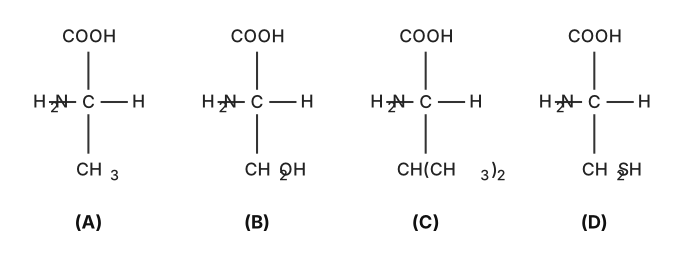
›Reveal solutionSolution
Matching side chains to amino acid names and recalling which are "essential" (diet-only): the isopropyl side chain identifies Valine, an essential amino acid — option (C).
Concept and Intuition
Essential amino acids are the ones the human body cannot synthesise on its own; they must be obtained from food. The standard list (memorised in NCERT biology/biomolecules chemistry) includes Valine, Leucine, Isoleucine, Phenylalanine, Tryptophan, Threonine, Methionine, Lysine, Histidine. Alanine, Serine, Cysteine, Glycine, etc. are non-essential (the body makes them from other metabolites).
Step-by-Step Solution
- Identify each amino acid from its side chain (all four share the same H2N−CH(−)−COOH backbone):
- (A) −CH3: this is Alanine — non-essential.
- (B) −CH2OH: this is Serine — non-essential.
- (C) −CH(CH3)2 (isopropyl): this is Valine — a branched-chain amino acid, and it is essential.
- (D) −CH2SH: this is Cysteine — non-essential. …
- Identify each amino acid from its side chain (all four share the same H2N−CH(−)−COOH backbone):
- AP EAPCET 2024Set eng-2024-05-19-AN1 markMCQQ.Identify the amino acid which has −NH2, −CO2H and −C(=O)NH2 groups (A) Alanine (B) Arginine (C) Asparagine (D) Aspartic acid
›Reveal solutionSolution
Asparagine uniquely carries a backbone −NH2 and −CO2H plus a side-chain amide −C(=O)NH2 group.
Concept and Intuition
Every α-amino acid has a backbone −NH2 and −CO2H. The question is really about the side chain: which amino acid's side chain is itself an amide (−CONH2)? That is asparagine, the amide of aspartic acid.
Step-by-Step Solution
- Alanine's side chain is just −CH3 — no extra functional groups.
- Arginine's side chain is a guanidino group (−NH−C(=NH)−NH2), not an amide.
- Aspartic acid's side chain is a second −CO2H (carboxylic acid), not an amide. …
🎓Unlock everything free for 14 days
- ✓Full step-by-step solutions
- ✓Concept-first explanations
- ✓Methods, shortcuts & mistakes
- ✓PYQ mapping + timed mock tests
Full access for 14 days. No credit card required.