Q.How can you determine the rate law of the following reaction?
2NO(g)+O2(g)→2NO2(g)
🔒You're viewing a preview — the full solution, concept, methods & PYQ mapping are locked.
🔒 Start your 14-day free trial to unlock the full solution →Concept understanding — Average Rate Of Reaction
Reaction Rate Stoichiometry – From Intuition to Precision
Imagine you are watching a simple reaction:
2NO2→2NO+O2
As NO₂ disappears, NO appears twice as fast as O₂ appears. Why? Because the balanced equation says: for every 2 molecules of NO₂ that break apart, you get 2 molecules of NO and 1 molecule of O₂. The numbers in front of the species — the stoichiometric coefficients — tell you the relative speeds at which reactants vanish and products appear.
That is the core idea: reaction rate stoichiometry is the relationship between the rates of change of different species in a chemical reaction, dictated by their coefficients in the balanced equation.
The Intuitive Picture
Think of a factory assembly line. The balanced equation is like a recipe:
- 2 units of raw material A → 2 units of product B + 1 unit of byproduct C
If the line runs steadily, every time 2 units of A are consumed, 2 units of B are produced and 1 unit of C is produced. So the rate at which A disappears must be twice the rate at which C appears. The rate at which B appears equals the rate at which A disappears (both have coefficient 2).
The stoichiometric coefficients are not speeds themselves — they are scaling factors that connect the speeds of different species.
The Precise Statement
For a general reaction:
aA+bB→cC+dD
The rate of reaction (often called the rate of the process, r) is defined as:
r=−a1dtd[A]=−b1dtd[B]=c1dtd[C]=d1dtd[D]
Here:
- dtd[X] is the instantaneous rate of change of concentration of species X (in mol L⁻¹ s⁻¹).
- The minus sign is used for reactants (their concentration decreases with time).
- The plus sign is used for products (their concentration increases with time).
- Dividing by the coefficient normalises the rate — so r is the same number for every species.
r=−a1dtd[A]=c1dtd[C]
This single value r is the intrinsic rate of the reaction, independent of which species you measure.
How to Use It (Step by Step)
Suppose you are given:
2H2+O2→2H2O
And you measure that dtd[H2]=−0.040 M/s (negative because H₂ is being consumed).
Step 1: Write the rate relation:
r=−21dtd[H2]=−11dtd[O2]=21dtd[H2O]
Step 2: Plug in the known value:
r=−21(−0.040)=+0.020 M/s
Step 3: Find the rate for O₂:
−dtd[O2]=r⇒dtd[O2]=−0.020 M/s
Step 4: Find the rate for H₂O:
21dtd[H2O]=r⇒dtd[H2O]=2r=0.040 M/s
A quick check: the coefficients tell you the relative rates. Here, H₂ disappears twice as fast as O₂, and H₂O appears at the same rate as H₂ disappears (both coefficient 2). Always verify your numbers match the coefficient ratios.
--- …
Why this formula?
Average Rate of Reaction — Why the Formula Holds
Let’s build this from the ground up. The goal is to understand why the average rate formula looks the way it does — not just memorise it.
1. What does "rate of reaction" mean physically?
A chemical reaction changes the concentration of reactants (decreasing) and products (increasing) over time.
- Rate = how fast this change happens.
- If you measure the change over a finite time interval, you get the average rate.
2. The core idea: change per unit time
For any quantity X that changes from X1 to X2 over time t1 to t2:
Average rate of change of X=ΔtΔX=t2−t1X2−X1
This is just the slope of the straight line connecting the two points on a concentration vs. time graph.
3. Applying this to a reaction
Consider a simple reaction:
A→B
- Reactant A is consumed: [A] decreases.
- Product B is formed: [B] increases.
For reactant A (disappearing):
Average rate=−ΔtΔ[A]
Why the minus sign?
Because Δ[A]=[A]2−[A]1 is negative (concentration drops). The rate itself must be positive (speed is never negative). So we multiply by −1.
For product B (appearing):
Average rate=+ΔtΔ[B]
Here Δ[B] is positive, so no minus sign needed.
4. The general formula for any reaction
For a balanced reaction:
aA+bB→cC+dD
The average rate is defined per mole of reaction — so it’s the same number regardless of which species you track.
We divide each ΔtΔ[species] by its stoichiometric coefficient:
Average rate=−a1ΔtΔ[A]=−b1ΔtΔ[B]=+c1ΔtΔ[C]=+d1ΔtΔ[D]
Why divide by the coefficient?
If 2 moles of A disappear for every 1 mole of C formed, then ΔtΔ[A] is twice as large as ΔtΔ[C]. Dividing by the coefficient normalises them to the same "per mole of reaction" rate.
5. Key exam point: the formula in one line
For any species X with stoichiometric coefficient νX (negative for reactants, positive for products):
Average rate=νX1ΔtΔ[X] …
The key idea is the method of initial rates: measure the initial rate of reaction for different initial concentrations of reactants, then compare how the rate changes when only one concentration is varied.
Reasoning steps:
- Run the reaction with a known initial [NO] and [O2], and measure the initial rate r0. Repeat with [NO] doubled while [O2] is held constant. If the rate quadruples, the reaction is second order in NO; if it doubles, it is first order.
- Now hold [NO] constant and double [O2]. If the rate doubles, the reaction is first order in O2; if it stays the same, it is zero order. …
The rate law is determined experimentally from initial-rate data, not from the stoichiometric coefficients. For the reaction 2NO+O2→2NO2, the experimentally observed rate law is Rate=k[NO]2[O2], making it third-order overall.
The biggest mistake students make here is looking at the balanced equation and writing Rate=k[NO]2[O2] because "the coefficients say so." That is wrong. The rate law is an experimental fact, not a prediction from the balanced equation. The coefficients in the balanced equation tell you the stoichiometric relationship — how much of each reactant is consumed or product formed — but they do not tell you how the rate depends on concentration.
For example, the reaction 2NO+O2→2NO2 could, in principle, have a rate law like Rate=k[NO][O2] or Rate=k[NO]2 or even Rate=k[O2]. Only experiment can decide.
Rate=k[NO]m[O2]n
where m and n are the orders with respect to NO and O2, determined from initial-rate data.
Here is how you actually determine the rate law, step by step.
- Collect initial-rate data. You run the reaction several times, each time changing the initial concentration of one reactant while keeping the other constant. You measure the initial rate (the slope of concentration vs. time at t=0) for each trial. A typical data set for this reaction looks like:
| Trial | [NO]0 (M) | [O2]0 (M) | Initial Rate (M/s) |
|---|---|---|---|
| 1 | 0.10 | 0.10 | 2.5×10⁻³ |
| 2 | 0.20 | 0.10 | 1.0×10⁻² |
| 3 | 0.10 | 0.20 | 5.0×10⁻³ |
- Find the order with respect to NO. Compare trials where [O2] is constant and [NO] changes. Here, trials 1 and 2: [O2] is fixed at 0.10 M, and [NO] doubles from 0.10 to 0.20 M. The rate goes from 2.5×10⁻³ to 1.0×10⁻² M/s — that is a factor of 4 increase. Since 2m=4, we get m=2. So the reaction is second order in NO. …
Method: Initial Rates Method
This is the standard experimental approach to determine the rate law when you have concentration vs. time data from multiple trials.
Steps
Step 1: Write the general rate law form
For the reaction:
2NO(g)+O2(g)→2NO2(g)
The rate law is:
Rate=k[NO]m[O2]n
Here, m and n are the orders with respect to NO and O₂, and k is the rate constant.
Step 2: Collect data from at least two trials
You need initial rates at different initial concentrations. A typical data table looks like:
| Trial | [NO] (M) | [O₂] (M) | Initial Rate (M/s) |
|---|---|---|---|
| 1 | 0.10 | 0.10 | R1 |
| 2 | 0.20 | 0.10 | R2 |
| 3 | 0.10 | 0.20 | R3 |
Step 3: Find the order with respect to NO (m)
Compare trials where [O₂] is constant (e.g., Trial 1 and Trial 2):
R1R2=k[0.10]m[0.10]nk[0.20]m[0.10]n=(0.100.20)m=2m
If R2/R1=2, then m=1 (first order in NO).
If R2/R1=4, then m=2 (second order in NO).
Step 4: Find the order with respect to O₂ (n)
Compare trials where [NO] is constant (e.g., Trial 1 and Trial 3):
R1R3=k[0.10]m[0.10]nk[0.10]m[0.20]n=(0.100.20)n=2n
If R3/R1=2, then n=1 (first order in O₂). …
✗ Mistake 1: Assuming the rate law from the balanced equation
What students do:
They see 2NO+O2→2NO2 and write:
Rate=k[NO]2[O2]
Why it’s wrong:
Rate law is experimentally determined, not derived from stoichiometric coefficients. The coefficients only tell you the order with respect to each reactant if the reaction is elementary — but most reactions are multi-step.
How to avoid:
Always remember: Rate law is an experimental fact, not a prediction from the balanced equation. Unless the problem explicitly says “elementary reaction,” never use coefficients as exponents.
✗ Mistake 2: Confusing average rate with instantaneous rate
What students do:
They calculate the average rate over a time interval and treat it as the rate law constant.
Why it’s wrong:
Average rate changes with time. The rate law uses instantaneous rate (the slope of concentration vs. time at a specific moment).
How to avoid:
- For rate law determination, always use initial rates (rate at t≈0).
- Average rate is useful for monitoring progress, not for finding the rate law.
✗ Mistake 3: Forgetting to account for stoichiometric coefficients in rate definition
What students do:
They write:
Rate=−ΔtΔ[NO]
without dividing by the coefficient.
Why it’s wrong:
By IUPAC definition, for aA+bB→cC:
Rate=−a1ΔtΔ[A]=−b1ΔtΔ[B]=c1ΔtΔ[C]
For this reaction:
Rate=−21ΔtΔ[NO]=−ΔtΔ[O2]=21ΔtΔ[NO2]
How to avoid:
Always write the rate definition with the reciprocal of the coefficient in front. This ensures consistency when comparing rates from different species.
✗ Mistake 4: Using wrong units or forgetting to check units
What students do:
They calculate k without verifying that the units match the overall order.
Why it’s wrong: …
- AP EAPCET 2026Set ap-2026-05-20-FN1 markMCQQ.Observe the following reaction 2N2O5(g)→4NO2(g)+O2(g) At T(K), the concentration of N2O5(g) changed from 2 mol L−1 to 1.5 mol L−1 in 100 min. What is the average rate (in mol L−1min−1) of this reaction? (A) 5×10⁻³ (B) 2.5×10⁻³ (C) 2.5×10³ (D) 1.25×10⁻³
›Reveal solutionSolution
This tests the definition of "rate of reaction" that is normalised by stoichiometric coefficients so it gives the same value regardless of which species you track. The rate works out to 2.5×10⁻³ molL−1min−1.
Concept and Intuition
For a general reaction aA→bB+cC, different species are consumed/produced at different numerical speeds proportional to their coefficients. To get one unambiguous rate of reaction, each species' rate of change is divided by its own coefficient (with a minus sign for reactants, since their concentration falls): Rate=−a1dtd[A]=b1dtd[B]=c1dtd[C].
Step-by-Step Solution
- Reaction: 2N2O5(g)→4NO2(g)+O2(g), so the coefficient of N2O5 is 2.
- Concentration of N2O5 changes from 2 to 1.5 molL−1, so Δ[N2O5]=1.5−2=−0.5 molL−1, over Δt=100 min.
- Average rate of disappearance of N2O5=−ΔtΔ[N2O5]=−100−0.5=5×10⁻³ molL−1min−1. …
- AP EAPCET 2025Set eng-2025-05-23-FN1 markMCQQ.A→B is a first order reaction. The concentration of A is decreased from x mol L−1 to y mol L−1 in 100 min. What is the average velocity of the reaction in mol L−1 min−1 ? (A) 100∣x−y∣ (B) 100∣y−x∣2 (C) ∣x−y∣100 (D) ∣x+y∣100
›Reveal solutionSolution
This tests the basic definition of average rate of reaction as the change in concentration of a reactant over the time interval.
Concept and Intuition
The average rate of a reaction over a time interval is simply how much the concentration of a reactant (or product) changes, divided by how long it took — with a sign convention so the rate is always reported as a positive quantity.
Step-by-Step Solution
- Average rate of disappearance of A =−ΔtΔ[A]=−t[A]final−[A]initial.
- Here [A] decreases from x to y over t=100 min, so Δ[A]=y−x (negative, since y<x).
- Average rate =−100y−x=100x−y, and writing it generally (regardless of which is larger) as a positive quantity: 100∣x−y∣. …
- AP EAPCET 2025Set eng-2025-05-26-FN1 markMCQQ.R⟶P is a first order reaction. The concentration of R changed from 0.04 to 0.03 mol L−1 in 40 min. What is the average velocity of the reaction in mol L−1 s−1? (A) 2.5×10⁻⁴ (B) 4.167×10⁻⁶ (C) 4.167×10⁶ (D) 2.5×10⁻⁵
›Reveal solutionSolution
Average rate is simply the change in concentration of reactant divided by the time elapsed (converted to seconds); the 'first order' label is not even needed for this particular calculation. Answer: (B).
Concept and Intuition
The average rate of a reaction over a finite time interval is defined purely from the measured change in concentration and elapsed time — it does not require knowing the rate law or order of the reaction (order only matters for finding the instantaneous rate constant k via the integrated rate law). Here we are only asked for the average velocity, so a direct Δ[conc]/Δt calculation suffices, with careful unit conversion from minutes to seconds since the answer must be in molL−1s−1.
Step-by-Step Solution
- Change in concentration of R: Δ[R]=0.04−0.03=0.01 molL−1 (a decrease, since R is being consumed).
- Time elapsed: 40 min =40×60=2400 s.
- Average rate =Δt−Δ[R]=24000.01 molL−1s−1. …
- AP EAPCET 2024Set eng-2024-05-20-FN1 markMCQQ.For a first order reaction, the concentration of reactant was reduced from 0.03 mol L−1 to 0.02 mol L−1 in 25 min. What is its rate (in mol L−1s−1)? (A) 6.667×10⁻⁶ (B) 4×10⁻⁴ (C) 6.667×10⁻⁴ (D) 4×10⁻⁶
›Reveal solutionSolution
Rate is simply the drop in concentration divided by the elapsed time (converted to seconds) — 6.667×10⁻⁶ molL−1s−1, answer (A).
Concept and Intuition
The (average) rate of a reaction over a time interval is defined as the change in concentration of a reactant divided by the time elapsed (with a negative sign convention for reactants, but the magnitude is what's asked here). Care must be taken to convert all times to consistent units (here, minutes to seconds, since the rate is required in s−1).
Step-by-Step Solution
- Concentration drop: Δ[reactant]=0.03−0.02=0.01 molL−1.
- Time elapsed: 25 min=25×60=1500 s.
- Average rate =15000.01=6.667×10⁻⁶ molL−1s−1. …
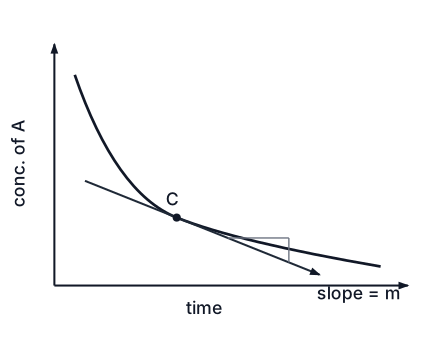
- AP EAPCET 2024Set eng-2024-05-23-FN1 markMCQQ.A→P is a first order reaction. The following graph is obtained for this reaction. (x-axis = time; y-axis = conc. of A). [FIGURE] (a concentration-vs-time curve for a first-order reaction, with a point C marked on the curve and a tangent line drawn through C labelled 'slope = m'). The instantaneous rate of the reaction at point C is (A) m1 (B) m (C) 2.303 m (D) 2.303m1
›Reveal solutionSolution
On a plain concentration-vs-time graph, the instantaneous rate at any point is just the magnitude of the tangent's slope there — here that is simply m, regardless of the reaction being first order.
Concept and Intuition
The instantaneous rate of a reaction A→P is defined purely graphically as Rate=−dtd[A], which is exactly the negative of the slope of the concentration-vs-time curve at that instant. This definition holds for a reaction of ANY order — it is a direct consequence of the definition of rate, not something that depends on the rate law. The factor of 2.303 only enters when working with log10[A] vs t plots (used to extract the first-order rate constant k from the slope −k/2.303) — it is irrelevant here since the axes are plain concentration and time, not logarithmic concentration.
Step-by-Step Solution
- The graph plots [A] (concentration of A) on the y-axis against time on the x-axis — a decaying curve, as expected since A is being consumed.
- At point C, a tangent line is drawn with slope magnitude m (the curve is decreasing, so the true signed slope is −m, but this magnitude labelled m represents how fast concentration is falling at that instant).
- By definition, instantaneous rate =−dtd[A]C=m (taking the tangent's slope magnitude as the rate). …
- AP EAPCET 2021Set eng-2021-08-20-FN1 markMCQQ.Which statement among the following is incorrect? (A) Unit of rate of disappearance is M s−1 (B) Unit of rate of reaction is M s−1 (C) Unit of rate constant k depends upon order of reaction (D) Unit of rate constant k for a first order reaction is M s−1
›Reveal solutionSolution
This tests the general rule "unit of k = (molL−1)1−ns−1" for a reaction of order n. The false statement is (D): first order k has units s−1, not Ms−1.
Concept and Intuition
For a reaction of order n: rate=k[A]n, and rate always has units Ms−1. Rearranging for k:
k=[A]nrate⇒units of k=(M)1−ns−1
So the units of k change with order — this is exactly why chemists use the units of an experimentally measured k to identify the reaction order.
Step-by-Step Solution
- Rate of reaction / rate of disappearance of reactant: both are ΔtΔ[conc], units Ms−1 — (A), (B) correct.
- Units of k depend on order: for order n, units are M1−ns−1 — (C) correct.
- For n=1 (first order): units of k=M1−1s−1=M0s−1=s−1, not Ms−1. …
🎓Unlock everything free for 14 days
- ✓Full step-by-step solutions
- ✓Concept-first explanations
- ✓Methods, shortcuts & mistakes
- ✓PYQ mapping + timed mock tests
Full access for 14 days. No credit card required.