Q.Match the items of Column I and Column II.
Column I:
Column II:
You're viewing a preview — the full solution, concept, methods & PYQ mapping are locked.
Start your 14-day free trial to unlock the full solution →The key idea is to match each term in Column I with its most natural description in Column II based on the time interval over which the rate is measured. Diamond reacts so slowly that its rate is imperceptible; instantaneous rate is measured over a very short interval; average rate is measured over a long duration. The correct matches are: (i) → (b), (ii) → (a), (iii) → (c).
The question asks you to match items from Column I (three terms related to reaction rates) with their appropriate descriptions in Column II. This is a conceptual matching problem, not a calculation. The core idea is understanding what each term means in the context of chemical kinetics.
Average rate of reaction is the change in concentration of a reactant or product over a finite, measurable time interval — typically a long duration, like minutes or hours. It gives you a single, overall speed for that entire period.
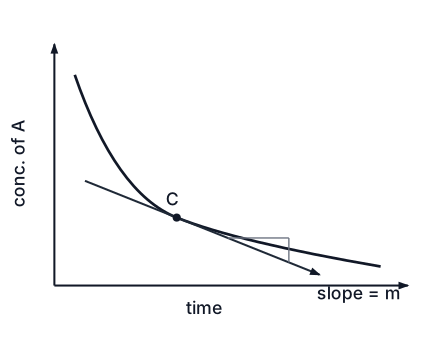
Instantaneous rate of reaction is the rate at a specific moment in time. To find it, you need to measure the change in concentration over an extremely short interval — so short that the rate is essentially constant during that interval. In practice, this is done by drawing a tangent to the concentration vs. time curve at the point of interest.
Diamond is a special case. Diamond is an allotrope of carbon that is thermodynamically unstable under standard conditions — it should slowly convert to graphite. However, the rate of this conversion is so incredibly slow at room temperature that it is effectively zero on human timescales. You cannot measure any change in concentration over any practical time interval. The rate is imperceptible.
Now, let's match them step by step.
-
Match (i) Diamond.
Diamond's conversion to graphite is so slow that no change is observed over any ordinary time period. The description that fits this is "ordinarily rate of conversion is imperceptible."
So, (i) matches with (b).
-
Match (ii) Instantaneous rate. …
Unlock everything free for 14 days
- Full step-by-step solutions
- Concept-first explanations
- Methods, shortcuts & mistakes
- PYQ mapping + timed mock tests
Full access for 14 days. No credit card required.