Q.Assertion: All collision of reactant molecules lead to product formation.
Reason: Only those collisions in which molecules have correct orientation and sufficient kinetic energy lead to compound formation.
🔒You're viewing a preview — the full solution, concept, methods & PYQ mapping are locked.
🔒 Start your 14-day free trial to unlock the full solution →Concept understanding — Arrhenius Equation Plot
The Arrhenius Equation Plot: Why Temperature Changes Reaction Speed
You already know that heating things up makes reactions go faster. A cold chai takes forever to dissolve sugar; hot chai does it in seconds. But how much faster? And is there a pattern that holds for every reaction?
That pattern is the Arrhenius equation, and plotting it in a clever way reveals something fundamental about how molecules need to collide to react.
The core idea: an energy barrier
Imagine a ball sitting in a valley. To get to the next valley, it must first be pushed up over a hill. That hill is the activation energy (Ea) — the minimum energy two molecules need to have when they collide, for the reaction to happen.
At a low temperature, most molecules move slowly. Only a tiny fraction have enough energy to climb that hill. Raise the temperature, and suddenly many more molecules have the required energy. The fraction of molecules with energy ≥Ea is given by the Boltzmann distribution:
fraction=e−Ea/RT
where R is the gas constant and T is the absolute temperature (in Kelvin). This exponential is the heart of the story.
The Arrhenius equation (precise statement)
The rate constant k of a reaction depends on temperature as:
k=Ae−Ea/RT
- k = rate constant (how fast the reaction proceeds)
- A = pre-exponential factor (frequency of collisions, times a steric factor — how often molecules hit in the right orientation)
- Ea = activation energy (J/mol or kJ/mol)
- R = 8.314 J/(mol·K)
- T = temperature in Kelvin
k is not the reaction rate itself — it's the proportionality constant in the rate law. But for a fixed concentration, a larger k means a faster reaction.
Why plot it? The linear trick
The equation k=Ae−Ea/RT is exponential in 1/T. That's hard to eyeball. But take the natural logarithm of both sides:
lnk=lnA−REa⋅T1
This is the equation of a straight line:
y=c+mx
where:
- y=lnk
- x=1/T
- slope m=−Ea/R
- intercept c=lnA
So if you measure k at several temperatures and plot lnk versus 1/T, you get a straight line — provided the reaction follows Arrhenius behaviour (most do, over moderate temperature ranges).
Always use Kelvin for T. Celsius will give you a curved mess because 1/T is not linear in Celsius.
What the plot tells you
From the slope, you get Ea:
Ea=−(slope)×R
A steep negative slope means a large Ea — the reaction is very sensitive to temperature. A shallow slope means a small Ea — temperature doesn't affect it much.
From the intercept, you get A:
A=eintercept
This tells you about the collision frequency and orientation factor. A high A means molecules are colliding often and in the right geometry.
A typical Arrhenius plot looks like this
| T (K) | k (s⁻¹) | 1/T (K⁻¹) | lnk |
|---|---|---|---|
| 300 | 0.0012 | 0.00333 | -6.72 |
| 310 | 0.0028 | 0.00323 | -5.88 |
| 320 | 0.0061 | 0.00313 | -5.10 |
| 330 | 0.0125 | 0.00303 | -4.38 |
Plot lnk (y-axis) vs 1/T (x-axis). The points fall on a straight line. Draw the best-fit line, measure its slope, and compute Ea. …
Why this formula?
Arrhenius Equation Plot: Why It Holds
The Arrhenius equation is not a guess — it emerges from a deep physical picture of how molecules react. Let's build that understanding step by step.
The Core Idea: Molecules Need Energy to React
For a reaction to occur, molecules must collide with enough energy to break existing bonds and form new ones. This minimum energy is called the activation energy (Ea).
But not all collisions succeed — only those with kinetic energy ≥Ea lead to a reaction.
The Key Formula
The Arrhenius equation is:
k=Ae−Ea/(RT)
Where:
- k = rate constant
- A = pre-exponential factor (frequency of collisions with correct orientation)
- Ea = activation energy (J/mol)
- R = gas constant (8.314 J/mol·K)
- T = absolute temperature (K)
Why the Exponential Term Appears
Step 1: The Boltzmann Distribution
Molecules in a gas or liquid have a distribution of kinetic energies. The fraction of molecules with energy ≥E is given by the Boltzmann factor:
Fraction=e−E/(kBT)
For molar quantities, replace kB with R:
Fraction=e−Ea/(RT)
This is not arbitrary — it comes from statistical mechanics. The exponential arises because the probability of a molecule having energy E decreases exponentially as E increases.
Step 2: Rate Depends on This Fraction
The rate constant k is proportional to:
- The collision frequency (how often molecules meet)
- The fraction of collisions with energy ≥Ea
Thus:
k∝(collision frequency)×e−Ea/(RT)
The collision frequency is captured by A, giving:
k=Ae−Ea/(RT)
Why the Plot is Linear
Take the natural logarithm of both sides:
lnk=lnA−REa⋅T1
This is of the form y=mx+c, where:
- y=lnk
- x=1/T
- Slope m=−Ea/R
- Intercept c=lnA
Thus, plotting lnk vs 1/T gives a straight line — this is the Arrhenius plot.
What the Slope Tells Us
From the slope: …
The key idea is that not every molecular collision results in a reaction — only effective collisions (with sufficient energy and proper orientation) do.
Step 1: The assertion states that all collisions lead to products. This is false because many collisions are too weak or poorly oriented.
Step 2: The reason correctly identifies the two conditions for an effective collision: sufficient kinetic energy (to overcome activation energy) and correct orientation. This statement is true — it is the standard definition from collision theory. …
The assertion is FALSE — not every collision leads to product formation, only effective collisions do. The reason, however, correctly states the actual condition for a successful collision (correct orientation + sufficient kinetic energy) and is TRUE. This is an "Assertion incorrect, Reason correct" case, which none of the four listed options captures correctly — option (iv) as printed ("Both assertion and reason are incorrect") wrongly implies the reason is also false.
Assertion — "All collisions of reactant molecules lead to product formation" — is FALSE.
By collision theory, only a small fraction of collisions are effective. A collision yields product only when the molecules (i) carry kinetic energy at least equal to the activation energy Ea, and (ii) are correctly oriented. The overwhelming majority of collisions are ineffective.
Reason — "Only those collisions in which molecules have correct orientation and sufficient kinetic energy lead to compound formation" — is TRUE. This is the standard statement of collision theory, and it directly explains why the assertion is false (it describes the actual, narrower condition, contradicting "all collisions"). …
Concept: Collision Theory of Chemical Reactions
Collision theory states that for a reaction to occur, reactant particles must:
- Collide with each other
- Possess sufficient kinetic energy (≥ activation energy)
- Have the correct orientation during collision
Method: Statement Analysis Method
Step 1 – Identify the truth of the Assertion
The assertion says: “All collisions of reactant molecules lead to product formation.”
This is false — only effective collisions (those with enough energy and proper orientation) result in products. Most collisions are ineffective.
Step 2 – Identify the truth of the Reason
The reason says: “Only those collisions in which molecules have correct orientation and sufficient kinetic energy lead to compound formation.”
This is true — it correctly describes the conditions for an effective collision. …
Here’s a breakdown of the common mistakes students make on this question and how to avoid each.
Common Mistake 1: Misreading the Assertion as True
What students do:
They see the word “collision” and think of the collision theory of chemical reactions. They assume the assertion must be correct because reactions happen when molecules collide.
Why it’s wrong:
The assertion says all collisions lead to product formation. Collision theory clearly states that only a fraction of collisions — those with sufficient energy (≥ activation energy) and correct orientation — are effective. Most collisions are ineffective.
How to avoid:
- Read the assertion literally — look for absolute words like “all,” “always,” “never.”
- Recall the two conditions for an effective collision:
- Sufficient kinetic energy (≥ activation energy)
- Proper orientation
- If either condition is missing, no product forms. So “all collisions” is false.
Common Mistake 2: Thinking the Reason is Incorrect
What students do:
They confuse the reason with the assertion. They think the reason says “only those collisions with correct orientation and sufficient energy lead to product formation” is wrong because they remember that sometimes even with correct orientation and energy, a reaction may not occur due to other factors (like steric hindrance).
Why it’s wrong:
The reason is actually correct — it is a standard statement of collision theory. The two conditions (energy + orientation) are necessary for a reaction to occur. The reason does not claim they are sufficient for every possible reaction, but they are the minimum requirements.
How to avoid:
- Separate the assertion (a claim) from the reason (an explanation).
- The reason is a textbook definition — it is factually correct.
- Do not overcomplicate: if the reason matches the standard theory, mark it as correct.
Common Mistake 3: Choosing Option (i) — Both correct, reason explains assertion
What students do:
They see both statements as true and assume the reason explains the assertion. They think: “Since the reason says only some collisions work, that explains why all collisions don’t lead to product formation.”
Why it’s wrong:
The assertion is false (all collisions do not lead to product formation). The reason is true. So the reason cannot explain a false assertion. Option (i) requires both statements to be correct.
How to avoid:
- First, decide if the assertion is true or false.
- Then decide if the reason is true or false.
- Only then check if the reason explains the assertion (only possible if both are true).
- Here: Assertion = false, Reason = true → correct answer is (iv).
Common Mistake 4: Choosing Option (ii) — Both correct, reason does not explain
What students do: …
- AP EAPCET 2026Set ap-2026-05-19-AN1 markMCQQ.The Ea of first order reaction is 104 J mol−1. At 500 K, the fraction of molecules that have energy higher than Ea is X. What is X? (R=8.3 J mol K−1; frequency factor =1014) (A) logA+0.09 (B) exp(−2.4) (C) exp(−2.4)1014 (D) 1014+exp(−2.4)
›Reveal solutionSolution
The fraction of molecules exceeding activation energy is the Boltzmann factor e−Ea/RT, which evaluates to exp(−2.4) here.
Concept and Intuition
The Arrhenius equation k=Ae−Ea/RT splits rate into a collision-frequency factor A and an exponential Boltzmann factor e−Ea/RT, which physically represents the fraction of molecular collisions/molecules possessing energy at least Ea. This fraction is exactly what the question calls X.
Step-by-Step Solution
- Fraction with energy ≥Ea: X=e−Ea/RT.
- Compute the exponent: RTEa=8.3 J mol−1K−1×500 K104 J/mol=415010000≈2.41≈2.4. …
- AP EAPCET 2026Set ap-2026-05-20-FN1 markMCQQ.The following equation is obtained for a first order reaction logk=14−T1.25×104K The Ea (in kJ mol−1) and frequency factor, A (in s−1) of the reaction are respectively (R=8.3 J mol−1K−1) (A) 238.93 ; 14 (B) 238.93 ; 1014 (C) 23.89 ; 1014 (D) 23.89 ; 14
›Reveal solutionSolution
Match the given empirical rate-constant equation to the Arrhenius equation in log form to extract Ea and A. Answer: Ea=238.93 kJ/mol, A=1014 s−1.
Concept and Intuition
The Arrhenius equation k=Ae−Ea/RT, written in base-10 log form, is logk=logA−2.303RTEa — a straight line when logk is plotted against 1/T, with intercept logA and slope −Ea/2.303R. Any experimentally fitted equation of this form can be matched term-by-term to read off A and Ea directly.
Step-by-Step Solution
- Given: logk=14−T1.25×104.
- Arrhenius form: logk=logA−2.303REa⋅T1.
- Matching the constant term: logA=14⇒A=1014 s−1.
- Matching the 1/T coefficient: 2.303REa=1.25×10⁴ K.
- Ea=1.25×104×2.303×8.3 J/mol. Compute: 1.25×104×2.303=28,787.5; ×8.3=238,936.25 J/mol ≈238.93 kJ/mol. …
- AP EAPCET 2025Set eng-2025-05-21-AN1 markMCQQ.Activation energy for the hydrolysis of sucrose by acid is X kJmol−1 whereas activation energy for the hydrolysis of sucrose by sucrase is Y kJmol−1. X and Y respectively are (A) 6.22, 2.15 (B) 2.15, 6.22 (C) 6.22, 6.22 (D) 2.15, 2.15
›Reveal solutionSolution
A textbook comparison of activation energies for acid- vs enzyme-catalysed sucrose hydrolysis: X=6.22, Y=2.15 kJmol−1.
Concept and Intuition
A catalyst speeds up a reaction by providing an alternate pathway with lower activation energy, without changing ΔH of the reaction. Enzymes are exceptionally efficient catalysts, so an enzyme-catalysed pathway typically has a much lower Ea than the corresponding acid-catalysed (or uncatalysed) pathway for the same reaction, since k=Ae−Ea/RT — a smaller Ea gives a dramatically larger rate constant at the same temperature.
Step-by-Step Solution
- Identify the reaction: hydrolysis of sucrose to glucose + fructose, run two ways — acid-catalysed and sucrase(enzyme)-catalysed.
- Recall the standard reported values for this reaction: acid catalysis, Ea=6.22 kJmol−1; sucrase catalysis, Ea=2.15 kJmol−1. …
- AP EAPCET 2025Set eng-2025-05-22-FN1 markMCQQ.At T(K), the following equation is obtained for a first order reaction. logAk=−Tx The activation energy for this reaction is equal to (R = gas constant) (A) 2.303×x×R (B) x2.303R (C) 2.303Rx (D) 2.303xR1
›Reveal solutionSolution
Matching the given rate-law equation to the Arrhenius equation in logarithmic form directly identifies the activation energy as Ea=2.303xR.
Concept and Intuition
The Arrhenius equation, k=Ae−Ea/RT, in logarithmic (base 10) form becomes:
logk=logA−2.303RTEa⇒logAk=−2.303RTEa
Comparing coefficients with a given empirical equation of the same form directly reveals Ea.
Step-by-Step Solution
- Standard Arrhenius log form: logAk=−2.303RTEa.
- Given equation: logAk=−Tx.
- Equate the coefficients of T1: 2.303REa=x. …
- AP EAPCET 2025Set eng-2025-05-23-AN1 markMCQQ.The following equation is obtained for a first order reaction at 300 K. log10Ak=0.00174 What is the activation energy (in Jmol−1) of the reaction? (R=8.314 Jmol−1K−1) (A) 10.0 (B) 100.0 (C) 0.1 (D) 1.0
›Reveal solutionSolution
This tests applying the Arrhenius equation in logarithmic form to extract activation energy. The answer is 10.0 J/mol.
Concept and Intuition
The Arrhenius equation k=Ae−Ea/RT relates the rate constant to activation energy Ea and temperature T. Taking natural log and converting to base-10: log10Ak=−2.303RTEa. So the magnitude of log10(k/A) scales directly with activation energy at a given temperature — a small log ratio corresponds to a small (near-zero) activation energy.
Step-by-Step Solution
- Write the relation: log10Ak=2.303RTEa.
- Rearranging: Ea=2.303RT×log10Ak.
- Substitute values: R=8.314 Jmol−1K−1, T=300 K, ∣log10(k/A)∣=0.00174. …
- AP EAPCET 2025Set eng-2025-05-26-AN1 markMCQQ.The following graph is obtained for a first order reaction (A → P). The activation energy (Ea in kJ mol−1) and heat of reaction (∣ΔH∣ in kJ mol−1) for this reaction are respectively (x = reaction coordinate; y = E in kJ mol−1) [FIGURE] (a potential-energy vs reaction-coordinate curve for A → P: reactant A sits at y=10, the curve rises to a peak at y=25, then falls to product P at y=5) (A) 5, 15 (B) 15, 5 (C) 25, 5 (D) 10, 25
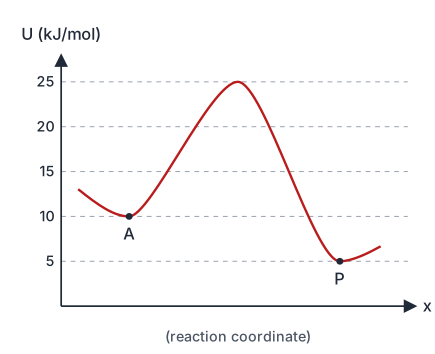
›Reveal solutionSolution
On a reaction energy diagram, Ea is the gap from reactant level to the peak, and ∣ΔH∣ is the gap between reactant and product levels — here Ea=15 kJ/mol and ∣ΔH∣=5 kJ/mol.
Concept and Intuition
A potential-energy vs reaction-coordinate diagram encodes both kinetics and thermodynamics in one picture: the height of the barrier above the reactants is the activation energy (how hard it is to get started), while the difference between the final resting level of products and the starting level of reactants is the heat of reaction (whether the overall process releases or absorbs energy).
Step-by-Step Solution
- From the graph: reactant A is at the dashed gridline y=10 kJ/mol.
- The curve rises through the hump to its highest point, which lines up with the y=25 kJ/mol gridline — this is the transition state / activated complex energy.
- Activation energy Ea=Epeak−EA=25−10=15 kJ/mol.
- The curve then falls to product P, at the y=5 kJ/mol gridline. …
- AP EAPCET 2025Set eng-2025-05-27-FN1 markMCQQ.For a reaction, the graph of lnk (on y-axis) and 1/T (on x-axis) is a straight line with a slope −2×10⁴ K. The activation energy of the reaction (in kJ mol−1) is (R=8.3 J K−1 mol−1) (A) 332 (B) 432 (C) 166 (D) 216
›Reveal solutionSolution
Straightforward application of the Arrhenius equation's linear form; the slope directly gives Ea after multiplying by −R.
Concept and Intuition
The Arrhenius equation k=Ae−Ea/RT becomes linear on taking logarithms:
lnk=lnA−REa⋅T1
Plotting lnk (y-axis) against 1/T (x-axis) gives a straight line of slope −Ea/R and intercept lnA.
Step-by-Step Solution
- Given slope =−2×10⁴ K.
- Since slope =−Ea/R: Ea=−(slope)×R=(2×10⁴ K)(8.3 J K−1mol−1). …
- AP EAPCET 2023Set ap-2023-05-23-AN1 markMCQQ.Given below are two statements Assertion (A): A catalyst, generally increases the rate of a reaction Reason (R): It lowers the activation energy of a reaction by providing a new path The correct answer is (A) Both (A) and (R) are correct and (R) is the correct explanation of (A) (B) Both (A) and (R) are correct and (R) is not the correct explanation of (A) (C) (A) is correct but (R) is not correct (D) (A) is not correct but (R) is correct
›Reveal solutionSolution
The assertion and reason are both true, and the reason correctly explains why the assertion is true. The correct option is (A).
-
Understanding the Assertion (A):
A catalyst is a substance that increases the rate of a chemical reaction without being consumed in the process. This is a fundamental fact in chemistry — catalysts speed up both forward and reverse reactions, allowing equilibrium to be reached faster. So (A) is correct.
-
Understanding the Reason (R):
The reason states that a catalyst lowers the activation energy by providing an alternative reaction pathway. This is the standard explanation from the Arrhenius equation:
k=Ae−Ea/(RT)
Lowering Ea (activation energy) increases the rate constant k, and thus the reaction rate. The catalyst does not change the overall thermodynamics (ΔH or ΔG) — it only reduces the energy barrier. So (R) is also correct.
- Checking if (R) explains (A): …
-
🎓Unlock everything free for 14 days
- ✓Full step-by-step solutions
- ✓Concept-first explanations
- ✓Methods, shortcuts & mistakes
- ✓PYQ mapping + timed mock tests
Full access for 14 days. No credit card required.