Q.Predict the order of reactivity of the following compounds in SN1 and SN2 reactions:
🔒You're viewing a preview — the full solution, concept, methods & PYQ mapping are locked.
🔒 Start your 14-day free trial to unlock the full solution →Concept understanding — Ambident Nucleophile Reactivity
Ambident Nucleophile Reactivity
Most nucleophiles attack through a single, obvious atom — a single lone pair, a single reactive site. An ambident nucleophile is unusual: it has TWO different atoms that each carry enough electron density to act as the attacking site, so it can bond to an electrophile through either one, giving two structurally different products from the same reagent.
Why This Happens: Resonance Delocalisation
An ambident nucleophile's negative charge (or lone pair) is delocalised by resonance across more than one atom, so more than one atom is genuinely nucleophilic.
Cyanide ion, CN−: −C≡N:↔:C=N−. Both the carbon and the nitrogen carry real electron density and can attack an electrophile.
- Attack through carbon gives an alkyl cyanide (nitrile), R−C≡N.
- Attack through nitrogen gives an alkyl isocyanide (isonitrile), R−N≡C.
Nitrite ion, NO2−: the negative charge is shared between nitrogen and the oxygens.
- Attack through oxygen gives an alkyl nitrite, R−O−N=O.
- Attack through nitrogen gives a nitroalkane, R−NO2.
What Decides Which End Attacks: The Counter-Ion Matters
For cyanide specifically, the identity of the metal counter-ion changes which end of CN− ends up bonded to the electrophile — this is the classic KCN-vs-AgCN contrast:
- KCN is genuinely ionic: it dissociates fully to give a FREE CN− ion. The carbon end is intrinsically the more nucleophilic site (more polarisable, and it forms the stronger C–C bond with the alkyl carbon), so KCN reacts through carbon, giving the nitrile as the major product.
- AgCN is covalent, with silver bonded to the CARBON of the cyanide group (Ag−C≡N). With the carbon end already occupied by silver, it is the NITROGEN lone pair that is left free to attack the alkyl halide — so AgCN gives the isocyanide as the major product.
A common mistake is to assume silver coordinates to nitrogen (since nitrogen is "more electronegative" or "harder"). It is the opposite: silver bonds to carbon, and it is precisely THAT occupation of the carbon end that forces attack to happen through nitrogen instead. …
Why this formula?
Ambident Nucleophile Reactivity: Why the Rules Hold
Ambident nucleophiles are nucleophiles that have two (or more) different atoms capable of donating a lone pair to form a bond with an electrophile. Classic examples include:
- Cyanide ion (CNX−): can attack via carbon or nitrogen
- Nitrite ion (NOX2X−): can attack via oxygen or nitrogen
- Enolate ions: can attack via carbon or oxygen
The key question: Why does one atom react preferentially over the other?
The Core Principle: Hard-Soft Acid-Base (HSAB) Theory
The reactivity of ambident nucleophiles is governed by HSAB theory, which states:
Hard acids prefer hard bases; soft acids prefer soft bases.
Why this holds — the reasoning:
- Hard species are small, highly charged, and non-polarizable. Their interactions are dominated by ionic (electrostatic) forces.
- Soft species are large, polarizable, and have diffuse electron clouds. Their interactions are dominated by covalent (orbital overlap) forces.
For an ambident nucleophile, the two attacking atoms differ in hardness/softness:
| Ambident Nucleophile | Harder Atom | Softer Atom |
|---|---|---|
| CNX− | N (hard) | C (soft) |
| NOX2X− | O (hard) | N (soft) |
| Enolate (CHX2=CH−OX−) | O (hard) | C (soft) |
The Key Formula(e) and Their Derivation
1. Charge Density Rule (for hard-hard interactions)
For a hard electrophile (e.g., HX+, CHX3X+, AlClX3):
The nucleophile attacks via the atom with higher charge density (more negative charge).
Why?
Hard-hard interactions are electrostatic. The force between charges is:
F=r2k⋅q1⋅q2
- q1, q2 = charges on the species
- r = distance between them
A hard electrophile has a localized positive charge. The nucleophile's atom with greater negative charge density (more concentrated charge) exerts a stronger electrostatic attraction. This atom is typically the more electronegative one (e.g., O in enolate, N in cyanide).
Example:
Enolate with CHX3I (hard electrophile) → O-alkylation (harder O attacks)
2. Polarizability Rule (for soft-soft interactions)
For a soft electrophile (e.g., CHX3CHX2I, HgX2+, BrX2):
The nucleophile attacks via the atom with higher polarizability (softer atom).
Why?
Soft-soft interactions are covalent and depend on orbital overlap. The softer atom has:
- Larger, more diffuse orbitals (e.g., 3p vs 2p)
- Lower electronegativity
- Greater polarizability — its electron cloud can distort easily to form a bond
The energy of orbital overlap is approximated by:
ΔE∝energy gap(overlap integral)2
A softer atom has a higher-energy HOMO (closer to the electrophile's LUMO), giving a smaller energy gap and stronger interaction.
Example: …
Concept: SN1 vs SN2 Reactivity. The key is carbocation stability for SN1 and steric hindrance for SN2.
(i) Four isomeric bromobutanes
-
SN1 depends on carbocation stability: tertiary > secondary > primary. Of the two primary bromides, the carbocation from 1-bromo-2-methylpropane ((CH3)2CHCH2Br) is more stable than from 1-bromobutane, because of the stronger electron-donating inductive effect of the (CH3)2CH− group -- so 1-bromo-2-methylpropane is more reactive than 1-bromobutane in SN1.
SN1: tert-butyl bromide > sec-butyl bromide > 1-bromo-2-methylpropane > 1-bromobutane.
-
SN2 depends on steric hindrance: methyl > primary > secondary > tertiary.
SN2: n-butyl > isobutyl > sec-butyl > tert-butyl.
(ii) Benzylic/allylic bromides
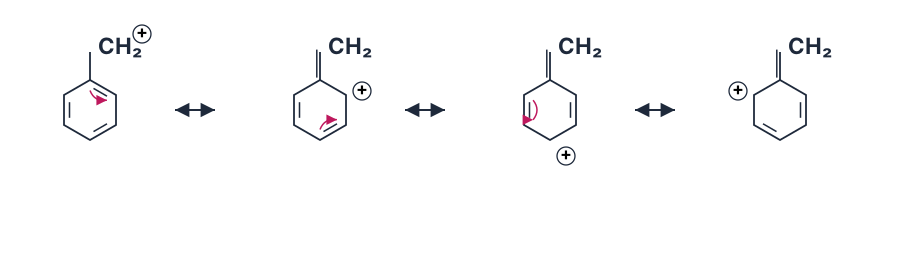
- SN1 follows carbocation stability: C6H5CH(C6H5)Br gives a diphenylmethyl carbocation (very stable, resonance with two phenyls). C6H5C(CH3)(C6H5)Br gives a tertiary benzylic carbocation (even more stable due to +I of methyl). C6H5CH(CH3)Br gives a secondary benzylic carbocation. C6H5CH2Br gives a primary benzylic carbocation (least stable among these). …
SN1 rate follows carbocation stability (3∘>2∘>1∘, resonance-stabilised benzylic cations winning); SN2 rate follows the reverse - the least hindered carbon reacts fastest.
Part (i): the four isomeric bromobutanes
CH3CH2CH2CH2Br (1-bromobutane, 1∘), CH3CH2CHBrCH3 (2-bromobutane, 2∘), (CH3)2CHCH2Br (1-bromo-2-methylpropane, 1∘), (CH3)3CBr (2-bromo-2-methylpropane, 3∘).
SN1 (carbocation stability): among the two primary bromides, the carbocation formed from (CH3)2CHCH2Br is more stable than the one from CH3CH2CH2CH2Br, because of the greater electron-donating inductive effect of the (CH3)2CH− group -- so 1-bromo-2-methylpropane is more reactive than 1-bromobutane in SN1:
2-bromo-2-methylpropane>2-bromobutane>1-bromo-2-methylpropane>1-bromobutane
SN2 (least steric hindrance fastest -- the reverse order):
1-bromobutane>1-bromo-2-methylpropane>2-bromobutane>2-bromo-2-methylpropane
Part (ii): benzylic bromides
(A) C6H5CH2Br (1∘ benzylic), (B) C6H5CH(C6H5)Br (2∘, two Ph), (C) C6H5CH(CH3)Br (2∘, one Ph), (D) C6H5C(CH3)(C6H5)Br (3∘, two Ph). …
Method: Carbocation Stability & Steric Hindrance Analysis
This method uses two fundamental principles:
- SN1 depends on carbocation stability (more stable carbocation → faster reaction)
- SN2 depends on steric hindrance (less hindered substrate → faster reaction)
(i) The four isomeric bromobutanes
Compounds:
- 1-bromobutane (primary)
- 2-bromobutane (secondary)
- 1-bromo-2-methylpropane (primary, branched)
- 2-bromo-2-methylpropane (tertiary)
SN1 Reactivity Order
Step 1: Identify the carbocation formed after Br⁻ leaves.
| Substrate | Carbocation type | Stability |
|---|---|---|
| 1-bromobutane | Primary | Least stable |
| 1-bromo-2-methylpropane | Primary, but stabilised more by the stronger +I effect of the (CH3)2CH− group | More stable than the n-butyl cation |
| 2-bromobutane | Secondary | Moderate |
| 2-bromo-2-methylpropane | Tertiary | Most stable |
Step 2: Order by carbocation stability. Of the two primary bromides, the carbocation from 1-bromo-2-methylpropane is more stable than from 1-bromobutane, because of the greater electron-donating inductive effect of the (CH3)2CH− group.
SN1 order:
2-bromo-2-methylpropane > 2-bromobutane > 1-bromo-2-methylpropane > 1-bromobutane
SN2 Reactivity Order
Step 1: Count the number of alkyl groups on the carbon bearing Br (steric hindrance).
| Substrate | Carbon type | Hindrance |
|---|---|---|
| 1-bromobutane | Primary (1°) | Least |
| 1-bromo-2-methylpropane | Primary (1°) but neopentyl-like | Moderate |
| 2-bromobutane | Secondary (2°) | High |
| 2-bromo-2-methylpropane | Tertiary (3°) | Maximum |
Step 2: Order by increasing steric hindrance.
SN2 order:
1-bromobutane > 1-bromo-2-methylpropane > 2-bromobutane > 2-bromo-2-methylpropane
(ii) Benzylic/allylic bromides
Compounds:
- C6H5CH2Br (primary benzylic)
- C6H5CH(CH3)Br (secondary benzylic)
- C6H5CH(C6H5)Br (secondary benzylic, diphenyl)
- C6H5C(CH3)(C6H5)Br (tertiary benzylic)
SN1 Reactivity Order
Step 1: Evaluate carbocation stability — benzylic carbocations are stabilized by resonance with the phenyl ring. More phenyl groups = more resonance stabilization.
| Carbocation | Stabilizing groups | Stability |
|---|---|---|
| C6H5CH2+ | 1 phenyl | Moderate |
Common Mistakes: SN1 vs SN2 Substitution Reactivity
This question tests your understanding of carbocation stability (for SN1) and steric hindrance (for SN2). Here are the most frequent errors students make:
Mistake 1: Confusing SN1 and SN2 Reactivity Trends
The error: Students often apply the same reasoning to both mechanisms — e.g., assuming that what makes a compound reactive in SN1 also makes it reactive in SN2.
Why it happens: Both reactions involve breaking the C–Br bond, but the rate-determining steps are completely different.
How to avoid:
- SN1 → Rate depends on carbocation stability (more substituted = more stable = faster)
- SN2 → Rate depends on steric hindrance (less hindered = faster)
Key rule: For SN1, think tertiary > secondary > primary > methyl. For SN2, think methyl > primary > secondary > tertiary.
Mistake 2: Forgetting Resonance Stabilisation in Benzylic Systems
The error: Treating C6H5CH2Br (benzyl bromide) as a simple primary alkyl halide.
Why it happens: Students memorise "primary = fast SN2, slow SN1" without considering special cases.
How to avoid:
- The benzyl carbocation (C6H5CH2+) is resonance-stabilised — the positive charge is delocalised into the benzene ring.
- This makes benzyl halides very reactive in SN1 despite being "primary" in a formal sense.
- Similarly, the benzylic position is less hindered than it looks — the flat benzene ring doesn't block backside attack as much as an alkyl group would.
Mistake 3: Misordering the Benzylic Series
The error: Assuming C6H5CH(C6H5)Br (diphenylmethyl bromide) is less reactive than C6H5CH(CH3)Br in SN1.
Why it happens: Students count alkyl groups but forget that phenyl rings stabilise carbocations even more than alkyl groups.
How to avoid:
- Compare carbocation stability: more phenyl groups = more resonance stabilisation
- Order for SN1: C6H5C(CH3)(C6H5)Br (tertiary + 2 phenyl) > C6H5CH(C6H5)Br (secondary + 2 phenyl) > C6H5CH(CH3)Br (secondary + 1 phenyl) > C6H5CH2Br (primary + 1 phenyl)
Mistake 4: Ignoring Steric Effects in SN2 for Benzylic Halides
The error: Assuming all benzylic halides are equally fast in SN2 because they're "benzylic."
Why it happens: Students over-focus on the benzylic stabilisation and forget that bulky groups still block backside attack.
How to avoid:
- For SN2, steric hindrance dominates:
- C6H5CH2Br (least hindered) → fastest
- C6H5CH(CH3)Br (one methyl group) → slower
- C6H5CH(C6H5)Br (one phenyl group) → even slower
- C6H5C(CH3)(C6H5)Br (tertiary, two bulky groups) → very slow or no reaction
Mistake 5: Mixing Up the Isomeric Bromobutanes …
- AP EAPCET 2026Set eng-2026-05-12-AN1 markMCQQ.What are A and B in the following reaction sequence? C4H9BrASN2C4H9NO2 (major Product) SnHClB (A) AgNO2 ; CH3CH2CH2CH2NH2 (n-butylamine) (B) AgNO2 ; (CH3)3C−NH2 (tert-butylamine) (C) KNO2 ; CH3CH2CH(NH2)CH3 (sec-butylamine) (D) KNO2 ; (CH3)2CHCH2NH2 (isobutylamine)
›Reveal solutionSolution
AgNO2 (covalent silver nitrite) gives the nitroalkane as major product via N-attack in a clean SN2 (no skeletal rearrangement); Sn/HCl then reduces the nitro group to give n-butylamine.
Concept and Intuition
Nitrite, NO2−, is an ambident nucleophile — it can bond to an electrophile through either its nitrogen or one of its oxygens, giving two different constitutional products from the same formal reagent. The identity of the counter-cation changes which end reacts: with the more ionic alkali-metal nitrites (Na/KNO2), the reaction tends toward O-attack, giving alkyl nitrites (esters, R–O–N=O); with the more covalent silver salt AgNO2, the reaction instead proceeds through nitrogen, giving the nitroalkane R–NO2 as the major product — mirroring the well-known KCN (C-attack, nitrile) vs AgCN (N-attack, isocyanide) contrast for cyanide.
Step-by-Step Solution
- The question states the major product's formula as C4H9NO2, i.e. a nitroalkane (R–NO2), not an alkyl nitrite ester — this identifies the reagent needed as AgNO2, which favours N-attack.
- The arrow is explicitly labelled SN2: a clean, single-step backside-attack substitution with inversion at the reacting carbon and, crucially, no carbocation intermediate — so no skeletal rearrangement is possible.
- Taking C4H9Br in its default (straight-chain) reading as n-butyl bromide, SN2 attack by AgNO2 gives 1-nitrobutane, CH3CH2CH2CH2NO2, with the carbon skeleton unchanged. …
- AP EAPCET 2026Set eng-2026-05-13-FN1 markMCQQ.In which of the following set/s, reactant and reagent are correctly matched to get ethyl isonitrile as major product? I. CH3CH2Cl — AgCN II. CH3CHO — NH2OH, (CH3CO)2O III. CH3CH2NH2 — CHCl3/OH−, Δ The correct answer is (A) I , III (B) II , III (C) I only (D) II only
›Reveal solutionSolution
This tests which reagent pairs genuinely give an isonitrile (isocyanide) as the major product. AgCN + alkyl halide (N-attack) and the carbylamine reaction (1° amine + CHCl₃/KOH) both do; the oxime-dehydration route gives a nitrile instead. Answer: I, III.
Concept and Intuition
Isonitriles (R−NC) and nitriles (R−CN) are structural isomers formed from the ambident cyanide ion CN−, which can attack an electrophile through either its carbon end or its nitrogen end. With KCN (essentially ionic), the more nucleophilic and less electronegative carbon end attacks preferentially, giving the nitrile as major product. With AgCN, the compound is largely covalent — silver is bonded to the carbon of CN− (soft–soft Ag–C interaction), which ties up the carbon and leaves the lone pair on nitrogen free to act as the nucleophile. So AgCN + R–X gives the isocyanide as the major product. Separately, the carbylamine reaction — a 1° amine treated with chloroform and alcoholic KOH — is a completely different, classical route to isocyanides: KOH generates the electrophilic carbene :CCl2 from CHCl3, which is attacked by the amine nitrogen's lone pair, and after loss of HCl twice, gives R−NC directly. This reaction is in fact used as a qualitative test for primary amines (the isocyanide has a distinctive foul smell).
Step-by-Step Solution
- Statement I: CH3CH2Cl + AgCN. Because AgCN is covalent (Ag–C≡N), the nitrogen lone pair performs the SN2 attack on the alkyl halide's carbon, displacing Cl−, giving CH3CH2−N≡C (ethyl isocyanide) as the major product. Correctly matched. …
- AP EAPCET 2026Set eng-2026-05-18-FN1 markMCQQ.Identify the product Y in the following reaction sequence (catalyst; major product) C2H4i) HBrii) AgCNXH2/CatalystY (major product) (A) n-propyl amine (B) Isopropyl amine (C) Ethyl amine (D) Ethyl methyl amine
›Reveal solutionSolution
This tests the AgCN-vs-KCN distinction (isocyanide formation) and the reduction of isocyanides to secondary N-methylamines; the product Y is ethyl methyl amine.
Concept and Intuition
Cyanide salts react with alkyl halides at either the carbon end (giving a nitrile, R-CN) or the nitrogen end (giving an isocyanide/carbylamine, R-NC), and which end attacks depends on the counter-cation. KCN is largely ionic, so the more nucleophilic carbon end of CN− attacks, giving the nitrile. AgCN is more covalent (Ag–C bond character ties up the carbon), forcing the alkyl halide to be attacked through nitrogen, giving the isocyanide. Isocyanides, R−N≡C, are then reduced by H2/catalyst by sequential addition across both the π bonds of the N≡C triple bond, ending in a secondary amine R−NH−CH3 (the terminal carbon becomes a methyl group bonded to N).
Step-by-Step Solution
- C2H4+HBr→CH3CH2Br (simple electrophilic addition of HBr to ethylene; both carbons are equivalent so there's no regiochemistry issue).
- CH3CH2Br+AgCN→CH3CH2−NC (ethyl isocyanide) — this is X. AgCN's covalent Ag–C bond makes the nitrogen end of cyanide the nucleophile, giving the isocyanide rather than the nitrile that KCN would give. …
- AP EAPCET 2026Set ap-2026-05-19-FN1 markMCQQ.Consider the following reaction C2H5Cl+KCN⟶X (major product) X can also be obtained from which of the following reactions? I. C2H5NH2KOH / CHCl3, Δ II. C2H5CONH2Py, Δ III. C2H5CHO(i) NH2OH (ii) (CH3CO)2O Correct answer is (only = only) (A) I, II only (B) II, III only (C) I, III only (D) I, II, III
›Reveal solutionSolution
Ethyl chloride + KCN gives the nitrile C2H5CN; checking each alternative route shows the carbylamine reaction (I) instead gives the isomeric isocyanide, while amide dehydration (II) and aldoxime dehydration (III) both genuinely give the same nitrile.
Concept and Intuition
Cyanide is an ambident nucleophile: with alkyl halides in KCN it attacks through carbon to give a nitrile (R−CN), while the carbylamine (isocyanide) test attacks through nitrogen to give an isocyanide (R−NC) — these are structural isomers, not the same compound. Nitriles can also be made by dehydrating a primary amide (losing water from −CONH2) or by dehydrating an aldoxime (itself made from an aldehyde + hydroxylamine), both of which retain the original carbon count of the starting compound.
Step-by-Step Solution
- C2H5Cl+KCN→C2H5−CN (X = propanenitrile) via C-attack (SN2).
- Route I: C2H5NH2CHCl3/KOH,ΔC2H5NC — this is the carbylamine reaction, producing the isocyanide R−NC, NOT the nitrile R−CN. So I does not give X.
- Route II: C2H5CONH2 on dehydration loses H2O to directly give C2H5CN — same compound as X. …
- AP EAPCET 2024Set eng-2024-05-18-FN1 markMCQQ.An alkyl halide C3H7Cl, on reaction with a reagent X gave the major product Y (C4H7N). Y on hydrolysis released gas, which turns red litmus to blue. What are X and Y? (A) KCN/C2H5OH, CH3CH2CH2−NC (propyl isocyanide) (B) KCN/C2H5OH, CH3CH2CH2−CN (butanenitrile) (C) AgCN/C2H5OH, CH3CH2CH2−CN (butanenitrile) (D) AgCN/C2H5OH, CH3CH2CH2−NC (propyl isocyanide)
›Reveal solutionSolution
KCN/ethanol attacks alkyl halides mainly through carbon, giving the nitrile as major product; nitrile hydrolysis releases NH3 (turns red litmus blue) — X, Y = KCN/C2H5OH, propyl cyanide, option (B).
Concept and Intuition
Cyanide ion, CN−, is an ambident nucleophile — it can attack through either its carbon or its nitrogen atom, giving two different products from the same alkyl halide:
- R−X+CN−→R−CN (alkyl cyanide/nitrile) — attack through carbon.
- R−X+CN−→R−NC (alkyl isocyanide/carbylamine) — attack through nitrogen.
Which product dominates depends on the counter-ion/solvent:
- KCN (or NaCN) in a polar solvent like ethanol is largely ionic, so the more nucleophilic carbon end of CN− attacks preferentially — nitrile is the major product.
- AgCN is much more covalent (Ag–C bond character), which leaves the nitrogen lone pair more available/nucleophilic — isocyanide is the major product with AgCN.
The two products differ sharply in what their hydrolysis gives:
- Nitrile hydrolysis: R−CN+2H2OH+/OH−RCOOH+NH3 — releases ammonia gas, a colourless pungent gas that turns red litmus blue (basic gas) — matching the clue in the question.
- Isocyanide hydrolysis: R−NC+2H2O→RNH2+HCOOH — releases an amine and formic acid, not free ammonia gas in the same simple sense.
Step-by-Step Solution
- C3H7Cl (n-propyl chloride) + CN− replaces Cl with CN, giving a 4-carbon, 1-nitrogen product C4H7N — consistent with either CH3CH2CH2−CN (nitrile) or CH3CH2CH2−NC (isocyanide); both share the molecular formula C4H7N. …
- AP EAPCET 2022Set eng-2022-07-05-AN1 markMCQQ.Assertion (A): I-Bromopentane reacts with AgCN to give pentylisocyanide Reason (R): AgCN is mainly ionic in nature (A) A is true R is true and R is correct explanation of A (B) A is true, R is true but R is not correct explanation of A (C) A is true, R is false (D) A is false, R is true
›Reveal solutionSolution
The assertion (isocyanide forms with AgCN) is correct, but the stated reason (that AgCN is ionic) is factually wrong — AgCN is predominantly covalent, and that's the real reason for the isocyanide-selective outcome.
Concept and Intuition
Cyanide is an ambident nucleophile — it can attack an electrophile through either its carbon or its nitrogen lone pair. With ionic KCN/NaCN, the free CN− ion attacks predominantly through carbon (since a C-C bond is more stable than a C-N bond), giving alkyl cyanides (nitriles) as the major product. With AgCN, however, the Ag-C bond is largely covalent, tying up the carbon and leaving the nitrogen lone pair free to act as the nucleophile, giving isocyanides (isonitriles) as the major product.
Step-by-Step Solution
- Evaluate the Assertion: 1-bromopentane reacting with AgCN indeed gives pentyl isocyanide (C5H11−NC) as the major product — this matches known behaviour of AgCN in nucleophilic substitutions, so A is TRUE. …
- AP EAPCET 2022Set eng-2022-07-07-AN1 markMCQQ.Hydrolysis of the minor product formed from the reaction of 1-Bromo propane and ethanolic KCN given (A) CH3CH2CH2−NH2 (a straight three-carbon chain ending in −NH2, n-propylamine) (B) CH3CH(NH2)CH3 (a branched three-carbon chain with −NH2 on the middle carbon, isopropylamine) (C) CH3CH2CH2−COOH (a straight three-carbon chain ending in −COOH, butanoic acid) (D) CH3CH(COOH)CH3 (a branched three-carbon chain with −COOH on the middle carbon, isobutyric acid)
›Reveal solutionSolution
The minor product of alkyl halide + ethanolic KCN is the isocyanide (attack via the N end of the ambident CN−); hydrolysing an isocyanide is the classic carbylamine reaction, giving a primary amine and formic acid.
Concept and Intuition
CN− is an ambident nucleophile — it can attack through carbon (giving a nitrile, R−CN) or through nitrogen (giving an isocyanide/isonitrile, R−NC). With the more ionic, aqueous/ethanolic KCN, C-attack (nitrile) dominates as the major product, but some N-attack (isocyanide) also occurs as a minor product. Isocyanides are hydrolysed (acid-catalyzed) to a primary amine plus formic acid — this reaction is in fact used as a diagnostic (carbylamine test) and as a method to convert an alkyl halide into a primary amine with one carbon degradation avoided (unlike nitrile hydrolysis/reduction, which keeps the extra carbon).
Step-by-Step Solution
- 1-Bromopropane + ethanolic KCN → major product: CH3CH2CH2−CN (butanenitrile precursor, C-attack); minor product: CH3CH2CH2−NC (propyl isocyanide, N-attack).
- Hydrolysis of the isocyanide (minor product): CH3CH2CH2−NC+2H2OH+CH3CH2CH2−NH2+HCOOH. …
🎓Unlock everything free for 14 days
- ✓Full step-by-step solutions
- ✓Concept-first explanations
- ✓Methods, shortcuts & mistakes
- ✓PYQ mapping + timed mock tests
Full access for 14 days. No credit card required.