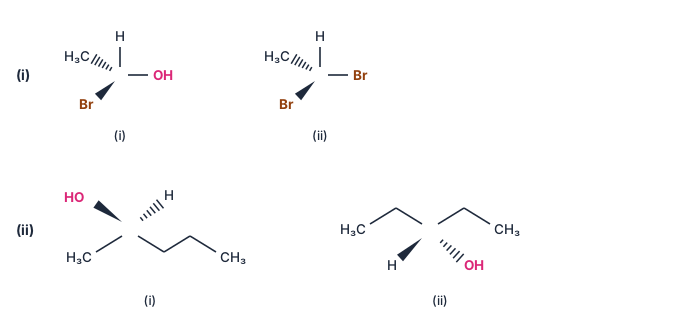
Q.Identify chiral and achiral molecules in each of the following pair of compounds. (Wedge and Dash representations according to Class XI.)
🔒You're viewing a preview — the full solution, concept, methods & PYQ mapping are locked.
🔒 Start your 14-day free trial to unlock the full solution →Concept understanding — Optical Isomerism and Enantiomers
Optical Isomerism and Enantiomers
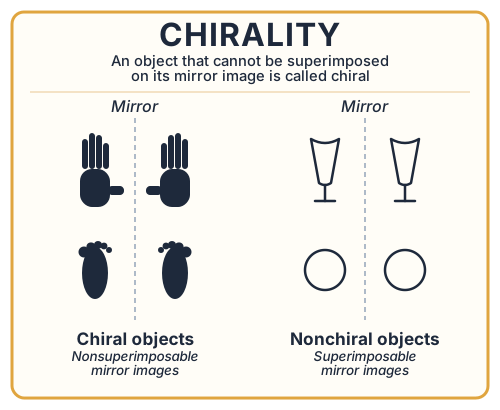
A carbon atom that is bonded to four different groups is called an asymmetric or chiral carbon. A molecule containing such a carbon is not superimposable on its mirror image, just as a left hand is not superimposable on a right hand. The two non-superimposable mirror-image forms are called enantiomers, and the property of existing as such pairs is optical isomerism.
Enantiomers are identical in most physical properties (melting point, boiling point, density) and in ordinary chemical reactions, but they differ in one striking way: each rotates the plane of plane-polarised light by an equal angle in opposite directions. The form that rotates it clockwise is dextrorotatory (+); the one that rotates it anticlockwise is laevorotatory (−).
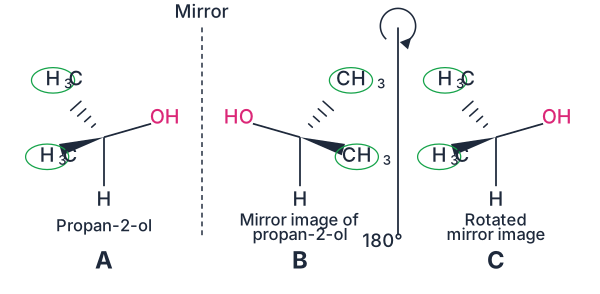
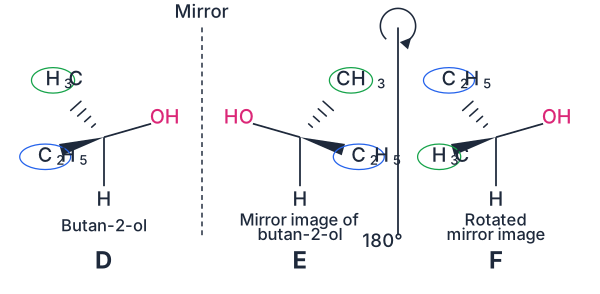
To compare three-dimensional structures, chemists use wedge-and-dash drawings (a solid wedge points toward the viewer, a dashed wedge points behind the plane). Two drawings of the same four groups on one chiral carbon are enantiomers if one is the mirror image of the other and no rotation can make them coincide. A practical test is to interchange any two groups on the reference structure: a single swap converts a molecule into its enantiomer, while two successive swaps return the original configuration.
For example, propan-2-ol — whose carbon carries two identical CH₃ groups — gives a mirror image that a simple 180° rotation brings back onto the original:
Contrast that with butan-2-ol, whose carbon carries four different groups (CH₃, C₂H₅, OH, H) — its rotated mirror image never coincides with the original:
Concept: Chirality (Optical Isomerism) — a molecule is chiral when a carbon is bonded to four different groups (a chiral carbon), making it non-superimposable on its mirror image.
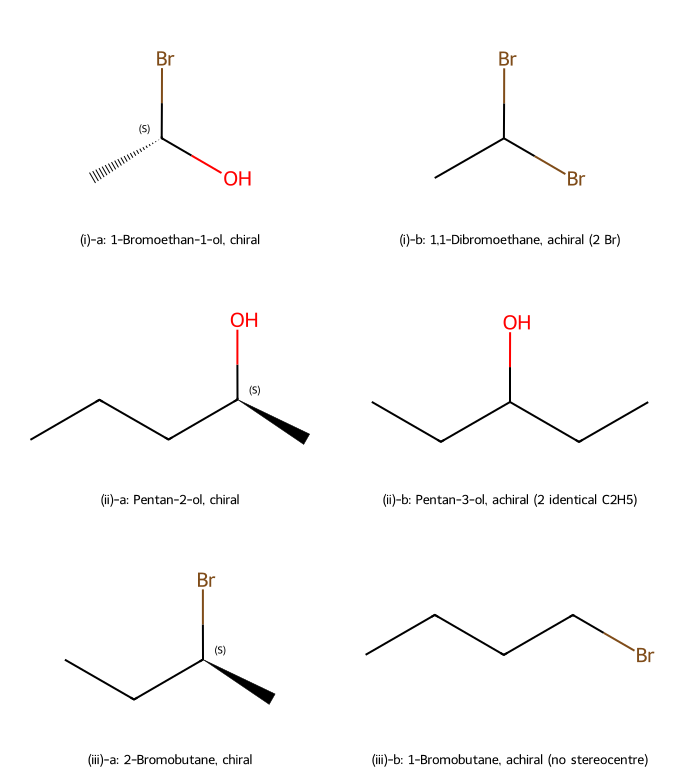
Step 1 – Check each compound for a carbon with four distinct substituents. (i) CH3CH(Br)OH: The central carbon is attached to H, Br, OH, and CH3 — all four different. Chiral.
CH3CHBr2: The central carbon has two identical Br atoms — not chiral. Achiral.
(ii) Pentan-2-ol: Carbon-2 is attached to H, OH, CH3, and CH2CH2CH3 — four different groups. Chiral.
Pentan-3-ol: Carbon-3 is attached to H, OH, and two identical CH2CH3 groups — not chiral. Achiral. …
The key idea is that a molecule is chiral if it has a carbon atom bonded to four different groups (a stereocenter) and is non-superimposable on its mirror image. For the given pairs: (i) 1-Bromoethan-1-ol is chiral; 1,1-dibromoethane is achiral.
(ii) Pentan-2-ol is chiral; pentan-3-ol is achiral.
(iii) 2-Bromobutane is chiral; 1-bromobutane is achiral.
Why This Approach Works
Chirality is a property of molecular handedness — a molecule is chiral if its mirror image cannot be superimposed on it, much like your left and right hands. The most common cause in organic chemistry is a stereocenter (or chiral center): a carbon atom bonded to four different substituents. If even two substituents are identical, the molecule becomes achiral because it will have a plane of symmetry.
The wedge-and-dash notation helps visualize the 3D arrangement: a solid wedge means a bond coming out of the plane toward you, a dashed wedge means a bond going behind the plane, and a plain line means a bond in the plane. But the real trick is to check each carbon for four different groups — no need to draw every 3D structure if you can spot the symmetry.
A common mistake is to think that any carbon with four bonds is a chiral center. It must have four different groups. Also, a molecule can be achiral even if it has no obvious plane of symmetry — but for these simple compounds, checking for a plane of symmetry is a reliable shortcut.
Let’s work through each pair step by step.
(i) 1-Bromoethan-1-ol (CH3CH(Br)OH) and 1,1-dibromoethane (CH3CHBr2)
1. Analyze 1-Bromoethan-1-ol (CH3CH(Br)OH).
The structure is:
CH3−CH(Br)−OH
The central carbon (C2) is bonded to:
- a hydrogen atom (H)
- a bromine atom (Br)
- a hydroxyl group (OH)
- a methyl group (CH3)
Are all four groups different? Yes — H, Br, OH, and CH3 are all distinct. So this carbon is a stereocenter. The molecule has no plane of symmetry (the OH and Br are different, and the CH3 and H are different), so it is chiral.
2. Analyze 1,1-dibromoethane (CH3CHBr2).
The structure is:
CH3−CH(Br)2
The central carbon (C2) is bonded to:
- a hydrogen atom (H)
- two bromine atoms (Br and Br) — these are identical
- a methyl group (CH3)
Because two of the groups are the same (the two Br atoms), this carbon is not a stereocenter. The molecule has a plane of symmetry that passes through the H, the C, and the CH3, cutting between the two Br atoms. So it is achiral.
For a carbon with two identical substituents, the molecule is always achiral — it will have a plane of symmetry through the carbon and the two different groups.
(ii) Pentan-2-ol (CH3CH(OH)CH2CH2CH3) and Pentan-3-ol (CH3CH2CH(OH)CH2CH3)
1. Analyze Pentan-2-ol.
The structure is:
CH3−CH(OH)−CH2−CH2−CH3
The carbon with the OH group (C2) is bonded to:
- a hydrogen atom (H)
- a hydroxyl group (OH)
- a methyl group (CH3) on one side
- a propyl group (CH2CH2CH3) on the other side
Are all four groups different? Yes — H, OH, CH3, and CH2CH2CH3 are all distinct. So C2 is a stereocenter. The molecule has no plane of symmetry (the chain is asymmetric), so it is chiral.
2. Analyze Pentan-3-ol.
The structure is:
CH3−CH2−CH(OH)−CH2−CH3
The carbon with the OH group (C3) is bonded to:
- a hydrogen atom (H)
- a hydroxyl group (OH)
- two ethyl groups (CH2CH3 and CH2CH3) — these are identical …
Method: Chirality Centre (Stereocentre) Identification Method
This method checks whether a carbon atom is bonded to four different groups. If such a carbon exists, the molecule is chiral (optically active). If no such carbon exists, the molecule is achiral.
Steps:
- Draw the full structural formula (condensed or wedge-dash).
- Identify each carbon that is bonded to four different atoms/groups.
- Check for symmetry — even if a carbon has four different groups, the molecule may still be achiral if it has a plane of symmetry (meso compound).
- Classify:
- At least one chiral carbon + no plane of symmetry → chiral
- No chiral carbon OR has a plane of symmetry → achiral
(i) 1-Bromoethan-1-ol vs 1,1-dibromoethane
1-Bromoethan-1-ol (CH3CH(Br)OH)
- Carbon-2 (the middle carbon) is bonded to: CH3, H, Br, OH — four different groups
- No plane of symmetry → Chiral
1,1-Dibromoethane (CH3CHBr2)
- Carbon-1 (the left carbon) is bonded to: CH3, H, Br, Br — two identical Br atoms → not four different groups
- No chiral carbon → Achiral
Result: (i) Chiral and Achiral
(ii) Pentan-2-ol vs Pentan-3-ol
Pentan-2-ol (CH3CH(OH)CH2CH2CH3)
- Carbon-2 is bonded to: CH3, H, OH, CH2CH2CH3 — four different groups
- No symmetry → Chiral
Pentan-3-ol (CH3CH2CH(OH)CH2CH3)
- Carbon-3 is bonded to: CH2CH3, H, OH, CH2CH3 — two identical ethyl groups → not four different groups
- No chiral carbon → Achiral
Result: (ii) Chiral and Achiral
--- …
Common Mistakes in Identifying Chiral vs. Achiral Molecules
Students often struggle with this topic because they confuse structural isomerism with stereoisomerism. The question asks you to identify chirality — which depends on stereochemistry. (Note: pairs (ii) and (iii) happen to be position isomers of each other, but pair (i)'s two compounds have different molecular formulas and are not isomers at all — isomerism is not what decides chirality.) Here are the most frequent errors and how to avoid them.
Mistake 1: Confusing "Structural Isomerism" with "Chirality"
The error:
Students think that because two compounds are structural isomers, they must have different chirality. In reality, chirality is about the arrangement of atoms around a single carbon, not about different carbon skeletons.
How to avoid:
- Remember: Structural isomers have different connectivity. Chirality depends on whether a carbon has four different groups attached.
- For each compound, draw the full structure (wedge-dash) and check each carbon individually — don't rely on the formula alone.
Mistake 2: Forgetting to Check All Carbons for a Chiral Centre
The error:
Students only check the carbon that looks "different" (e.g., the one with a Br or OH) and miss that other carbons might also be chiral — or that the obvious carbon is actually not chiral.
How to avoid:
- A chiral carbon must have four different substituents.
- For each carbon, list its four attached groups. If any two are identical, it is achiral.
Example from (i):
- CH3CH(Br)OH: The central carbon has:
- CH3
- H
- Br
- OH → All four are different → chiral.
- CH3CHBr2: The central carbon has:
- CH3
- H
- Br
- Br (two identical Br atoms) → Not all different → achiral.
Mistake 3: Ignoring Symmetry in Larger Molecules
The error:
In compounds like pentan-3-ol, students see an OH group and assume chirality, forgetting that the molecule has a plane of symmetry.
How to avoid:
- Draw the molecule and look for a plane of symmetry. If the molecule can be divided into two mirror-image halves, it is achiral (meso compound or simply symmetric).
- For pentan-3-ol (CH3CH2CH(OH)CH2CH3):
- The central carbon (with OH) has:
- H
- OH
- CH2CH3 (left)
- CH2CH3 (right)
- The two ethyl groups are identical → carbon is achiral.
- The central carbon (with OH) has:
Mistake 4: Assuming All Halogenated Alkanes Are Chiral
The error:
Students think that because a molecule has a halogen (Br, Cl, etc.), it must be chiral. This is false — chirality depends on the substitution pattern, not just the presence of a halogen.
How to avoid:
- Check if the carbon with the halogen has four different groups.
- In 1-bromobutane (CH3CH2CH2CH2Br):
- The carbon with Br is at the end of the chain.
- It has: H,H,Br,CH2CH2CH3 → two H's are identical → achiral.
Mistake 5: Misreading Wedge-Dash Notation (Class XI Level)
The error:
Students ignore the wedge-dash representation and only look at the condensed formula, missing the 3D arrangement.
How to avoid: …
Showing the 12 most recent of 13 on this concept.
- AP EAPCET 2026Set ap-2026-05-19-FN1 markMCQQ.Which of the following are chiral molecules? Pentan-3-ol (I) 3-Methylheptane (II) 3-Bromo-3-methylpentane (III) 3-Bromo-2-methylpentane (IV) Correct answer is (only = only) (A) I, II, III only (B) II, IV only (C) II, III only (D) I, II only
›Reveal solutionSolution
A carbon is a stereocentre (making the molecule chiral) only if it bears four different groups; testing each compound shows only II and IV qualify.
Concept and Intuition
Chirality in a simple acyclic molecule usually arises from a single sp³ carbon attached to four different substituents (a stereocentre). If any two of the four attached groups are identical, that carbon is not a stereocentre and the molecule (if this is its only candidate centre) is achiral.
Step-by-Step Solution
- Pentan-3-ol: CH3CH2−CH(OH)−CH2CH3. C3 bears OH, H, and two identical −C2H5 groups → not a stereocentre → achiral.
- 3-Methylheptane: CH3CH2−CH(CH3)−CH2CH2CH2CH3. C3 bears H, CH3, −C2H5 (towards C1–C2), and −C4H9 (towards C4–C7) — all four different → stereocentre → chiral.
- 3-Bromo-3-methylpentane: CH3CH2−C(Br)(CH3)−CH2CH3. This carbon bears Br, CH3, and two identical −C2H5 groups → not a stereocentre → achiral. …
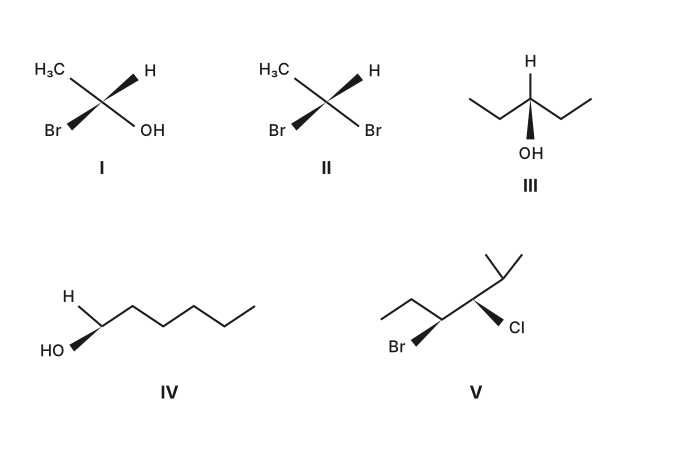
- AP EAPCET 2026Set ap-2026-05-20-FN1 markMCQQ.Identify the chiral molecules from the following [FIGURE] (five wedge-dash skeletal structures labelled I-V: I = a carbon bearing H, Br, OH and CH3 substituents shown with wedge/dash stereochemistry; II = a similar carbon bearing H, Br, Br (two Br groups) and CH3; III = a pentane-type chain with a stereocentre bearing OH and H shown with wedge/dash bonds; IV = a pentanol-type chain with OH and H shown on a stereocentre with wedge bonds; V = a chain bearing adjacent Br and Cl stereocentres next to an isopropyl branch, shown with wedge/dash bonds) (only = only) (A) I, II only (B) I, IV, V only (C) II, III, IV only (D) I, V only
›Reveal solutionSolution
Apply the "four different groups" test to each drawn stereocentre: I, IV and V each have four distinct substituents (chiral); II and III each have two identical substituents on their stereocentre (achiral).
Concept and Intuition
A carbon atom is a genuine stereocentre — and hence can make a molecule chiral — only when all four groups attached to it are different. If any two of the four attached groups are identical, that carbon is not a stereocentre (there's an internal mirror-plane/symmetry through it), and the molecule (assuming no other stereocentre) is achiral.
Step-by-Step Solution
- I: central carbon bears CH3, H, Br, OH — four different groups → genuine stereocentre → chiral.
- II: central carbon bears CH3, H, Br, Br — two of the four groups are identical (Br and Br) → not a stereocentre → achiral.
- III: a chain with OH/H on a carbon flanked by two alkyl "chain ends" that are described as symmetric (e.g. pentan-3-ol type, CH3CH2−CH(OH)−CH2CH3) — the two flanking ethyl groups are identical → not a stereocentre → achiral.
- IV: OH/H on a carbon at one end of a longer chain (e.g. pentan-2-ol type, CH3−CH(OH)−CH2CH2CH3) — the four groups are CH3, H, OH, and propyl, all different → chiral. …
- AP EAPCET 2024Set eng-2024-05-18-FN1 markMCQQ.Which of the following does not show optical isomerism? (A) Cis−[CrCl2(C2O4)2]3− (B) [PtCl2(en)2]2+ (C) [Co(NH3)3(NO2)3] (D) [Co(en)3]3+
›Reveal solutionSolution
This tests which coordination-geometry type can never be chiral. MA3B3 octahedral complexes ([Co(NH3)3(NO2)3]) have a mirror plane in every geometric isomer, so they never show optical isomerism — the answer is (C).
Concept and Intuition
A complex shows optical isomerism only if it is chiral, i.e. its mirror image is non-superimposable on itself. This happens when the molecule has no improper symmetry element (no σ plane, no Sn axis, no centre of symmetry). For octahedral complexes with chelating ligands, whether a particular geometric isomer is chiral depends on its symmetry, not just its formula — you must check each type:
- M(AA)3 (three symmetric bidentate ligands): always chiral — it has only C3 and C2 rotational symmetry, like a three-bladed propeller, with left- and right-handed forms.
- M(AA)2X2 (two bidentate + two monodentate): the cis isomer is chiral (no mirror plane); the trans isomer is achiral (has a mirror plane through the two X groups and the metal).
- MA3B3 (three of one monodentate ligand + three of another): both possible geometric isomers, facial (fac, the three A's on one triangular face) and meridional (mer, the three A's in a plane through the metal), each possess a mirror plane that reflects the molecule onto itself. So neither fac nor mer is chiral — this type never shows optical isomerism, regardless of which geometric isomer you pick.
Step-by-Step Solution
- (A) cis-[CrCl2(C2O4)2]3− is M(AA)2X2 with AA= oxalate, X= Cl. Since it is explicitly the cis isomer, it lacks a mirror plane and is chiral — it does show optical isomerism.
- (B) [PtCl2(en)2]2+ is the same M(AA)2X2 pattern (AA= en, X= Cl), here on octahedral Pt(IV). Its cis form (the one conventionally discussed for this complex) is chiral — it does show optical isomerism. …
- AP EAPCET 2023Set ap-2023-05-22-FN1 markMCQQ.Which of the following exhibits optical isomerism? I. CH3CHCH2CH3 with a CH2Br branch on the CH carbon II. (CH3)2CHCH2Br III. (BrCH2)2CHCH2CH3 IV. CH3CH2CHCH(CH3)2 with a CH3 branch on the CH carbon (A) I, II only (B) II, III only (C) I, IV only (D) III, IV only
›Reveal solutionSolution
Checking each structure for a carbon with four different substituents (the requirement for chirality/optical isomerism) shows only structures I and IV qualify.
Concept and Intuition
A molecule shows optical isomerism if it has at least one stereocenter — a carbon attached to four different groups. The quickest check is to look at the candidate carbon and list its four substituents; if any two are identical, that carbon is not a stereocenter.
Step-by-Step Solution
- Structure I: CH3−CH(CH2Br)−CH2−CH3. The central CH carbon has substituents: CH3, CH2Br, CH2CH3 (ethyl), and H — all four different ⇒ chiral, shows optical isomerism.
- Structure II: (CH3)2CH−CH2Br. The CH carbon has substituents: CH3, CH3, CH2Br, H — two identical CH3 groups ⇒ not chiral.
- Structure III: (BrCH2)2CH−CH2CH3. The CH carbon has substituents: CH2Br, CH2Br, CH2CH3, H — two identical CH2Br groups ⇒ not chiral. …
- AP EAPCET 2023Set ap-2023-05-23-AN1 markMCQQ.The optical rotation of a racemic mixture of 2-methyl 1-butanol is (A) +11.5 (B) +5.75 (C) +2.87 (D) 0
›Reveal solutionSolution
By definition, a racemic mixture (equal parts of two enantiomers) is optically inactive — net rotation is always zero, regardless of how large each individual enantiomer's specific rotation is.
Concept and Intuition
When a chiral compound exists as a 50:50 mixture of its two enantiomers (a racemic mixture, or racemate), the rotation contributed by the (+) form is exactly cancelled by the equal and opposite rotation contributed by the (−) form — this is called "external compensation," and it is a defining property of any racemic mixture, independent of the specific compound.
Step-by-Step Solution
- 2-Methyl-1-butanol has a stereocentre (at C-2), so it exists as a pair of enantiomers, (+)-2-methyl-1-butanol and (−)-2-methyl-1-butanol.
- A "racemic mixture" by definition contains these two enantiomers in exactly equal (1:1) proportion.
- Each enantiomer rotates plane-polarised light by an equal magnitude but in opposite directions (say +5.75° and −5.75°). …
- AP EAPCET 2023Set ap-2023-05-23-FN1 markMCQQ.The correct statement with respect to D-glucose(x) and D-Fructose (y) is (A) Both x and y are dextrorotatory compounds (B) Both x and y are laevorotatory compounds (C) x is leavorotatory and y is dextrorotatory compound (D) x is dextroratory and y is leavorotatory compound
›Reveal solutionSolution
The 'D/L' label is a configurational descriptor, unrelated to the actual (+)/(−) optical rotation; D-glucose happens to be dextrorotatory and D-fructose happens to be laevorotatory.
Concept and Intuition
Students often assume 'D' means dextrorotatory, but D/L nomenclature (Fischer convention) only describes whether the OH on the highest-numbered stereocentre matches D- or L-glyceraldehyde's configuration — it says nothing about the actual sign of rotation measured in a polarimeter, which is denoted separately by (+) or (−).
Step-by-Step Solution
- D-glucose has a specific rotation of about +52.7∘, i.e. it rotates plane-polarised light clockwise (dextrorotatory) — commonly called 'dextrose'.
- D-fructose has a specific rotation of about −92∘, i.e. it rotates plane-polarised light counter-clockwise (laevorotatory) — commonly called 'laevulose', and this strong laevorotation is why invert sugar (a glucose+fructose mix) is net laevorotatory. …
- AP EAPCET 2023Set eng-2023-05-15-FN1 markMCQQ.The optically inactive compound from the following is (A) 2-Bromopropanal (B) 3-Bromopropanal (C) 3-Bromo 2-iodopropanal (D) 2-Bromo 3-iodopropanal
›Reveal solutionSolution
A compound is optically active only if it has a chiral (stereogenic) carbon — one attached to four different groups. Checking each option, only 3-bromopropanal lacks such a carbon.
Concept and Intuition
Optical activity arises from chirality — the molecule and its mirror image are non-superimposable. The simplest and most common source of chirality in an open-chain molecule is a carbon attached to four different substituents (a stereocentre). If no atom in the molecule has four different groups, the molecule (and its mirror image) are identical, so it is optically inactive.
Step-by-Step Solution
- 2-Bromopropanal: CH3−CHBr−CHO. The middle carbon (C2) is bonded to −CHO, −Br, −CH3, and −H — four different groups → chiral centre → optically active.
- 3-Bromopropanal: OHC−CH2−CH2Br. Here C2 (the only carbon besides the terminal ones) is bonded to −H, −H, −CHO, and −CH2Br — it carries two hydrogens, so it is not a stereocentre. No other carbon qualifies either (C1 is the aldehyde carbon with a double bond to O, C3 has two H's and Br). So the molecule has no chiral centre → optically inactive. …
- AP EAPCET 2023Set eng-2023-05-18-AN1 markMCQQ.How many asymmetric carbons are present in the following molecule? HOH2CCH(Br)CH(Br)CH2OH (A) 3 (B) 1 (C) 4 (D) 2
›Reveal solutionSolution
Only the two central CHBr carbons (C2, C3) each carry four different substituents; the terminal CH₂OH carbons don't qualify, giving 2 asymmetric carbons.
Concept and Intuition
A carbon is "asymmetric" (a stereocentre) if it is attached to four different groups. For a chain like HOH₂C–CHBr–CHBr–CH₂OH, check each carbon in turn.
Step-by-Step Solution
- Number the chain C1(CH₂OH)–C2(CHBr)–C3(CHBr)–C4(CH₂OH).
- C1: bonded to two H's, OH, and C2 — has two identical H's, not a stereocentre.
- C2: bonded to H, Br, –CH₂OH (the C1 side), and –CHBrCH₂OH (the C3 side). These four groups are all different (the C1-side group ≠ the C3-side group) → stereocentre.
- C3: bonded to H, Br, –CH₂OH (the C4 side), and –CHBrCH₂OH (the C2 side) — again four different groups → stereocentre.
- C4: bonded to two H's, OH, and C3 — not a stereocentre.
- Total asymmetric carbons = 2 (C2 and C3).
Common Mistakes …
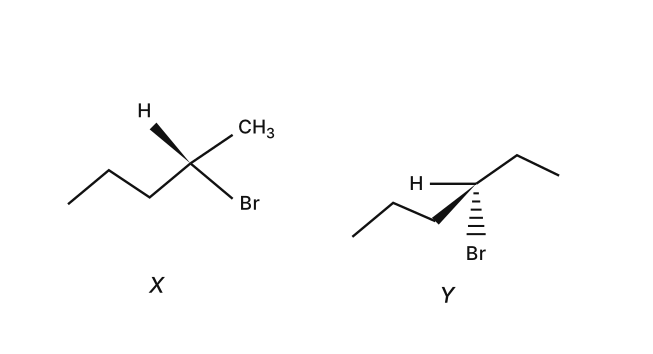
- AP EAPCET 2023Set eng-2023-05-19-FN1 markMCQQ.Below shown molecules are [FIGURE] (two stereocenter structures labeled X and Y, each a hexane-type carbon chain drawn in zigzag with a stereocenter carbon bearing H, CH3, and Br substituents shown using wedge-and-dash bonds to indicate 3-D configuration; X shows H on a wedge and CH3 on a dash with Br in-plane, Y shows H in-plane and CH3 on a dash with Br on a wedge below) (A) X = Y = Achiral (B) X = Y = chiral (C) X = chiral, Y = Achiral (D) X = Achiral, Y = Chiral
›Reveal solutionSolution
Each stereocentre carries four different groups (alkyl chain, CH3, H, Br), so both X and Y are chiral.
Concept and Intuition
A molecule is chiral when it contains an asymmetric carbon — a carbon bonded to four mutually different groups, giving a non-superimposable mirror image. The way wedge and dash bonds are drawn only sets the 3-D configuration (R or S); it does not create or destroy chirality. What matters is whether the four attached groups are all different.
Step-by-Step Solution
- Structure X: the stereocentre carbon is bonded to a propyl-type chain, a CH3 group, an H atom and a Br atom.
- These four groups are all different ⇒ X has an asymmetric carbon ⇒ X is chiral.
- Structure Y: the stereocentre carbon (a 2-bromobutane-type centre) is bonded to an ethyl-type chain, a CH3 (methyl) fragment, an H atom and a Br atom.
- Again all four groups differ ⇒ Y also has an asymmetric carbon ⇒ Y is chiral.
- Since each has exactly one stereocentre with four different substituents, both molecules are chiral.
Common Mistakes …
- AP EAPCET 2021Set ap-2021-09-03-AN1 markMCQQ.Which of the following has a chiral 'C'? (A) CH2I−CH2I (B) CH3CH2Cl (C) (CH3)2CFCl (D) CH3CH(Cl)(I)
›Reveal solutionSolution
This tests recognizing a chiral (stereogenic) carbon — one bonded to four different groups; only CH3CH(Cl)(I) qualifies.
Concept and Intuition
A carbon atom is chiral (a stereocentre) if and only if it is bonded to four different substituent groups. If any two of the four groups are identical, the carbon has a plane of symmetry locally and is not chiral.
Step-by-Step Solution
- (A) CH2I−CH2I: Consider either carbon — it's bonded to: H, H, I, and CH2I. Two of the four groups (H and H) are identical, so this carbon is NOT chiral.
- (B) CH3CH2Cl: The CH2 carbon is bonded to: H, H, Cl, CH3. Again two H's are identical — NOT chiral. (The CH3 carbon has 3 H's, even less chiral.)
- (C) (CH3)2CFCl: The central carbon is bonded to: CH3, CH3, F, Cl. Two identical CH3 groups — NOT chiral. …
- AP EAPCET 2021Set eng-2021-08-19-FN1 markMCQQ.The number of optical isomers possible for 2 – Bromo 3 – Chloro butane are ________ (A) 8 (B) 10 (C) 4 (D) 2
›Reveal solutionSolution
With two different stereocentres bearing different halogens, no meso compound is possible, so the count is the full 2n=4 distinct optical isomers.
Concept and Intuition
For a molecule with n stereocentres, the maximum number of stereoisomers is 2n, but this reduces if the molecule has an internal symmetry allowing a meso compound (an achiral diastereomer where one half's chirality cancels the other's). A meso compound requires the two stereocentres to carry the same set of substituents so that a mirror plane can map one centre exactly onto the other. Here, though, the two stereocentres carry different halogens (Br on C2, Cl on C3), so the molecule has no such symmetry, and no meso form exists.
Step-by-Step Solution
- Draw the structure: CH3−CHBr−CHCl−CH3 (2-bromo-3-chlorobutane).
- Identify stereocentres: C2 (bonded to CH3, Br, H, and the rest of the chain) and C3 (bonded to CH3, Cl, H, and the rest of the chain) — both are genuine stereocentres since each has 4 different groups.
- Since C2's halogen (Br) differs from C3's halogen (Cl), there is no mirror-symmetry relating the two centres — unlike, say, 2,3-dibromobutane where both centres are identical and a meso form exists. …
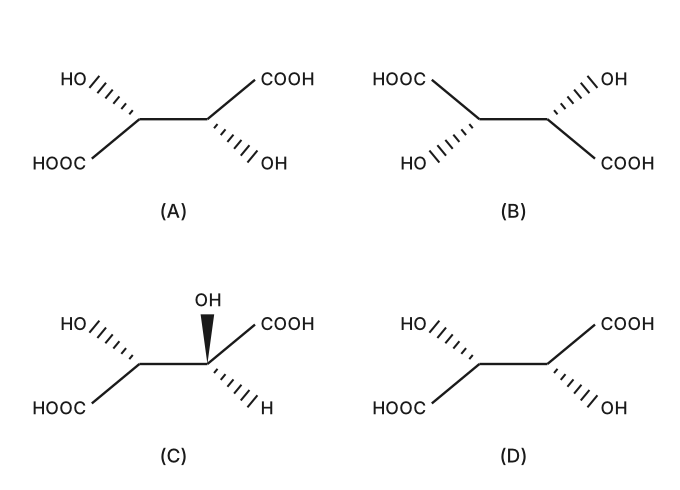
- AP EAPCET 2021Set eng-2021-08-24-FN1 markMCQQ.Which statement regarding the following structures are true? [FIGURE] (a 2x2 grid of four stereochemical structures labelled (A), (B), (C), (D), each a wedge/dash (Fischer-style) drawing of a 2,3-dihydroxybutanedioic-acid-type skeleton HO-CH-COOH / HOOC-CH-OH: (A) has HO with dashed/hashed bond top-left and OH with dashed/hashed bond bottom-right, COOH top-right, HOOC bottom-left; (B) has HOOC top-left, OH with hashed bond top-right, HO with hashed bond bottom-left, COOH bottom-right; (C) has HO with hashed bond top-left, COOH top-right, a bold wedge OH pointing up from the central vertex with H shown bottom-right, HOOC bottom-left; (D) has HO with hashed bond top-left, COOH top-right, HOOC bottom-left, OH with hashed bond bottom-right) (A) A and B are diastereomers, C and D are enantiomers (B) A and B are enantiomers, C and D are enantiomers (C) A and B are enantiomers, C and D are diastereomers (D) A and B are diastereomers, C and D are diastereomers
›Reveal solutionSolution
(A) and (B) are related by a genuine mirror reflection (enantiomers); (C) differs from (D) (which is drawn identically to (A)) at only one of its two stereocentres, making that pair diastereomers rather than mirror images.
Concept and Intuition
For a molecule with two stereocentres (like tartaric acid, HOOC–CHOH–CHOH–COOH): flipping both stereocentres gives the true mirror image (an enantiomer, non-superimposable), while flipping only one of the two stereocentres gives a diastereomer (specifically an epimer) — same connectivity, different spatial relationship, and generally different physical properties (unlike enantiomers, which share all scalar physical properties). Reading these wedge/hash drawings, a genuine left–right flip of the whole 2-D structure that keeps every wedge as a wedge and every hash as a hash is a valid way to represent a true mirror reflection (reflecting through a vertical plane leaves front/back and up/down unchanged, and only swaps left/right).
Step-by-Step Solution
- Compare (A) and (B): (B)'s substituent layout is the exact left–right mirror of (A)'s, with the wedge/hash character of every bond preserved (only the "COOH"/"HOOC" and "OH"/"HO" reading direction flips, which is just a labelling convention for which end faces the bond, not a chemical difference).
- A left–right reflection that preserves all wedge/hash assignments is a genuine mirror operation (reflection through the vertical plane), so both stereocentres are inverted together — this is precisely what defines an enantiomer pair. Hence A and B are enantiomers.
- Now compare (D) to (A): (D)'s substituent layout (HO hashed upper-left, COOH plain upper-right, HOOC plain lower-left, OH hashed lower-right) is identical to (A)'s — the same molecule, same stereochemistry at both centres.
- Compare (C) to (A)/(D): the left stereocentre in (C) is unchanged from (A) (HO hashed upper-left, HOOC plain lower-left). But the right stereocentre is drawn differently: in (A)/(D), OH is hashed (pointing back) at that carbon (with H implicit, pointing front); in (C), OH is explicitly a bold wedge (pointing front) and H is explicitly hashed (pointing back) — this is the spatially inverted configuration at that one carbon. …
🎓Unlock everything free for 14 days
- ✓Full step-by-step solutions
- ✓Concept-first explanations
- ✓Methods, shortcuts & mistakes
- ✓PYQ mapping + timed mock tests
Full access for 14 days. No credit card required.