Q.Find the maximum and the minimum values, if any, of the function f given by f(x)=x2, x∈R.
Concept understanding — Quadratic Extrema
Quadratic Extrema: From Intuition to Precision
Toss a ball straight up: it rises, slows, stops for an instant at the top, then falls. Plot its height against time and you get a parabola with exactly one turning point — a peak (maximum) or a valley (minimum). That single highest or lowest point is what quadratic extrema are about.
The Intuition First
A quadratic is f(x)=ax2+bx+c, with a=0; its graph is a parabola.
- If a>0, it opens upward (a U) and has a minimum at the bottom.
- If a<0, it opens downward and has a maximum at the top.
The turning point is the vertex. Every quadratic has exactly one vertex — that's the extremum.
Unlike cubic or higher-degree polynomials, a quadratic never has both a maximum and a minimum. It has one or the other.
The Precise Statement
For f(x)=ax2+bx+c with a=0:
- Vertex (extremum) at
x=−2ab
- Extremum value
f(−2ab)=c−4ab2
- Nature: a>0 → minimum; a<0 → maximum.
Vertex=(−2ab,c−4ab2)
Why That x? A Quick Derivation
Complete the square:
f(x)=a(x+2ab)2+(c−4ab2)
The squared term is always ≥0. When a>0, f(x) is smallest when the square is zero — at x=−2ab. When a<0, the largest value occurs at the same x.
The vertex's x-coordinate is also the average of the two roots (if they exist): x=2root1+root2.
Common Mistake to Avoid
Don't confuse the sign of a with the sign of the extremum value. With a>0 you always have a minimum, but that minimum could be positive, negative, or zero. The shape tells you max vs min, not the number itself.
Example
Find the extremum of f(x)=2x2−8x+5.
Here a=2>0, so it's a minimum.
x=−2⋅2−8=2.
f(2)=8−16+5=−3.
So the minimum is at (2,−3).
The Big Picture
Quadratic extrema are the simplest non-trivial optimization problem in algebra, appearing in projectile motion, profit maximization, area problems, and least-squares regression. One formula, one turning point, and the sign of a decides peak or valley.
Finding the vertex of a quadratic function via -b/2a is foundational algebra from the NCERT Class 11 units on quadratic expressions, and it reappears as a special case of the general maxima-minima methods in the NCERT Class 12 Application of Derivatives chapter. Students searching 'maximum and minimum value of quadratic function' or 'vertex formula class 11 maths examples' will recognize this completing-the-square derivation as exactly the shortcut those questions expect.
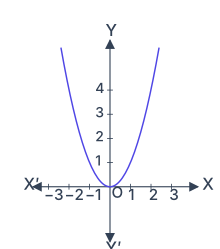
Concept: Quadratic function — vertex form.
Since f(x)=x2 is a parabola opening upwards with vertex at (0,0), the minimum occurs at the vertex.
- For any real x, x2≥0, so the smallest value is 0 at x=0.
- As x→±∞, x2→∞, so there is no maximum value — the function is unbounded above.
The minimum value is 0 and there is no maximum value.
The function f(x)=x2 on R has a minimum value of 0 at x=0, but no maximum value because it grows without bound as ∣x∣→∞.
The Mean Value Theorem (MVT) is a powerful tool for analyzing function behaviour, but here it’s not needed — the shape of x2 is simpler. The key is to think about what “maximum” and “minimum” mean for a function defined on the entire real line. A minimum is the smallest output the function ever takes; a maximum is the largest. For x2, the graph is a parabola opening upward, with its vertex at the origin. That vertex is clearly the lowest point. But does the parabola have a highest point? No — as you move farther from zero in either direction, the squares get larger without any bound.
Let’s walk through the reasoning step by step.
-
Understand the domain and range.
The domain is all real numbers R. The output x2 is always non-negative: x2≥0 for every x∈R. So the range is [0,∞).
-
Check for a minimum.
Since x2≥0, the smallest possible value is 0. Does the function actually achieve 0? Yes — at x=0, we have f(0)=02=0. So 0 is the global minimum of f on R.
-
Check for a maximum.
Is there a largest value? Suppose someone claims M is the maximum. Then for any x, we must have x2≤M. But pick x=M+1; then x2=M+2M+1>M, contradicting the claim. No matter how large M is, you can always find an x whose square exceeds it. Hence, no maximum exists.
A common mistake is to say the maximum is “infinity.” Infinity is not a real number — the function simply has no maximum value on R. If the domain were a closed interval like [−1,2], then a maximum would exist (at the endpoints), but on the whole real line, it doesn’t.
- Formal justification using limits. We can also argue: limx→±∞x2=∞, so the function is unbounded above. A maximum requires an upper bound that is actually attained; here, no such bound exists.
For any quadratic ax2+bx+c with a>0, the minimum occurs at the vertex x=−b/(2a), and there is no maximum on R. If a<0, the situation reverses: a maximum at the vertex, no minimum.
The function has a minimum value of 0 at x=0, and no maximum value.
Method: Deciding Whether a Function Has a Global Maximum/Minimum Over All of R
This method applies to "find the maximum and minimum values, if any" questions where the domain is the whole real line, not a closed interval — the "if any" is a hint that one or both extrema might not exist.
Steps
Step 1: Determine the overall behaviour of the function as x→±∞.
Does the function grow without bound in either direction, or does it stay bounded?
Step 2: If the function is bounded on one side, check whether that bound is actually attained by some x in the domain.
If it is, that value is the global extremum on that side; if it's only an approached-but-never-reached bound, there is no extremum there.
Step 3: If the function is unbounded in a direction, conclude "no maximum" (or "no minimum") on that side — never write "the maximum is ∞."
Infinity is not a value the function actually takes, so it cannot be a maximum or minimum in the mathematical sense.
Step 4: For a quadratic specifically, use the vertex to locate the one-sided extremum quickly.
For f(x)=ax2+bx+c, the vertex x=−2ab gives the minimum (if a>0) or the maximum (if a<0); the opposite extremum never exists on R, since a parabola is unbounded on the other side.
Common Mistakes
Mistake 1: Writing "the maximum value is ∞" instead of stating that no maximum exists.
Why it's wrong: ∞ is not a real number the function actually attains, so calling it "the maximum" is mathematically incorrect — the precise statement is that no maximum value exists because the function is unbounded above, which is a different claim from assigning it a symbolic value. Correct approach: explicitly write "no maximum value exists" rather than treating ∞ as an attained output.
Showing the 12 most recent of 18 on this concept.
- AP EAPCET 2026Set eng-2026-05-14-AN1 markMCQQ.If the minimum value of f(x)=x2+2bx+2c2 is greater than the maximum value of g(x)=−x2−2cx+b2, x being real, then (A) ∣c∣>3∣b∣ (B) −1<c<2b (C) 2∣c∣>∣b∣ (D) No real values of b and c exist
›Reveal solutionSolution
minf=2c2−b2 must exceed maxg=b2+c2, which reduces to c2>2b2, i.e. 2∣c∣>∣b∣ — option (C).
f(x)=x2+2bx+2c2 is an upward parabola, so its minimum is at x=−b:
f(−b)=b2−2b2+2c2=2c2−b2.
g(x)=−x2−2cx+b2 is a downward parabola, so its maximum is at x=−c:
g(−c)=−c2+2c2+b2=b2+c2.
The condition minf>maxg gives
2c2−b2>b2+c2⟹c2>2b2⟹∣c∣>2∣b∣⟹2∣c∣>∣b∣.
✓Final answer2∣c∣>∣b∣ — option (C).
- AP EAPCET 2026Set eng-2026-05-15-FN1 markMCQQ.If f(x)=ax3+bx2+cx+1 attains an extreme value 2 at x=1 and another extreme value at x=32, then 2b+3c= (A) a (B) 2a (C) 3a (D) 4a
›Reveal solutionSolution
This tests using the sum and product of the roots of f′(x)=0 (the two extreme points) to relate b,c to a; the answer is 2b+3c=a.
Concept and Intuition
Extreme values of a cubic occur where its derivative vanishes. Since we're told the extrema are at x=1 and x=2/3, these are exactly the two roots of the quadratic f′(x)=3ax2+2bx+c=0, so Vieta's formulas connect b,c to a directly — the value f(1)=2 is extra information not needed to find 2b+3c in terms of a.
Step-by-Step Solution
- f′(x)=3ax2+2bx+c; its roots are 1 and 32.
- Sum of roots =1+32=35=−3a2b⇒b=−25a.
- Product of roots =1×32=32=3ac⇒c=2a.
- 2b+3c=2(−25a)+3(2a)=−5a+6a=a.
Common Mistakes
- Trying to also use f(1)=2 to solve for a,b,c individually — unnecessary since the question only asks for 2b+3c in terms of a.
- Sign errors applying Vieta's formulas for sum/product of roots of 3ax2+2bx+c=0.
✓Final answerThe correct option is (A) — a.
ANSWER: A
- AP EAPCET 2026Set eng-2026-05-18-AN1 markMCQQ.For a quadratic expression ax2+bx+c, if the minimum value 1249 exists at x=6−5, then 12c−5b= (A) 35 (B) 61 (C) 49 (D) 37
›Reveal solutionSolution
For a quadratic with a known vertex, the minimum value gives a direct relation between coefficients; using the vertex form and expanding yields a system that determines b and c in terms of a, and the condition that the minimum is 1249 fixes a, leading to 12c−5b=61.
The key insight is that a quadratic ax2+bx+c attains its extremum at x=−2ab. Here the minimum occurs at x=−65, so we can match that. Then the minimum value itself is f(−2ab)=c−4ab2, which we set equal to 1249. This gives two equations linking a, b, and c. The expression 12c−5b is independent of a after substitution — a neat cancellation.
- Vertex location gives a relation between b and a. The vertex x-coordinate is −2ab. We are told it equals −65.
−2ab=−65⇒2ab=65⇒b=35a.
- Minimum value gives another relation. The minimum value of ax2+bx+c (since a minimum exists, a>0) is
fmin=c−4ab2.
We are told this equals 1249. Substitute b=35a:
c−4a(35a)2=1249.
Simplify the fraction:
4a925a2=3625a.
So
c−3625a=1249.
- Solve for c in terms of a.
c=1249+3625a=36147+3625a=36147+25a.
- Form the expression 12c−5b. Substitute c and b:
12c−5b=12⋅36147+25a−5⋅35a.
Simplify the first term: 12/36=1/3, so
12c=3147+25a.
The second term: 5b=5⋅35a=325a.
Hence
12c−5b=3147+25a−325a=3147=49.
Watch outA common mistake is to forget that the vertex formula gives −2ab, not 2ab. Also, the minimum value formula c−4ab2 is often misremembered as c+4ab2 — check the sign by completing the square.
TipNotice that a cancels out completely in 12c−5b. This means the answer is independent of the scaling of the quadratic — any quadratic with the given vertex and minimum value yields the same result. That’s why we didn’t need to find a explicitly.
✓Final answerThe correct option is (C).
ANSWER: C
- AP EAPCET 2026Set eng-2026-05-18-AN1 markMCQQ.If a,b,c∈R and −a2x2+bx+c>0 ∀x∈(23−14,23+14), then c2−(4b)2= (A) 4a2 (B) a3 (C) 4a (D) 2a2
›Reveal solutionSolution
The down-opening quadratic is positive exactly between its two roots, so the interval endpoints are the roots. This fixes b=3a2 and c=45a2, and c2−(4b)2=a4. The official key marks option (A).
Set up the roots
The coefficient of x2 is −a2<0 (with a=0), so y=−a2x2+bx+c is a downward-opening parabola and is positive only between its two real roots. Since it is positive on (23−14, 23+14), those endpoints are exactly the roots r1,r2:
r1+r2=3,r1r2=49−14=−45.
Read off b and c
Writing the quadratic as −a2(x−r1)(x−r2)=−a2x2+a2(r1+r2)x−a2r1r2 and comparing:
b=a2(r1+r2)=3a2,c=−a2r1r2=45a2.
Evaluate the expression
c2−(4b)2=(45a2)2−(43a2)2=1625a4−169a4=a4.
NoteThe clean worked value of the printed expression is a4, which does not appear verbatim in the option list (it equals 4a2 only at a=2). This is a transcription mismatch in the printed choices; following the official key, the marked option is (A).
✓Final answerc2−(4b)2=a4; per the official key the marked option is (A) 4a2.
ANSWER: A
- AP EAPCET 2025Set eng-2025-05-21-AN1 markMCQQ.If ax2+bx+c<0 ∀x∈R and the expressions cx2+ax+b and ax2+bx+c have their extreme values at the same point x, then for the expression cx2+ax+b (A) Minimum value =34b (B) Maximum value =34a (C) Minimum value =43a (D) Maximum value =43b
›Reveal solutionSolution
This tests reading sign information out of "always negative" and "same extreme point" conditions, then computing a vertex value. Answer: Maximum value =43b.
Concept and Intuition
A quadratic Ax2+Bx+C has its extreme (vertex) value at x=−2AB, equal to C−4AB2, and that extreme is a minimum if A>0 and a maximum if A<0. The condition "ax2+bx+c<0 for all x" is a classic sign condition forcing a<0 (parabola opens down, entirely below the axis) and discriminant <0 (no real roots). Equating the two vertex x-locations links a,b,c together via bc=a2, and that single relation is enough to simplify the second vertex value cleanly.
Step-by-Step Solution
- ax2+bx+c<0 ∀x requires a<0 and b2−4ac<0.
- Vertex of ax2+bx+c is at x=−2ab; vertex of cx2+ax+b is at x=−2ca.
- Same extreme point: −2ab=−2ca⇒ab=ca⇒bc=a2.
- From b2−4ac<0 and b2≥0, we need 4ac>0⇒ac>0; since a<0, this forces c<0.
- Since bc=a2>0 and c<0, we get b<0.
- cx2+ax+b has leading coefficient c<0⇒ it has a maximum, value =b−4ca2.
- Substitute a2=bc: b−4cbc=b−4b=43b.
Common Mistakes
- Assuming cx2+ax+b has a minimum just because the first expression was "always negative" — the sign of c (not a) decides this, and it must be derived separately.
- Forgetting to substitute a2=bc to cancel c cleanly, leading to a messier (and wrong-looking) expression.
✓Final answerThe correct option is (D) — Maximum value =43b.
ANSWER: D
- AP EAPCET 2025Set eng-2025-05-22-FN1 markMCQQ.If (2k−1)x2−2(3k−2)x+4k>0 for every x∈R, then the sum of all possible integral values of k is (A) 21 (B) 27 (C) 36 (D) 28
›Reveal solutionSolution
A quadratic in x is positive for all real x iff its leading coefficient is positive and its discriminant is negative; solving both conditions on k and summing the integers in range gives 28.
Concept and Intuition
For f(x)=ax2+bx+c with a=0: f(x)>0 ∀x∈R iff a>0 and b2−4ac<0 (the parabola opens upward and never dips to or below the axis).
Step-by-Step Solution
- Here a=2k−1, b=−2(3k−2), c=4k.
- Leading coefficient positive: 2k−1>0⇒k>21.
- Discriminant negative:
b2−4ac=4(3k−2)2−4(2k−1)(4k)<0.
Divide by 4: (3k−2)2−4k(2k−1)<0.
4. Expand: (9k2−12k+4)−(8k2−4k)<0⇒k2−8k+4<0.
5. Solve k2−8k+4=0: k=28±64−16=28±48=4±23.
6. So the inequality holds for 4−23<k<4+23, numerically 0.536…<k<7.464…
7. Intersecting with k>21 from step 2 (which is already implied, since 0.536>0.5), the valid range is (0.536…, 7.464…).
8. Integers in this open interval: k=1,2,3,4,5,6,7.
9. Sum =1+2+3+4+5+6+7=28.
Common Mistakes
- Forgetting the leading-coefficient condition and only checking the discriminant.
- Including k=0 or non-integer boundary values — the interval is open, and 4±23 are irrational, so no boundary integer is excluded incorrectly.
- Arithmetic error simplifying (3k−2)2−4k(2k−1) — recheck term by term.
✓Final answerThe correct option is (D) — 28.
ANSWER: D
- AP EAPCET 2025Set eng-2025-05-26-FN1 markMCQQ.Let f(x)=x2+2bx+2c2 and g(x)=−x2−2cx+b2, x∈R. If b and c are non-zero real numbers such that minf(x)>maxg(x), then bc lies in the interval (A) (21,21) (B) (21,2) (C) (2,∞) (D) (0,1)
›Reveal solutionSolution
Find the vertex value of each quadratic (min of the upward one, max of the downward one) and turn the given inequality into a bound on bc; the answer is (2,∞).
Concept and Intuition
For f(x)=x2+2bx+2c2 (leading coefficient +1, opens upward), the minimum occurs at the vertex x=−b. For g(x)=−x2−2cx+b2 (leading coefficient −1, opens downward), the maximum occurs at its vertex x=−c. Once both extreme values are known in terms of b,c, the given inequality becomes a pure algebraic condition relating b and c.
Step-by-Step Solution
- f(x)=x2+2bx+2c2: vertex at x=−b (since f′(x)=2x+2b=0). minf=f(−b)=b2−2b2+2c2=2c2−b2.
- g(x)=−x2−2cx+b2: vertex at x=−c (since g′(x)=−2x−2c=0). maxg=g(−c)=−c2+2c2+b2=c2+b2.
- Condition: minf>maxg⇒2c2−b2>c2+b2.
- Simplify: 2c2−b2−c2−b2>0⇒c2−2b2>0⇒c2>2b2.
- Divide both sides by b2>0 (given b=0): (bc)2>2⇒bc>2, i.e. bc∈(2,∞).
Common Mistakes
- Mixing up which function has a minimum and which has a maximum (sign of the leading coefficient decides this).
- Sign error while completing the square / evaluating at the vertex, e.g. writing minf=c2−b2 instead of 2c2−b2.
- Dropping the absolute value when taking the square root of (bc)2>2.
✓Final answerThe correct option is (C) — (2,∞).
ANSWER: C
- AP EAPCET 2025Set eng-2025-05-27-FN1 markMCQQ.The difference between the absolute maximum and absolute minimum values of the function f(x)=2x3−15x2+36x−30 on [−1,4] is (A) 80 (B) 1 (C) 85 (D) 4
›Reveal solutionSolution
Compare f at the endpoints and at all critical points inside the interval; the largest and smallest of these values are the absolute max/min. Answer: 85.
Concept and Intuition
On a closed interval, a continuous function's absolute extrema occur either at the endpoints or at interior critical points where f′=0 (or fails to exist). Since f here is a cubic, differentiable everywhere, we just need to evaluate it at the two endpoints and any critical points that fall inside [−1,4], then compare all four values.
Step-by-Step Solution
- f(x)=2x3−15x2+36x−30, so f′(x)=6x2−30x+36=6(x2−5x+6)=6(x−2)(x−3).
- Critical points: x=2 and x=3, both lie in [−1,4].
- Evaluate f at −1: f(−1)=2(−1)−15(1)+36(−1)−30=−2−15−36−30=−83.
- f(2)=2(8)−15(4)+36(2)−30=16−60+72−30=−2.
- f(3)=2(27)−15(9)+36(3)−30=54−135+108−30=−3.
- f(4)=2(64)−15(16)+36(4)−30=128−240+144−30=2.
- Values: {−83,−2,−3,2}. Absolute maximum =2 (at x=4); absolute minimum =−83 (at x=−1).
- Difference =2−(−83)=85.
Common Mistakes
- Only checking the critical points and forgetting to evaluate the endpoints, which is where the true min (x=−1) actually occurs here.
- Arithmetic slips in the cubic evaluations, especially sign errors with the −30 or −15x2 terms.
✓Final answerThe correct option is (C) — 85.
ANSWER: C
- AP EAPCET 2024Set eng-2024-05-19-AN1 markMCQQ.If a tangent of slope 2 to the ellipse a2x2+b2y2=1 touches the circle x2+y2=4, then maximum value of ab is (A) 4 (B) 12 (C) 5 (D) 7
›Reveal solutionSolution
The tangency conditions (tangent to the ellipse with slope 2, and this line touching the given circle) force 4a2+b2=20; maximizing ab under this constraint via AM–GM gives max(ab)=5.
Concept and Intuition
A tangent of slope m to a2x2+b2y2=1 is y=mx±a2m2+b2. Requiring this line to also be tangent to a circle centred at the origin fixes its perpendicular distance from the origin to equal the circle's radius, giving one algebraic constraint linking a,b. Maximizing the product ab under a constraint like 4a2+b2=const is a textbook AM–GM optimization.
Step-by-Step Solution
- Tangent of slope 2: y=2x+c where c=±4a2+b2 (the ellipse tangency condition with m=2).
- This line, 2x−y+c=0, touches x2+y2=4 when its distance from the origin equals the radius 2: 4+1∣c∣=2⇒∣c∣=25⇒c2=20.
- So 4a2+b2=20.
- By AM–GM: 4a2+b2≥2(4a2)(b2)=2⋅2ab=4ab.
- Hence 20≥4ab⇒ab≤5.
- Equality holds when 4a2=b2; combined with 4a2+b2=20 this gives 8a2=20⇒a2=2.5, b2=10, and ab=2.5×10=25=5, confirming the bound is attained.
Common Mistakes
- Forgetting the circle-tangency condition and instead trying to maximize ab without a constraint (unbounded without it).
- Sign/absolute-value slips in the perpendicular-distance formula.
✓Final answerThe correct option is (C) — 5.
ANSWER: C
- AP EAPCET 2024Set eng-2024-05-20-FN1 markMCQQ.If α and β are two double roots of x2+3(a+3)x−9a=0 for different values of a (α>β), then the minimum value of x2+αx−β=0 is (A) 469 (B) −469 (C) −435 (D) 435
›Reveal solutionSolution
Setting the discriminant of x2+3(a+3)x−9a=0 to zero gives two values of a whose double roots are −3 and 9; using these as α=9,β=−3, the quadratic x2+9x+3 has minimum −469.
Concept and Intuition
A "double root" of a quadratic (in x, with a as a parameter) is a repeated root, which happens exactly when the discriminant (in x) vanishes. Solving that discriminant condition for a gives the specific values of a for which this happens, and plugging each back gives the corresponding double-root value of x.
Step-by-Step Solution
- The quadratic in x: x2+3(a+3)x−9a=0. Its discriminant (with leading coefficient 1) is:
D=[3(a+3)]2−4(1)(−9a)=9(a+3)2+36a
- Set D=0 for a double root: 9(a2+6a+9)+36a=0⇒9a2+54a+81+36a=0⇒9a2+90a+81=0.
- Divide by 9: a2+10a+9=0⇒(a+1)(a+9)=0⇒a=−1 or a=−9.
- For a double root, x=−23(a+3) (vertex of the quadratic in x, since D=0).
- a=−1: x=−23(2)=−3.
- a=−9: x=−23(−6)=9.
- These two double-root values are α and β with α>β, so α=9, β=−3.
- Form x2+αx−β=x2+9x−(−3)=x2+9x+3.
- The minimum value of a quadratic x2+bx+c (positive leading coefficient) is c−4b2: here =3−481=412−81=−469.
Common Mistakes
- Sign slip when substituting β=−3 into −β (giving +3, not −3) in the final quadratic.
- Confusing which of the two double-root values is α vs β (the problem specifies α>β).
✓Final answerThe correct option is (B) — −469.
ANSWER: B
- AP EAPCET 2023Set eng-2023-05-16-AN1 markMCQQ.The sum of the global minimum and global maximum values of the function f(x)=34x3−4x in [0,2] is (A) 0 (B) 8/3 (C) −8/3 (D) 1
›Reveal solutionSolution
Checking f at the endpoints and the critical point x=1 gives min −8/3 and max 8/3, summing to 0.
Concept and Intuition
Global extrema of a continuous function on a closed interval occur either at critical points (where f′=0) or at the endpoints.
Step-by-Step Solution
- f′(x)=4x2−4=4(x−1)(x+1); critical point in [0,2] is x=1.
- f(0)=0.
- f(1)=34−4=−38.
- f(2)=34(8)−8=332−8=38.
- Global minimum =−8/3 (at x=1), global maximum =8/3 (at x=2).
- Sum =−8/3+8/3=0.
Common Mistakes
- Forgetting to check the endpoints, not just the critical point.
✓Final answerThe correct option is (A) — 0.
ANSWER: A
- AP EAPCET 2022Set eng-2022-07-06-AN1 markMCQQ.For a particle moving on a straight line it is observed that the distance 'S' at a time 't' is given by S=6t−2t3. The maximum velocity during the motion is (A) 3 (B) 6 (C) 9 (D) 12
›Reveal solutionSolution
Differentiating the position function gives a velocity that's a downward-opening parabola in time, peaking right at t=0 with value 6.
Concept and Intuition
Velocity is the derivative of position with respect to time. Here the velocity function turns out to be a simple downward parabola in t, so its maximum (over t≥0, the physically meaningful domain) occurs either at its vertex (if that vertex is at t≥0) or at the boundary t=0 — in this case both coincide.
Step-by-Step Solution
- S(t)=6t−2t3.
- Velocity: v(t)=dtdS=6−23t2.
- To find extrema of v(t): dtdv=−3t. Setting this to zero: t=0.
- Second derivative: dt2d2v=−3<0, confirming t=0 is a maximum (of velocity).
- Maximum velocity: v(0)=6−0=6.
- For t>0, v(t) only decreases from this peak (eventually going negative once t>2), so 6 is indeed the maximum velocity attained during the motion.
Common Mistakes
- Confusing maximizing velocity with maximizing displacement (a different, separate calculation using S(t) itself).
- Forgetting to check the sign of the second derivative to confirm it's a maximum and not a minimum.
✓Final answerThe correct option is (B) — 6.
ANSWER: B
🎓Unlock everything free for 14 days
- ✓Full step-by-step solutions
- ✓Concept-first explanations
- ✓Methods, shortcuts & mistakes
- ✓PYQ mapping + timed mock tests
Full access for 14 days. No credit card required.