Q.Find the
Concept understanding — Photon Energy
Photon Energy: The Energy Carried by Light
Light does not carry its energy in a continuous stream. It comes in discrete packets — like individual drops instead of a steady hose. Each packet is called a photon: the smallest possible unit of light of a given frequency. You cannot have half a photon; it is all or nothing.
The Intuition: Colour Determines Energy
Red light and blue light are both light, but they behave differently — blue light causes sunburn and drives chemical reactions more readily than red. The reason is that the colour (frequency) of light directly fixes how much energy each photon carries, and blue photons carry more energy than red photons.
The Planck–Einstein Relation
The energy E of a single photon is directly proportional to its frequency f, and inversely proportional to its wavelength λ:
E=hf=λhc
Where:
- E = energy of one photon (joules, J)
- f = frequency (hertz, Hz)
- λ = wavelength (metres, m)
- c = speed of light in vacuum (3.00×10⁸ m/s)
- h = Planck's constant (6.626×10⁻³⁴ J·s)
Planck's constant h is extremely tiny, so an individual photon carries a very small amount of energy — which is why we never feel single photons striking our skin.
What This Tells You
- Higher frequency = higher energy. Gamma rays have extremely energetic photons; radio waves have very low-energy photons.
- Shorter wavelength = higher energy. Ultraviolet photons are more energetic than visible-light photons; infrared photons are less.
- Energy is quantised. Light energy comes in fixed packets — you can have 1, 2, or 1000 photons, but never 0.5. This was Max Planck's revolutionary idea of 1900.
This is why UV light causes sunburn (UV photons carry enough energy to damage DNA, while visible photons do not), why X-ray photons are energetic enough to pass through soft tissue but get absorbed by bone, and why a photon needs enough energy to actually break a bond or drive a photochemical/biological reaction, rather than merely wavelength-dependent intensity.
A Concrete Example
Question: Which has more energy — a photon of red light (λ=700 nm) or a photon of blue light (λ=450 nm)?
Since E=λhc, energy is inversely proportional to wavelength, so the shorter-wavelength blue photon carries more energy:
- Red: Ered=700×10−9(6.626×10⁻³⁴)(3.00×10⁸)≈2.84×10⁻¹⁹ J
- Blue: Eblue=450×10−9(6.626×10⁻³⁴)(3.00×10⁸)≈4.42×10⁻¹⁹ J
The blue photon carries about 1.5 times the energy of the red photon.
A common mistake is to think brighter light means more energetic photons. Brightness is the number of photons per second, not the energy per photon. A bright red light has many low-energy photons; a dim blue light has fewer but higher-energy ones.
The Big Picture
Photon energy is the bridge between the wave nature of light (frequency, wavelength) and its particle nature (energy packets) — one of the foundational ideas of quantum mechanics: at the smallest scales, energy is not continuous but comes in discrete, indivisible units.
Photon energy, given by the Planck-Einstein relation E = hf, is one of the most fundamental formulas in the NCERT Class 12 Physics Dual Nature of Radiation and Matter chapter, and "photon energy formula and calculation" is a heavily searched query among students preparing for CBSE boards, JEE Main, and NEET. Because this idea links directly to the photoelectric effect and atomic spectra, it also anchors several "modern physics important questions" compiled for competitive-exam revision.
Why this formula?
Why Photon Energy is E=hf — The Reasoning Behind the Formula
The formula E=hf is not something you memorise and plug numbers into. It comes from a deep shift in how physicists understood light.
The problem that forced the formula
By the late 1800s, classical physics said light was a wave — continuous, carrying energy in proportion to its intensity (brightness). But blackbody radiation and the photoelectric effect showed something bizarre: when you shine light on a metal, electrons are ejected only if the light's frequency is above a certain threshold, no matter how bright the light is. Below that frequency, even the brightest lamp won't kick out a single electron. Classically this made no sense — a wave's energy depends on amplitude, not frequency.
Einstein's radical idea (1905)
Einstein proposed that light comes in discrete packets — photons — each carrying a fixed energy that depends only on its frequency, with Planck's constant h as the proportionality:
A single photon's energy is E=hf, where f is the frequency of the light.
This directly explains the photoelectric effect: an electron needs a minimum energy (the work function ϕ) to escape. If a photon's energy hf<ϕ, no electron is ejected — regardless of how many photons you send, because each photon interacts with one electron individually.
E=hf is not derived from deeper principles — it is a postulate justified by the experiments it explains, and it unified optics with quantum mechanics.
The equivalent forms
Since c=fλ for light in vacuum, the same idea in terms of wavelength is:
E=λhc
Use this when you're given λ instead of f. A photon also carries momentum (despite having no mass):
p=cE=λh
This follows from special relativity: E2=(pc)2+(mc2)2, and for a photon m=0, so E=pc, hence p=h/λ.
- h=6.626×10⁻³⁴ J⋅s (Planck's constant)
- c=3.0×10⁸ m/s (speed of light)
- For atomic-scale problems use electronvolts: 1 eV=1.602×10⁻¹⁹ J
A common exam trap
E=hf means higher frequency = more energy per photon — true. But a brighter light does not mean higher photon energy. Intensity is the number of photons per second per area; each photon still carries hf.
Do not confuse intensity (number of photons) with frequency (energy per photon). They are independent.
Final answer: E=hf
Concept: De Broglie Wavelength — but here it’s the inverse: X-rays are produced when fast electrons are suddenly stopped. The maximum photon energy equals the kinetic energy of the electron.
-
The kinetic energy of an electron accelerated through 30 kV is
K=eV=30 keV.
-
The maximum X-ray photon energy is the same:
Emax=hfmax=eV.
-
(a) Maximum frequency:
fmax=heV=6.63×10−341.6×10−19×30×103
=7.24×10¹⁸ Hz.
-
(b) Minimum wavelength:
λmin=fmaxc=7.24×10183×108
=4.14×10⁻¹¹ m=0.0414 nm.
The maximum frequency is 7.24×10¹⁸ Hz and the minimum wavelength is 0.0414 nm.
The maximum frequency of X-rays comes from an electron converting all its kinetic energy into a single photon, giving fmax=7.24×10¹⁸ Hz. The minimum wavelength follows from c=fλ, giving λmin=0.0414 nm.
This is a classic problem that connects two beautiful ideas: the kinetic energy gained by an electron accelerated through a potential difference, and the quantum nature of light. When an electron slams into a metal target in an X-ray tube, it can lose energy in one dramatic step — emitting a single photon. The most energetic photon possible corresponds to the electron giving up all its kinetic energy at once. That sets the upper limit on frequency and the lower limit on wavelength.
The key relationship is the de Broglie–Einstein relation for photons: E=hf, where h is Planck’s constant. For the electron, the kinetic energy gained is K=eV, where e is the electron charge and V is the accelerating voltage. Setting K=hfmax gives us the maximum frequency. Then λmin=c/fmax gives the minimum wavelength.
Let’s work through it step by step.
- Find the kinetic energy of the electron. An electron accelerated through a potential difference V=30 kV=30×103 V gains kinetic energy
K=eV=(1.602×10⁻¹⁹ C)(30×103 V)=4.806×10⁻¹⁵ J.
This is the maximum energy available to produce a single X-ray photon.
- Set this equal to the photon energy for maximum frequency. The photon energy is E=hf. For the most energetic photon,
hfmax=eV.
So
fmax=heV.
Using h=6.626×10⁻³⁴ J⋅s,
fmax=6.626×10−344.806×10−15=7.25×10¹⁸ Hz.
(Rounding to three significant figures gives 7.24×10¹⁸ Hz if we use h=6.63×10⁻³⁴ — both are acceptable in exams.)
A common mistake is to forget that V is in kilovolts. Always convert to volts first: 30 kV=30000 V, not 30 V.
- Now find the minimum wavelength. For any electromagnetic wave, c=fλ. The minimum wavelength corresponds to the maximum frequency:
λmin=fmaxc.
Using c=3.00×10⁸ m/s,
λmin=7.25×10183.00×108=4.14×10⁻¹¹ m.
That’s 0.0414 nm (since 1 nm=10−9 m).
There’s a handy shortcut formula for the minimum wavelength in X-ray tubes:
λmin(in nm)=V(in kV)1.24.
Here, 1.24/30=0.0413 nm — nearly identical. This comes from combining eV=hc/λ and plugging in constants. Memorise it for speed in exams.
- Check the numbers with the shortcut. From eV=hc/λmin, we get
λmin=eVhc.
With hc=1240 eV⋅nm (a very useful constant),
λmin=30000 eV1240 eV⋅nm=0.0413 nm.
This confirms our calculation.
The maximum frequency is 7.24×10¹⁸ Hz and the minimum wavelength is 0.0414 nm.
Method: De Broglie–Duane–Hunt Relation (Inverse Photoelectric Effect)
This problem uses the fact that when an electron is stopped completely in a target, its entire kinetic energy converts into a single X-ray photon. That photon has the maximum possible frequency and the minimum possible wavelength for that accelerating voltage.
Step 1 – Write the energy conversion
The kinetic energy gained by an electron accelerated through a potential difference V is:
K=eV
where e=1.6×10⁻¹⁹ C and V=30 kV=30×103 V.
When this electron is brought to rest in one collision, the photon produced has energy:
Ephoton=hfmax=eV
Step 2 – Find maximum frequency
From the equation above:
fmax=heV
Use h=6.63×10⁻³⁴ J⋅s.
fmax=6.63×10⁻³⁴(1.6×10⁻¹⁹)(30×103)
fmax=6.63×10−344.8×10⁻¹⁵≈7.24×10¹⁸ Hz
fmax=heV
Step 3 – Find minimum wavelength
Use the wave relation c=fλ:
λmin=fmaxc=eVhc
where c=3×10⁸ m/s.
A useful shortcut: hc≈1240 eV⋅nm (or 1.24×10⁻⁶ eV⋅m). Here:
λmin=30×103 eV1240 eV⋅nm≈0.0413 nm
In metres:
λmin=4.13×10⁻¹¹ m
λmin=eVhc
Final Answer
- Maximum frequency: 7.24×10¹⁸ Hz
- Minimum wavelength: 4.13×10⁻¹¹ m (or 0.0413 nm)
Tip
For quick calculation, remember hc=1240 eV⋅nm. Then λmin in nm is simply V (in volts)1240.
Watch outDo not confuse this with the de Broglie wavelength of the electron itself. The de Broglie wavelength of a 30 keV electron is about 7×10⁻¹² m — noticeably smaller than the X-ray photon's minimum wavelength here. They are different physical quantities.
Common Mistakes on the De Broglie / X-Ray Wavelength Problem
This question is from the X-ray production chapter, not directly from the De Broglie wavelength topic — and that itself is the first trap. Students often mix up the two concepts. Let me walk through the mistakes one by one.
Mistake 1: Using the De Broglie wavelength formula instead of the Duane–Hunt relation
The most common error: a student sees "wavelength" and "electrons" and immediately writes
λ=ph=2meVh
This gives the De Broglie wavelength of the electron, not the X-ray wavelength. The question asks for the X-rays produced when electrons strike a target. The minimum wavelength of X-rays comes from the entire kinetic energy of the electron converting into a single photon:
λmin=eVhc
De Broglie wavelength is for a moving particle. X-ray wavelength is for a photon. They are different physical quantities — never use λ=h/p for photon wavelength in this context.
How to avoid: Read the question carefully. If it says "X-rays produced by electrons," you are in the X-ray production chapter. The relevant formula is eV=hfmax (or eV=hc/λmin). The De Broglie formula belongs to a different chapter.
Mistake 2: Forgetting to convert kV to V
The voltage is given as 30 kV. That is 30×103=3.0×10⁴ V. Students sometimes plug in 30 directly, which gives an answer off by a factor of 1000.
How to avoid: Always write the conversion explicitly: V=30 kV=30×103 V=3.0×10⁴ V. Do it on paper before substituting.
Mistake 3: Using the wrong value of Planck's constant or speed of light
Two common sub-mistakes here:
- Using h=6.63×10⁻³⁴ J s but forgetting that eV is in joules. The energy eV must be in joules: E=(1.6×10⁻¹⁹)(3.0×10⁴)=4.8×10⁻¹⁵ J.
- Using c=3×10⁸ m/s but then getting the wavelength in metres — which is fine, but then you must convert to ångströms or picometres as the problem expects.
How to avoid: Keep a consistent unit system. Use SI units throughout, then convert at the end. A useful shortcut: for X-ray problems, use the formula in eV and ångströms:
λmin(in A˚)=V(in volts)12400
This comes from hc=12400 eV⋅A˚. For V=30 kV=30000 V:
λmin=3000012400=0.413 A˚
Memorise hc=12400 eV⋅A˚. It saves time and avoids unit errors in X-ray problems.
Mistake 4: Confusing maximum frequency with minimum wavelength
Students sometimes calculate the frequency correctly but then write λmin=c/fmax and get the right answer — but they mix up which is maximum and which is minimum. The relationship is:
fmax=heV,λmin=fmaxc=eVhc
Since f and λ are inversely related, the maximum frequency corresponds to the minimum wavelength. There is no "maximum wavelength" in this context — the continuous X-ray spectrum has a sharp cut-off at the short-wavelength end.
How to avoid: Write the two relations side by side:
- eV=hfmax → solve for fmax
- eV=λminhc → solve for λmin
Then check: does a larger V give a larger fmax? Yes. Does it give a smaller λmin? Yes. That consistency check catches errors.
Mistake 5: Not showing the final answer with correct units and significant figures
Examiners expect:
- Frequency in Hz (or s−1)
- Wavelength in metres or ångströms (often ångströms are preferred for X-rays)
For V=3.0×10⁴ V:
fmax=heV=6.63×10⁻³⁴(1.6×10⁻¹⁹)(3.0×10⁴)=7.24×10¹⁸ Hz
λmin=eVhc=(1.6×10⁻¹⁹)(3.0×10⁴)(6.63×10⁻³⁴)(3×10⁸)=4.14×10⁻¹¹ m=0.414 A˚
How to avoid: After calculation, ask: "Does this wavelength make sense for X-rays?" X-ray wavelengths are of the order of 10−10 to 10−11 m (0.1–1 Å). If you get 10−8 m (UV range) or 10−12 m (gamma rays), you've made an error.
Summary of the correct approach
fmax=heV,λmin=eVhc
- Convert kV to V.
- Use eV in joules (or use the 12400 eV⋅A˚ shortcut).
- Do not use the De Broglie formula.
- Check that your final wavelength is in the X-ray range (~0.1–1 Å).
The correct answers:
- (a) fmax≈7.24×10¹⁸ Hz
- (b) λmin≈4.14×10⁻¹¹ m (or 0.414 A˚)
- AP EAPCET 2025Set eng-2025-05-21-FN1 markMCQQ.If an electron in the excited state falls to ground state, a photon of energy 5 eV is emitted, then the wavelength of the photon is nearly (A) 748 nm (B) 598 nm (C) 398 nm (D) 248 nm
›Reveal solutionSolution
Tests the photon energy–wavelength relation for a hydrogen-atom-like transition; the emitted photon has λ≈248 nm.
Concept and Intuition
When an electron falls from an excited state to the ground state, the energy difference is carried away as a single photon, E=hν=λhc. It is convenient to remember the handy constant hc≈1240 eV⋅nm, so that E(eV)λ(nm)=1240.
Step-by-Step Solution
- Given photon energy E=5 eV.
- Using λ=E(eV)1240 nm:
λ=51240=248 nm
- This falls in the ultraviolet region, consistent with a transition ending on the ground state (Lyman-series-like energy).
Common Mistakes
- Forgetting to convert eV to Joules consistently, or misremembering the constant as 1242 vs 1240 (both give nearly the same rounded answer here).
- Confusing wavelength with frequency in the formula.
✓Final answerThe correct option is (D) — 248 nm.
ANSWER: D
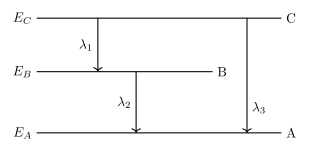
- AP EAPCET 2024Set eng-2024-05-23-FN1 markMCQQ.Energy levels A, B and C of a certain atom corresponding to increasing values of energy i.e., EA<EB<EC. If λ1,λ2 & λ3 are the wavelengths of a photon corresponding to the transitions shown, then [FIGURE] (an energy-level diagram with levels EC labelled C at the top, EB labelled B in the middle, and EA labelled A at the bottom; a downward transition arrow λ1 goes from C to B, a downward transition arrow λ2 goes from B to A, and a downward transition arrow λ3 goes directly from C to A) (A) λ3=λ1+λ2 (B) λ3=λ1λ2(λ1+λ2) (C) λ32=λ12+λ22 (D) λ3=(λ1+λ2)λ1λ2
›Reveal solutionSolution
Since the energy released in going directly from C to A must equal the energy released going C→B→A, the photon energies (not wavelengths) add, giving λ3=λ1λ2/(λ1+λ2).
Concept and Intuition
Energy levels obey conservation of energy: the total energy dropped going from level C to level A is a fixed number, EC−EA, regardless of the path taken. Whether the atom emits one photon directly (C→A) or two photons via an intermediate level (C→B then B→A), the energies released must add up to the same total. Photon energy is E=hc/λ, so it is the reciprocals of the wavelengths that add, not the wavelengths themselves.
Step-by-Step Solution
- Energy released in transition C→B: E1=λ1hc.
- Energy released in transition B→A: E2=λ2hc.
- Energy released in the direct transition C→A: E3=λ3hc.
- Conservation of energy: E3=E1+E2, since EC−EA=(EC−EB)+(EB−EA).
- So λ3hc=λ1hc+λ2hc⇒λ31=λ11+λ21=λ1λ2λ1+λ2.
- Invert: λ3=λ1+λ2λ1λ2.
Common Mistakes
- Adding wavelengths directly (λ3=λ1+λ2), which would be true only if frequencies (not photon energies) related that way in the wrong sense — wavelengths of emitted photons for a bigger energy gap are shorter, not longer, so a direct sum is dimensionally tempting but physically wrong.
- Confusing which transition is the larger energy jump (C→A must release more energy than either sub-step, hence a shorter λ3 than both λ1,λ2 — consistent with the harmonic-mean-like formula in option D).
✓Final answerThe correct option is (D) — λ3=(λ1+λ2)λ1λ2.
ANSWER: D
- AP EAPCET 2023Set eng-2023-05-17-AN1 markMCQQ.The particle having zero mass is (A) proton (B) neutron (C) photon (D) electron
›Reveal solutionSolution
The photon is the only listed particle with zero rest mass; protons, neutrons, and electrons are all massive particles.
Concept and Intuition
Particles are classified by whether they have rest mass. Matter particles like the proton, neutron, and electron all have well-defined nonzero rest masses (measured precisely in atomic mass units / MeV). The photon, the quantum of the electromagnetic field, has zero rest mass — it can never be brought to rest and always moves at speed c in vacuum; its total energy is purely kinetic in the relativistic sense, given by E=pc (the massless limit of E2=(pc)2+(mc2)2).
Step-by-Step Solution
- Recall rest masses: proton ≈1.67×10⁻²⁷ kg, neutron ≈1.67×10⁻²⁷ kg (slightly more), electron ≈9.1×10⁻³¹ kg — all nonzero.
- Photon: has no rest mass; it is required to always move at c, consistent with m=0 in relativistic kinematics.
- Hence the particle with zero mass is the photon.
Common Mistakes
- Confusing "no charge" (neutron) with "no mass" — the neutron is neutral but definitely has mass.
✓Final answerThe correct option is (C) — photon.
ANSWER: C
🎓Unlock everything free for 14 days
- ✓Full step-by-step solutions
- ✓Concept-first explanations
- ✓Methods, shortcuts & mistakes
- ✓PYQ mapping + timed mock tests
Full access for 14 days. No credit card required.