Q.A short bar magnet has a magnetic moment of 0.48 J T−1. Give the direction and magnitude of the magnetic field produced by the magnet at a distance of 10 cm from the centre of the magnet on
🔒You're viewing a preview — the full solution, concept, methods & PYQ mapping are locked.
🔒 Start your 14-day free trial to unlock the full solution →Concept understanding — Magnetic Poles
Magnetic Poles: The Intuition First
Imagine you have a bar magnet — the kind you might have stuck on your refrigerator. If you bring two of them close, something interesting happens. Sometimes they snap together with a satisfying click. Other times, they push each other away, refusing to touch no matter how hard you try.
That's not random. Every magnet has two special regions, one at each end, where the magnetic force is strongest. These are its magnetic poles.
The word "pole" comes from the Greek polos, meaning "pivot" or "axis" — the Earth itself has a North Pole and a South Pole, and it behaves like a giant magnet.
The Two Types of Poles
Every magnet has exactly two poles: a north pole and a south pole. You cannot have a magnet with only one pole — cut a bar magnet in half, and each half immediately becomes a complete magnet with its own north and south poles.
The rule of interaction is simple and memorable:
- Unlike poles attract: north pulls south, south pulls north.
- Like poles repel: north pushes north away; south pushes south away.
This is the fundamental behaviour. No exceptions.
The Precise Statement
Magnetic poles are the regions of a magnet where the external magnetic field is strongest. Every magnet has exactly two poles — a north pole and a south pole — that cannot be isolated. Like poles repel; unlike poles attract.
The key points to remember for exams:
- Poles always come in pairs — there is no magnetic monopole (a single isolated pole) in nature, despite decades of searching.
- The north pole is defined as the pole that points toward Earth's geographic north when the magnet is freely suspended.
- The south pole points toward Earth's geographic south.
A Common Confusion (Watch Out)
Earth's geographic North Pole is actually a magnetic south pole. Why? Because the north pole of a compass needle (which is a magnetic north pole) is attracted to it. And unlike poles attract. So the Earth's north pole behaves like a magnetic south pole. This often trips students up in exams.
Why This Matters …
Why this formula?
Magnetic Poles: Why the Key Formulas Hold
Let's build this from first principles — understanding why a magnetic pole behaves the way it does, not just memorizing the result.
1. What Is a Magnetic Pole?
A magnetic pole is a conceptual point where the magnetic field appears to originate or terminate. In reality, magnetic poles always come in north-south pairs (no isolated monopoles exist in nature), but we treat them as idealized sources for calculations.
- North pole: source of magnetic field lines (outward)
- South pole: sink of magnetic field lines (inward)
2. The Key Formula: Force Between Two Magnetic Poles
The force between two magnetic poles of strengths m1 and m2, separated by distance r, is:
F=4πμ0⋅r2m1m2
Why this form?
This is a Coulomb's law analog — and that's not a coincidence. Here's the reasoning:
-
Experimental observation: Magnetic poles attract/repel with a force that:
- Varies as 1/r2 (inverse square law)
- Is proportional to the product of pole strengths
- Depends on the medium (via μ0, the permeability of free space)
-
Mathematical analogy: The magnetic field B at distance r from a single pole m is:
B=4πμ0⋅r2m
This comes from Gauss's law for magnetism applied to a point source.
- Force derivation: The force on pole m2 in the field of pole m1 is:
F=m2⋅B1=m2⋅(4πμ0⋅r2m1)
Hence:
F=4πμ0⋅r2m1m2
Key insight: The 1/r2 dependence is not arbitrary — it follows from the geometry of 3D space (flux spreads over a sphere of area 4πr2).
3. The Magnetic Field of a Bar Magnet (Two Poles)
For a bar magnet of length 2l with poles +m and −m, the field at a point on the axis at distance x from the center is:
B=4πμ0⋅(x2−l2)22ml
Why this form?
-
Superposition principle: The total field is the vector sum of fields from the north pole (+m) and south pole (−m).
-
Field from north pole at distance (x−l):
BN=4πμ0⋅(x−l)2m(away from north)
- Field from south pole at distance (x+l):
BS=4πμ0⋅(x+l)2m(toward south)
- Net field (both along same direction on axis):
B=BN−BS=4πμ0m[(x−l)21−(x+l)21]
- Simplify using algebra:
(x−l)21−(x+l)21=(x2−l2)24xl
Therefore:
B=4πμ0⋅(x2−l2)24mxl
But for a bar magnet, the magnetic moment is M=m⋅(2l) (pole strength × separation). So 2ml=M, giving:
B=4πμ0⋅(x2−l2)22Mx
Key insight: The field is not simply 1/r2 because we have two poles — the net effect is a dipole field, which falls off as 1/r3 at large distances.
4. The Far-Field Approximation (Dipole Formula)
For x≫l (far from the magnet), x2−l2≈x2, so:
B≈4πμ0⋅x32M
Why 1/x3?
- A single pole gives 1/r2 …
Concept: Magnetic field of a bar magnet — the field depends on position (axial vs equatorial) and falls as 1/r3.
Step 1 — Axial field formula
For a point on the axis at distance r from the centre:
Baxis=4πμ0⋅r32M
Direction: away from the north pole (along the axis, from south to north outside the magnet).
Step 2 — Equatorial field formula
For a point on the equatorial line (perpendicular bisector):
Beq=4πμ0⋅r3M
Direction: opposite to the magnetic moment (from north to south, parallel to the axis but reversed).
Step 3 — Plug in values
M=0.48 J T−1, r=0.10 m, 4πμ0=10−7 T m A−1. …
The magnetic field of a short bar magnet is derived from its magnetic moment using the axial and equatorial formulas. At 10 cm from the centre, the axial field is 0.96×10⁻⁴ T directed away from the north pole, and the equatorial field is 0.48×10⁻⁴ T directed opposite to the magnetic moment.
The key to solving this lies in understanding that a bar magnet behaves like a magnetic dipole. Its magnetic moment M is a vector pointing from the south pole to the north pole inside the magnet. The field it produces at any point depends on the orientation of that point relative to the dipole axis.
For a short magnet (length much smaller than the distance r), we use the dipole approximation. This is valid here because the distance 10 cm is large compared to the magnet's length (which is not given but implied to be small). The formulas are exact for a point dipole and excellent approximations for a short bar magnet.
For a magnetic dipole of moment M:
- Axial field (on the axis, at distance r from centre): Baxis=4πμ0⋅r32M
- Equatorial field (on the perpendicular bisector, at distance r): Beq=4πμ0⋅r3M
Notice the factor of 2 difference: the axial field is twice the equatorial field at the same distance. This is a direct consequence of the dipole field geometry — field lines are denser along the axis.
Now let's apply these to the given data.
-
Write down the known quantities.
Magnetic moment M=0.48 J T−1 (which is equivalent to A m2).
Distance r=10 cm=0.10 m.
The constant 4πμ0=10−7 T m A−1 (exactly, by definition of the ampere).
-
Calculate the axial field.
Baxis=10−7×(0.10)32×0.48
First, (0.10)3=0.001=10−3.
So Baxis=10−7×10−30.96=10−7×0.96×103=0.96×10⁻⁴ T.
That is 9.6×10⁻⁵ T.
Direction: On the axis, the field points away from the north pole and toward the south pole. Since the magnetic moment points from south to north, the axial field is parallel to M on the side of the north pole, and antiparallel on the south pole side. The problem asks for "direction" — we state it as along the axis, away from the north pole (or equivalently, in the direction of M if the point is on the north side).
- Calculate the equatorial field. …
Method: Axial and Equatorial Field Formulas for a Bar Magnet
This problem uses the standard dipole field formulas for a short bar magnet. The magnet is treated as a magnetic dipole, and we apply the two specific cases — axial point and equatorial point.
Step 1 — Recall the formulas
For a short bar magnet of magnetic moment M:
- On the axis (end-on position):
Baxis=4πμ0⋅r32M
- On the equatorial line (broadside-on position):
Beq=4πμ0⋅r3M
Where:
- 4πμ0=10−7 T m A−1
- M=0.48 J T−1
- r=10 cm=0.1 m
Step 2 — Calculate magnitude on the axis
Baxis=10−7×(0.1)32×0.48
First, (0.1)3=0.001=10−3
Baxis=10−7×10−30.96=10−7×960=9.6×10⁻⁵ T
Direction: Along the axis, away from the north pole (i.e., from south to north outside the magnet).
Step 3 — Calculate magnitude on the equatorial line …
Here are the most common mistakes students make with this classic magnetic dipole problem, along with how to avoid each one.
Mistake 1: Using the Wrong Formula for Axis vs. Equator
The Mistake:
Students often mix up the formulas for the magnetic field on the axis (Baxis) and the equatorial line (Beq). A common error is using the axis formula for the equator, or forgetting the factor of 2 difference.
The Correct Concept:
The magnetic field due to a short bar magnet (treated as a dipole) is different at these two points.
- On the axis: The field is stronger and points along the direction of the magnetic moment (M).
Baxis=4πμ0⋅r32M
- On the equatorial line: The field is half the axial value (at the same distance) and points opposite to the direction of the magnetic moment.
Beq=4πμ0⋅r3M
How to Avoid:
- Memorise the ratio: Baxis=2×Beq (for the same r).
- Visualise the dipole: The field lines are denser (stronger) coming out of the north pole (axis) and spread out (weaker) at the sides (equator).
Mistake 2: Forgetting the Unit Conversion for Distance
The Mistake:
The distance is given as 10 cm, but the formula requires metres. A very common error is to plug in r=10 instead of r=0.1 m.
The Correct Calculation:
r=10 cm=10×10−2 m=0.1 m
This means r3=(0.1)3=1×10⁻³ m3.
How to Avoid:
- Always convert cm to m before plugging into any formula involving SI units (Tesla, J/T, etc.).
- Write the conversion step explicitly in your solution. Do not do it mentally.
Mistake 3: Getting the Direction Wrong
The Mistake:
Students often state the direction incorrectly, especially for the equatorial point. They might say the field points "towards the magnet" without specifying which pole, or they forget the opposite direction on the equator.
The Correct Directions (for a standard bar magnet with North and South poles):
- (a) On the axis: The field points away from the North pole and towards the South pole. In standard notation, if the magnetic moment points from South to North, the field on the axis is along the direction of M (from South to North outside the magnet).
- (b) On the equatorial line: The field points parallel to the axis but opposite to the direction of M (i.e., from North to South).
How to Avoid:
- Draw a quick sketch. Draw the magnet (N at top, S at bottom). Draw the field lines: they leave N, curve around, and enter S. …
- AP EAPCET 2025Set eng-2025-05-22-FN1 markMCQQ.A short bar magnet has a magnetic moment of 0.48 JT−1. The magnitude of magnetic field at a point at 10 cm distance from the centre of the magnet on its axis is (A) 0.96 gauss (B) 0.48 gauss (C) 1.92 gauss (D) 1.44 gauss
›Reveal solutionSolution
The axial field of a short bar magnet falls off as 1/d3; substituting the given moment and distance gives 9.6×10⁻⁵ T, i.e. 0.96 gauss.
Concept and Intuition
A bar magnet behaves, at points far from it compared to its own length (the "short magnet" or point-dipole approximation), like a magnetic dipole. On its axis, the field is Baxial=4πμ0d32m — twice as strong as on the equatorial line at the same distance, and falling off rapidly (∝1/d3) because it is a dipole field, not a monopole field. This rapid fall-off is why bar-magnet fields become negligible just a short distance away.
Step-by-Step Solution
- Axial field formula: B=4πμ0⋅d32m, with 4πμ0=10−7 Tm/A.
- Substitute m=0.48 JT−1, d=0.1 m: d3=0.001 m3.
- B=10−7×0.0012×0.48=10−7×960=9.6×10⁻⁵ T. …
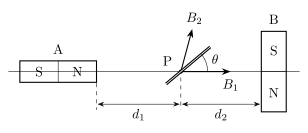
- AP EAPCET 2024Set ap-2024-05-17-FN1 markMCQQ.Two bar magnets A and B are identical and arranged as shown. Their lengths are negligible when compared to the separation between them. A magnetic needle placed between the magnets at point P gets deflected through an angle 'θ' under their influence. The ratio of distances d1 and d2 is [FIGURE] (bar magnet A with poles S–N lies horizontally on the left; bar magnet B stands vertically on the right with poles S (top) and N (bottom); at point P between them the field B1 from magnet A points along the horizontal axis toward B, and the field B2 from magnet B points vertically; the resultant magnetic needle direction makes angle θ with the horizontal; d1 is the horizontal distance from magnet A to the vertical line through P, and d2 is the horizontal distance from that vertical line to magnet B) (A) (2cotθ)1/3 (B) (2cotθ)1/2 (C) (2tanθ)1/3 (D) (2tanθ)1/2
›Reveal solutionSolution
Setting tanθ=B2/B1 with axial and equatorial dipole fields gives d1/d2=(2tanθ)1/3.
Concept and Intuition
Point P is end-on (axial) to magnet A, whose horizontal field is B1=4πμ0d132M. P is broadside (equatorial) to the perpendicular magnet B, whose field is B2=4πμ0d23M and points vertically. The needle aligns with the resultant, tilted at θ from the horizontal B1 direction.
Step-by-Step Solution
- Axial field of A at P: B1=4πμ0d132M (horizontal).
- Equatorial field of B at P: B2=4πμ0d23M (vertical).
- The deflection satisfies tanθ=B1B2=2M/d13M/d23=2d23d13.
- Rearrange: d23d13=2tanθ⇒d2d1=(2tanθ)1/3.
Common Mistakes …
- AP EAPCET 2023Set eng-2023-05-17-FN1 markMCQQ.Curl the palm of your right hand around the circular wire with the fingers pointing in the direction of current and the thumb gives the direction of the magnetic field. In this case the upper side of the loop may be thought of as (A) direction of current (B) direction of electric field (C) south pole (D) north pole
›Reveal solutionSolution
The right-hand rule identifies the face of a current loop from which the magnetic field lines emerge as its effective north pole.
Concept and Intuition
A current loop behaves like a magnetic dipole, with field lines emerging from one face (like a bar magnet's north pole) and entering the opposite face (like the south pole). The right-hand rule — curl the fingers in the direction of current flow, and the thumb points in the direction of the magnetic field along the axis — identifies which face is the "north" face: the field lines point out of that face, exactly the way they emerge from a bar magnet's north pole.
Step-by-Step Solution
- Curl the right-hand fingers along the direction of the current in the loop.
- The thumb then points along the axis of the loop, in the direction of the magnetic field inside/through the loop.
- The face from which the field lines emerge (the thumb's side) is, by analogy to a bar magnet, the north pole of this equivalent magnetic dipole. …
- AP EAPCET 2023Set eng-2023-05-18-AN1 markMCQQ.Which of the following do not exist? (A) Electric dipoles (B) Electric monopoles (C) Magnetic monopoles (D) Magnetic dipoles
›Reveal solutionSolution
This tests a foundational distinction between electricity and magnetism: isolated electric charges exist, but isolated magnetic poles do not. Magnetic monopoles do not exist.
Concept and Intuition
In electrostatics, a single point charge (an "electric monopole") is the most basic and commonly observed object — charges of a single sign exist freely (e.g., an electron or proton). Electric dipoles (pairs of equal and opposite charges) also exist as composite structures. In magnetism, however, every magnet observed in nature has both a north and a south pole together; cutting a bar magnet in half only produces two smaller magnets, each with its own north-south pair, never an isolated pole. This experimental fact is formalized as Gauss's law for magnetism (∮B⋅dA=0), which states magnetic field lines have no beginning or end — unlike electric field lines, which start and end on individual (monopole) charges.
Step-by-Step Solution
- Electric dipoles: composite systems of equal and opposite charges — these exist (e.g. polar molecules).
- Electric monopoles: single isolated charges — these definitely exist (e.g. a free electron or proton).
- Magnetic dipoles: bar magnets, current loops — these exist and are the most basic magnetic sources found. …
- AP EAPCET 2023Set eng-2023-05-18-FN1 markMCQQ.If B is magnetic field and q is the charge then the following represents the Gauss's law of magnetism (A) ∫B⋅ds=0 (B) ∫B⋅ds=q (C) ∫B⋅ds=4π (D) ∫B⋅ds=μoq
›Reveal solutionSolution
Gauss's law for magnetism asserts zero net magnetic flux through any closed surface, reflecting the absence of magnetic monopoles.
Concept and Intuition
Unlike electric field lines, which begin and end on charges (giving nonzero net flux, per Gauss's law of electrostatics), magnetic field lines always form closed loops with no beginning or end — there are no isolated magnetic "charges" (monopoles). Hence the net flux out of any closed surface for B is always exactly zero, regardless of what currents or magnets are inside or outside.
Step-by-Step Solution
- Compare with Gauss's law for electricity: ∫E⋅ds=q/ε0 (nonzero when charge is enclosed). …
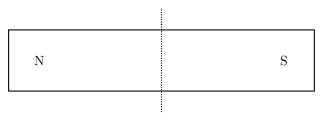
- AP EAPCET 2022Set eng-2022-07-08-AN1 markMCQQ.If a bar magnet is cut along the dotted line as shown in the figure and the two pieces are held separated by a small distance as they are, then [FIGURE] (a rectangular bar magnet with pole N labelled at the left end and pole S labelled at the right end; a vertical dotted line cuts through the bar approximately at its midpoint, perpendicular to its length) (A) They repel each other. (B) They attract each other. (C) They do not experience any force on each other. (D) Will repel or attract depending on the location of cut.
›Reveal solutionSolution
Cutting a bar magnet creates two new poles at the cut faces; in the original alignment these new faces are opposite (S facing N), so the pieces attract.
Concept and Intuition
A bar magnet's poles arise from an unbroken chain of aligned atomic dipoles running along its length, N at one end and S at the other. Cutting it does not erase this alignment — each half is simply a shorter version of the same chain, so each half becomes a complete magnet on its own, with a north and a south pole. The end that was already a pole (say N) stays N. The newly exposed face at the cut must become the other pole (S), because inside a magnet field lines run from S to N — the cut face, which used to be the interior mid-point where the field pointed toward the N end, becomes the new S pole for the left piece. By the same logic the right piece's cut face becomes a new N pole.
Step-by-Step Solution
- Original magnet: N (left end) ——— S (right end), dotted cut line at the midpoint.
- After cutting, left piece: retains N at its left end; develops a new S pole at its cut (right) face.
- Right piece: retains S at its right end; develops a new N pole at its cut (left) face.
- The two pieces are held apart "as they are" — i.e., in their original relative alignment, so the left piece's cut face (S) is nearest the right piece's cut face (N). …
- AP EAPCET 2022Set eng-2022-07-08-FN1 markMCQQ.A bar magnet of length 16 cm is placed in the magnetic meridian with the N-pole pointing towards geographical north. Two neutral points separated by 12 cm are obtained on the equatorial line of the magnet. If the horizontal component of earth's magnetic field = 3.2×10⁻⁵ T, then the pole strength of magnet is (A) 0.25 Am (B) 0.5 Am (C) 1 Am (D) 2 Am
›Reveal solutionSolution
Uses the equatorial-field neutral-point condition of a bar magnet to solve for pole strength, giving 2 Am.
Concept and Intuition
"Neutral points" on the equatorial line of a bar magnet are where the magnet's own (equatorial) field exactly cancels the Earth's horizontal field, so their location pins down the magnet's moment. The equatorial field of a short bar magnet at distance d from its centre is Beq=4πμ0(d2+l2)3/2m, where m=qm×2l is the magnetic moment and l is the half-length.
Step-by-Step Solution
- Half-length: l=16/2=8cm=0.08m.
- Neutral points are symmetric about the centre, separated by 12cm, so each is at d=6cm=0.06m from the centre.
- At a neutral point: Beq=H⇒4πμ0⋅(d2+l2)3/2qm(2l)=H.
- Compute d2+l2=0.0036+0.0064=0.01m2, so (d2+l2)3/2=(0.01)1.5=0.001m3. …
🎓Unlock everything free for 14 days
- ✓Full step-by-step solutions
- ✓Concept-first explanations
- ✓Methods, shortcuts & mistakes
- ✓PYQ mapping + timed mock tests
Full access for 14 days. No credit card required.