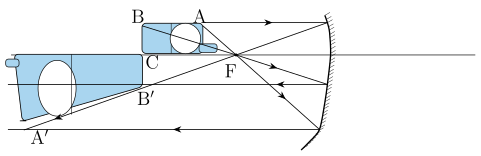
Q.A mobile phone lies along the principal axis of a concave mirror, as shown in Fig. 9.7. Show by suitable diagram, the formation of its image. Explain why the magnification is not uniform. Will the distortion of image depend on the location of the phone with respect to the mirror?
Concept understanding — Spherical Mirror Equation
The Spherical Mirror Equation: From Intuition to Formula
Imagine you're standing in front of a concave mirror — the kind that makes your face look bigger when you're close, but flips everything upside down when you step far back. That change isn't magic; it's geometry. The spherical mirror equation is the single relationship that predicts exactly where an image will form, and whether it's real or virtual, for any spherical mirror.
The Core Idea
Every point on an object sends out light rays in all directions. A mirror redirects those rays. The mirror equation tells you: given the mirror's curvature and the object's distance, where will those rays meet again (or appear to meet)?
There are only three quantities you need:
- u — object distance (from the mirror's pole)
- v — image distance (from the mirror's pole)
- f — focal length (a property of the mirror's curvature)
The equation is:
v1+u1=f1
The power is in the sign convention, because every distance can point in one of two directions.
The Sign Convention (New Cartesian Sign Convention)
This is where most students slip. The equation works for all spherical mirrors — concave and convex — only if you follow the convention used throughout NCERT and CBSE:
- All distances are measured from the mirror's pole.
- The incident light is taken to travel left to right, so distances measured in that same direction (to the right) are positive, and distances measured against it (to the left) are negative.
- Heights above the principal axis are positive; heights below are negative.
Because a real object is always placed in front of the mirror (to the left, where the incident light originates), its distance u is always negative.
Under this convention, the focal length of a concave mirror is negative (its focus F sits in front of the mirror, on the same side as the object), and the focal length of a convex mirror is positive (its focus lies behind the mirror). This is one of the most frequently tested facts in CBSE board exams.
A very common mistake is writing f as positive for a concave mirror because "it converges light." Convergence tells you the type of mirror, not the sign — the sign comes purely from where the focus physically sits relative to the pole, under the convention above.
Where Does the Formula Come From?
For a concave mirror, parallel rays from a distant object converge at the focus, a point at (signed) distance f from the mirror. The derivation uses similar triangles from a ray diagram.
›Proof
Consider an object of height ho in front of a concave mirror. Draw the ray parallel to the axis: it reflects through the focus F. Draw the ray through the centre of curvature C: it strikes the mirror normally and reflects straight back on itself. These two reflected rays cross to form the image, of height hi.
From similar triangles formed by the ray through C:
hiho=R−vu−R
where R=2f is the radius of curvature (with the same sign convention as f).
From similar triangles formed by the ray through F:
hiho=fu−f
Equating the two ratios and simplifying (using R=2f) gives:
v1+u1=f1
What the Equation Tells You
Rearranging for v:
v=u−fuf
Because u is negative for a real object, and v takes the sign the geometry dictates:
- v negative → the image forms in front of the mirror → real image (can be projected on a screen).
- v positive → the image forms behind the mirror → virtual image.
For a concave mirror (f negative), using the magnitude of the object distance ∣u∣ measured from the pole:
- ∣u∣>2∣f∣ → real, inverted, diminished image between f and 2f
- ∣u∣=2∣f∣ → real, inverted, same-size image at 2f
- ∣f∣<∣u∣<2∣f∣ → real, inverted, magnified image beyond 2f
- ∣u∣=∣f∣ → image at infinity
- ∣u∣<∣f∣ → virtual, erect, magnified image behind the mirror (the "shaving mirror" case)
For a convex mirror (f positive), any real object gives a virtual, erect, diminished image behind the mirror — the familiar "rear-view mirror" case.
The Magnification Link
m=hohi=−uv
A negative m means the image is inverted relative to the object; a positive m means it is erect.
A Worked Example
A concave mirror has focal length of magnitude 20 cm, so f=−20 cm. An object is placed 30 cm in front, so u=−30 cm.
v1=f1−u1=−201−−301=−201+301=60−3+2=−601
v=−60 cm
v is negative, so the image is real, 60 cm in front of the mirror. Magnification: m=−v/u=−(−60)/(−30)=−2 — the image is twice the object's size and inverted, matching the ∣f∣<∣u∣<2∣f∣ case above.
The Big Picture
The spherical mirror equation is one instance of a pattern that recurs across optics: the lens formula, the refraction-at-a-spherical-surface formula, and even more advanced optical-system equations share the same reciprocal-distance structure. Master the mirror equation together with its sign convention, and the rest of ray optics — telescopes, microscopes, your own eye — follows the same logic.
The spherical mirror equation, 1/v + 1/u = 1/f, together with the Cartesian sign convention, is one of the most heavily tested formulas in the NCERT Class 12 Physics chapter on ray optics, appearing in nearly every CBSE board paper and in JEE Main/NEET. Searches for "mirror formula sign convention numericals class 12 physics" will find this concave-versus-convex-mirror derivation matches the NCERT textbook precisely.
Why this formula?
Spherical Mirror Equation: Why the Formula Holds
The spherical mirror equation — also called the mirror formula — relates the object distance (u), image distance (v), and focal length (f) of a spherical mirror. Let's build the reasoning step by step.
1. The Key Formula
For a spherical mirror (concave or convex):
f1=u1+v1
Where:
- f = focal length (positive for concave, negative for convex)
- u = object distance from pole (always negative by sign convention)
- v = image distance from pole (sign depends on image location)
2. Why This Formula Holds — The Derivation
Step 1: Start with a ray diagram
Consider a concave mirror with:
- Pole P
- Centre of curvature C (radius R)
- Focus F (midpoint of PC, so f=R/2)
Take an object placed beyond C. Draw two rays from the object's tip:
- A ray parallel to the principal axis → reflects through F
- A ray through C → reflects back along itself
These rays meet at the image point.
Step 2: Use similar triangles
Let the object height be ho and image height be hi.
From the geometry of the ray through C:
- Triangle formed by object, C, and axis is similar to triangle formed by image, C, and axis.
This gives:
hiho=R−vu−R
(Here u and v are distances from P, with sign conventions applied later.)
Step 3: Use the parallel ray
From the ray parallel to the axis:
- Triangle formed by object, F, and axis is similar to triangle formed by image, F, and axis.
This gives:
hiho=fu−f
Step 4: Equate the two ratios
Since both ratios equal ho/hi:
R−vu−R=fu−f
Step 5: Substitute R=2f
For a spherical mirror, the focal length is half the radius of curvature:
R=2f
Substitute:
2f−vu−2f=fu−f
Step 6: Cross-multiply and simplify
Cross-multiply:
f(u−2f)=(u−f)(2f−v)
Expand:
fu−2f2=2fu−uv−2f2+fv
Cancel −2f2 on both sides:
fu=2fu−uv+fv
Bring all terms to one side:
0=fu−uv+fv
Rearrange:
uv=fu+fv
Step 7: Divide by uvf
Divide both sides by uvf:
f1=v1+u1
This is the mirror formula.
3. Why the Sign Convention Matters
The derivation above used distances as positive magnitudes. In actual problem-solving, we use the Cartesian sign convention:
- Distances measured against incident light are negative
- Distances measured along incident light are positive
For a concave mirror:
- u is negative (object in front)
- f is negative (focus in front)
- v is negative for real images (in front)
The formula f1=u1+v1 remains valid with these signed values.
4. Key Insight — Why It's Not Just a Formula
The mirror equation is not an arbitrary rule. It emerges from:
- Geometry (similar triangles from ray paths)
- Physics (law of reflection: angle of incidence = angle of reflection)
- Approximation (paraxial rays — rays close to the axis, so sinθ≈θ)
For rays far from the axis (marginal rays), spherical mirrors show spherical aberration — the formula breaks down.
5. Quick Summary
| Step | What we did |
|---|---|
| Drew two special rays | Parallel ray → through F; Ray through C → reflects back |
| Used similar triangles | Two pairs of similar triangles from geometry |
| Equated height ratios | ho/hi from both pairs |
| Substituted R=2f | Key relation for spherical mirrors |
| Simplified algebra | Cross-multiplied, cancelled, rearranged |
| Divided by uvf | Got f1=u1+v1 |
Bottom line: The mirror formula is a direct consequence of the law of reflection applied to a spherical surface, under the paraxial approximation. It's geometry + physics, not magic.
Unlike the usual object standing perpendicular to the axis (all points at one u), a phone lying along the axis has its near end B and far end E at different object distances uB=uE.
- Locate each end's image separately with the mirror formula v1+u1=f1; since uB=uE, the resulting image distances (and magnifications m=−v/u) differ for the two ends.
- Different magnification along the length means the image is stretched/compressed unevenly - not a faithful scaled copy of the phone.
- Location matters: far from the mirror, uB≈uE so distortion is small; close to the mirror - especially with one end inside F and the other outside - the distortion becomes severe (one image virtual, one real).
The image is distorted because the phone's two ends, lying at different distances along the axis, are magnified by different amounts; the distortion is worst when part of the phone is inside the focal length and part is outside, and shrinks as the phone is moved farther from the mirror.
A phone lying along the principal axis has its two ends at different object distances from the mirror, and since magnification m=−v/u depends on u, the two ends get magnified by different amounts - the image is stretched/compressed non-uniformly along its length. How severe this distortion is depends on where the phone sits relative to the focus.
Setting up the diagram
Draw a concave mirror with pole P, principal axis, focus F, and centre of curvature C marked on the axis. Unlike the usual textbook object (a small arrow standing perpendicular to the axis, where every point is at the same distance from the mirror), here the "object" - the phone - lies along the axis itself. Label its near end B (closer to the mirror, at object distance uB) and its far end E (farther away, at object distance uE), with uB<uE in magnitude.
Locating the image of each end
Use the mirror formula v1+u1=f1 (magnitudes, concave mirror) separately for each end, since each is effectively a point object on the axis:
- Near end B: solve for vB using u=uB. If B lies between the pole and the focus (uB<f), vB comes out negative - a virtual image, behind the mirror.
- Far end E: solve for vE using u=uE. If E lies beyond the focus, vE is positive - a real image, in front of the mirror.
Draw B′ and E′ at these two computed image positions on the axis; the image of the phone is the segment B′E′.
Why the magnification is not uniform
For a point on the axis, the lateral magnification is m=−v/u. Because u is different for B and E, the resulting v (and hence m) is different for each - so the image length B′E′ is not simply a uniformly-scaled copy of the real length BE. (Any dimension of the phone that lies genuinely perpendicular to the axis, at a single value of u, would still image with one single magnification - it's specifically the along-the-axis extent that gets distorted, because that's the direction along which u itself varies.)
m=−uv=f−uf (concave mirror, magnitudes with sign convention)
Since uB=uE, in general mB=mE - this unevenness in magnification along the length of the phone is exactly what produces the distorted image (nose-and-ears-style stretching, the same effect that distorts a selfie taken at close range with a tilted phone).
Does the distortion depend on where the phone is placed?
Yes.
| Phone position | What happens |
|---|---|
| Both ends well beyond C (far from the mirror) | uB≈uE (their difference is a small fraction of the distance) - magnifications are nearly equal, distortion is small. |
| Both ends between P and F (very close to the mirror) | Both images virtual, but at noticeably different magnifications - moderate distortion. |
| One end inside F, the other beyond F | One image virtual, the other real - the image is discontinuous at the point where the corresponding object point crosses F, giving extreme, even "broken" distortion. |
So moving the phone closer to the mirror (especially straddling the focus) makes the distortion worse; moving it far away makes the distortion shrink toward zero.
Because the phone lies along the axis, its two ends sit at different object distances and therefore get imaged with different magnifications (m=−v/u, depending on u) - producing a non-uniformly stretched image. The amount of distortion depends on the phone's location: it is worst when part of the phone lies inside the focal length and part outside, and it shrinks toward zero the farther the phone is placed from the mirror.
Method: Imaging an Object Extended Along the Principal Axis
This method applies whenever an object does not stand perpendicular to the axis at a single distance, but instead extends along the axis itself (a rod, a phone, a pencil lying flat toward the mirror).
Steps
Step 1: Notice that the usual magnification formula assumes one fixed u
The mirror equation v1+u1=f1 and the magnification m=−v/u are written for a single object distance u. The moment an object has different points at different distances from the pole, you can no longer treat it as one point object.
Step 2: Break the extended object into representative points
Pick the two (or more) extreme points of the object — e.g. the near end and the far end — and treat each as its own point object with its own object distance (unear, ufar, ...).
Step 3: Apply the mirror equation separately to each point
v1+u1=f1
Solve for the image distance v of each point independently, using the sign convention consistently. Note whether each resulting image is real or virtual (compare u to f).
Step 4: Compare the magnifications, not just the image positions
Compute m=−v/u for each point separately. Because u differs across the object, m differs too — this unevenness in magnification (not the image positions alone) is what produces a stretched/distorted image rather than a faithful scaled copy.
Step 5 (Applying to this problem): Reason about how the distortion changes with location
Check how close the object's points sit to the focus. Points straddling F give one real and one virtual image (severe, discontinuous-looking distortion); points far from the mirror give nearly equal u values for both ends (small distortion). This qualitative check — without recomputing exact numbers — answers "does the distortion depend on location" questions directly.
- AP EAPCET 2026Set eng-2026-05-14-FN1 markMCQQ.An object is placed at a distance of 15 cm from a convex lens of focal length 10 cm. On the other side of the lens, at its focus a convex mirror is placed such that final image formed coincides with the object. The focal length of convex mirror is (A) 20 cm (B) 10 cm (C) 15 cm (D) 30 cm
›Reveal solutionSolution
This tests combining the lens formula with the retro-reflection (normal-incidence) condition at a mirror. Answer: 10 cm.
Concept and Intuition
If the final image coincides with the original object, light must retrace its exact path after reflecting off the mirror. A ray retraces its path off a spherical mirror only if it strikes the mirror normally, i.e. it is travelling along a radius of the mirror — which means the point the rays are converging toward (before the mirror intervenes) must be the mirror's centre of curvature C. So the strategy is: (1) find where the lens alone would have focused the light, (2) find how far that point lies from the mirror, and (3) equate that distance to R, giving fmirror=R/2.
Step-by-Step Solution
- Lens formula (sign convention: distances measured from the lens, light travelling left to right): v1−u1=f1, with u=−15 cm, f=+10 cm (convex lens).
- v1=101+−151⋅(−1)... more carefully: v1=f1+u1=101−151=303−2=301, so v=30 cm.
- So without the mirror, the lens would converge light to a real image 30 cm from the lens, on the far side.
- The convex mirror is placed at the lens's focus on that side, i.e. at 10 cm from the lens. The converging beam is intercepted 10 cm before it would have converged, so relative to the mirror the rays are aiming at a point 30−10=20 cm behind the mirror. This is a virtual object for the mirror.
- For the mirror to send the rays straight back the way they came (so that after passing back through the lens they reconverge exactly on the original object), the rays must hit the mirror along its normal — i.e. they must be directed at the mirror's centre of curvature C.
- Hence R=20 cm, and for a spherical mirror f=R/2=10 cm.
Common Mistakes
- Confusing the focus of the mirror with the point where the rays converge (that point is C, not F).
- Forgetting to subtract the mirror's own position (10 cm) from the lens's image distance (30 cm) before treating it as the mirror's object/virtual-object distance.
- Assuming the image coincides with the object automatically just because the mirror is at the lens's focus — that condition alone doesn't guarantee retro-reflection; the normal-incidence condition is what does.
✓Final answerThe correct option is (B) — 10 cm.
ANSWER: B
- AP EAPCET 2026Set eng-2026-05-15-AN1 markMCQQ.An object is 20 cm away from a concave mirror with focal length 15 cm. If the object moves with a speed of 5 ms−1 along the axis, then the speed of the image will be (A) 45 ms−1 (B) 27 ms−1 (C) 9 ms−1 (D) 10 ms−1
›Reveal solutionSolution
Tests longitudinal magnification for a moving object in front of a mirror: the image speed is (v/u)2 times the object speed. Answer: 45 m/s.
Concept and Intuition
For a mirror, the image and object distances are related by the mirror formula v1+u1=f1. As the object moves slowly along the axis, the image also moves — but not at the same speed, because the relationship between v and u is nonlinear. Differentiating the mirror equation with respect to time shows that the instantaneous ratio of image speed to object speed equals the square of the ratio v/u (this ratio is also, incidentally, the linear magnification's magnitude). This squared dependence is why images near a focal point can appear to move dramatically faster or slower than the object itself.
Step-by-Step Solution
- Find the image distance using the mirror formula (magnitude form, real object and real image, concave mirror): v1+u1=f1, or equivalently v=u−fuf.
- Substitute u=20 cm, f=15 cm: v=20−1520×15=5300=60 cm.
- Differentiate v1+u1=f1 with respect to time (treating f as constant):
−v21dtdv−u21dtdu=0⟹dtdv=−(uv)2dtdu
- Take magnitudes: dtdv=(uv)2dtdu=(2060)2×5=9×5=45 m/s.
Common Mistakes
- Assuming the image moves at the same speed as the object (ignoring the nonlinear v-u relationship).
- Using the ratio (v/u) instead of its square for the speed relation — a very common slip.
✓Final answerThe correct option is (A) — 45 ms−1.
ANSWER: A
- AP EAPCET 2026Set eng-2026-05-18-FN1 markMCQQ.A dentist uses a mirror of 24 mm focal length. He views a cavity in the tooth of a patient by holding the mirror at a distance of 16 mm from the cavity. The magnification is (A) 2 (B) 3 (C) 1 (D) 1.5
›Reveal solutionSolution
This is the classic NCERT 'dentist's mirror' problem: a concave mirror used with the object inside the focal length gives a magnified, virtual image. Answer: magnification = 3.
Concept and Intuition
A dentist uses a concave mirror held close to the tooth (object distance less than the focal length) so that the mirror produces a virtual, erect, and magnified image — letting the dentist see an enlarged view of the cavity. This is a standard application of the mirror formula in the regime u<f.
Step-by-Step Solution
- Using the Cartesian sign convention (distances measured from the pole, incident light direction positive, real objects/distances to the left are negative): for a concave mirror, f=−24 mm; the object is at u=−16 mm.
- Mirror formula: v1+u1=f1.
- v1=f1−u1=−241−−161=−241+161.
- Common denominator 48: −482+483=481, so v=48 mm.
- Since v is positive (opposite sign convention region from a real image), this indicates a virtual image formed behind the mirror.
- Magnification: m=−uv=−−1648=3.
- So the image is magnified 3 times, virtual and erect — exactly what lets the dentist see the cavity clearly enlarged.
Common Mistakes
- Treating this as a case with u>f, which would give a real, inverted, diminished/magnified image on the same side — but here u=16<f=24, so the image is virtual and behind the mirror.
- Sign errors in the mirror formula, leading to a negative or fractional magnification instead of a clean integer value.
✓Final answerThe correct option is (B) — 3.
ANSWER: B
- AP EAPCET 2026Set ap-2026-05-20-AN1 markMCQQ.An object placed in front of a concave mirror at a distance of x cm from the pole gives a 3 times magnified real image. If it is moved to a distance of (x+5) cm, the magnification of the image becomes 2. The focal length of the mirror is (A) 15 cm (B) 20 cm (C) 25 cm (D) 30 cm
›Reveal solutionSolution
Setting up the real-image magnification relation m=f/(u−f) for both given object positions and solving the two equations simultaneously gives f=30 cm. Answer: (D).
Concept and Intuition
For a concave mirror forming a real (inverted) image, the magnification and object distance are linked through the focal length by m=u−ff (using magnitudes, with u>f so the object sits beyond the focus). Two different object positions with two different (given) magnifications give two independent equations in the two unknowns x (the first object distance) and f (focal length) — solving them together pins down both.
Step-by-Step Solution
- First position, u=x, m=3: 3=x−ff⇒3(x−f)=f⇒3x=4f⇒f=43x.
- Second position, u=x+5, m=2: 2=(x+5)−ff⇒2[(x+5)−f]=f⇒2x+10=3f⇒f=32x+10.
- Equate the two expressions for f: 43x=32x+10⇒9x=8x+40⇒x=40.
- f=43(40)=30 cm (check with the other equation: f=32(40)+10=390=30 cm — consistent).
Common Mistakes
- Using the virtual-image magnification sign convention (m=f/(f−u)) instead of the real-image form — mixing conventions gives an inconsistent pair of equations.
- Forgetting to move the object farther (adding 5, not subtracting) as stated, which is why the magnification decreases from 3 to 2.
✓Final answerThe correct option is (D) — 30 cm.
ANSWER: D
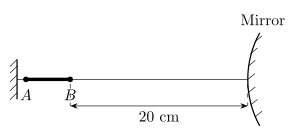
- AP EAPCET 2025Set ap-2025-05-19-FN1 markMCQQ.As shown in the figure, a rod AB of length 5 cm is placed infront of a convex mirror on its principal axis. If the radius of curvature of the mirror is 20 cm, then the length of the image of the rod is [FIGURE] (a rod AB lying along the principal axis in front of a convex mirror; the end B of the rod is shown at a distance of 20 cm from the pole of the mirror) (A) 5 cm (B) 2110 cm (C) 10 cm (D) 215 cm
›Reveal solutionSolution
For a convex mirror, the image of an extended object along the principal axis is found by locating the images of its endpoints using the mirror formula, then taking the difference of their image distances. Here, the image length is 2110 cm, so the correct option is (B).
We have a convex mirror with radius of curvature R=20 cm, so its focal length is f=2R=10 cm. For a convex mirror, the focal length is taken as positive in the standard sign convention (since the focus lies behind the mirror). The rod AB lies along the principal axis, with end B at 20 cm from the pole (so uB=−20 cm using the Cartesian sign convention: distances measured from the pole, positive in the direction of incident light, which is toward the mirror; here the object is on the left, so object distances are negative). End A is 5 cm farther from the mirror than B, so uA=−25 cm.
The mirror formula is:
v1+u1=f1
where v is the image distance (positive for virtual images behind a convex mirror).
- Image of end B For uB=−20 cm and f=+10 cm:
vB1+−201=101
vB1=101+201=202+1=203
vB=320 cm
This is positive, so the image of B is virtual, behind the mirror, at 320 cm from the pole.
- Image of end A For uA=−25 cm:
vA1+−251=101
vA1=101+251=505+2=507
vA=750 cm
Again positive, so the image of A is also virtual, behind the mirror.
- Length of the image Since both images lie on the same side of the mirror (behind it), the image of the rod is the segment between these two image points. The length is the absolute difference of their distances from the pole:
Image length=vA−vB=750−320
Compute:
750=21150,320=21140
Image length=21150−21140=2110 cm
Watch outA common mistake is to forget that the rod is along the principal axis, so its image is not simply magnified by the lateral magnification formula (which applies to objects perpendicular to the axis). Instead, we must treat each endpoint separately using the mirror formula.
TipFor an object lying along the axis, the image length is not m× object length; it's the difference in image distances. The longitudinal magnification is mL=−u2v2, but here the endpoints have different u, so it's safer to compute each v directly.
✓Final answerThe correct option is (B).
ANSWER: B
- AP EAPCET 2025Set eng-2025-05-26-AN1 markMCQQ.When an object is placed infront of a convex mirror at a distance 'u' from the pole of the mirror such that the size of the image is 'n' times that of the object, then the object distance 'u' = (A) n2f−nf (B) nf−nf (C) f−nf (D) f+n2f
›Reveal solutionSolution
Combining the mirror formula with the magnification formula for a convex mirror and solving for the object distance in terms of f and n gives u=f−f/n.
Concept and Intuition
For mirrors (New Cartesian sign convention: distances against the incident-light direction are negative; for a convex mirror f is positive; a real object always has u negative), the governing relations are:
v1+u1=f1,m=−uv
A convex mirror always forms a virtual, erect, diminished image of a real object, so its magnification is positive and less than 1 — exactly consistent with a size ratio n<1. The goal is to eliminate v between the two equations to express u purely in terms of f and n.
Step-by-Step Solution
- From the mirror formula: v1=f1−u1=fuu−f, so v=u−ffu.
- Substitute into m=−v/u: m=−u1⋅u−ffu=u−f−f=f−uf.
- Set m=n (given the image is n times the object size): n=f−uf.
- Solve for u: f−u=nf⇒u=f−nf.
- This matches option (C). (Sanity check: for n→1, u→0 — object at the pole, image same size, as expected; as n→0, u→−∞ — object very far away, image tiny, as expected.)
Common Mistakes
- Mixing up magnitude-only formulas with signed Cartesian ones, leading to a sign-flipped final expression.
- Forgetting that for a convex mirror with a real object, m is positive (erect image), not negative.
✓Final answerThe correct option is (C) — f−nf.
ANSWER: C
- AP EAPCET 2024Set eng-2024-05-20-AN1 markMCQQ.An object is placed at a distance of 18 cm in front of a mirror. If the image is formed at a distance of 4 cm on the other side, then focal length, nature of the mirror and nature of image are respectively (A) 3.14 cm, concave mirror and real image (B) 3.14 cm, convex mirror and real image (C) 5.14 cm, convex mirror and virtual image (D) 5.14 cm, concave mirror and virtual image
›Reveal solutionSolution
Applying the mirror formula with the object real (u=−18cm) and the image virtual, behind the mirror (v=+4cm) gives f≈+5.14cm — a convex mirror forming a virtual image.
Concept and Intuition
A real image can only form in front of a mirror (same side as the object); anything found behind the mirror must be virtual. Only convex mirrors (and concave mirrors with the object between pole and focus) can produce a virtual image; here we let the sign of f that comes out of the calculation tell us which mirror type is actually consistent with the data.
Step-by-Step Solution
- Sign convention: distances of real objects/images (in front, same side as incident light) are negative; distances of virtual images (behind the mirror) are positive.
- Object: real, in front, so u=−18 cm.
- Image: stated to form "on the other side," i.e., behind the mirror ⇒ virtual, so v=+4 cm.
- Mirror formula: v1+u1=f1.
41+−181=41−181=369−362=367
- f=736≈5.14 cm, and it's positive.
- In this convention, a positive focal length belongs to a convex mirror (focus behind the mirror); the image being at positive v (behind the mirror) confirms it is virtual.
Common Mistakes
- Assuming a concave mirror by default — but a positive f here rules that out; only a convex mirror (or a special concave case, which would give negative f) is consistent.
- Mixing up which side counts as positive; consistently using "real = negative, virtual = positive" for mirrors avoids the confusion.
✓Final answerThe correct option is (C) — 5.14 cm, convex mirror and virtual image.
ANSWER: C
- AP EAPCET 2023Set ap-2023-05-23-FN1 markMCQQ.The relation between focal length(f) and radius of curvature (R) of a spherical mirror is (A) R=2f (B) f=2R (C) R=f (D) R=3f
›Reveal solutionSolution
The standard paraxial-ray relation for spherical mirrors is f=R/2. Answer: (B).
Concept and Intuition
For rays close to the principal axis (paraxial approximation), a geometric analysis of reflection at a spherical mirror surface shows that the focal point lies exactly halfway between the pole and the centre of curvature.
Step-by-Step Solution
- Consider a ray parallel to the principal axis striking the mirror close to the pole and reflecting through the focus.
- Using the geometry of the mirror (radius R, centre of curvature C) and the law of reflection, for small angles the focal length works out to f=2R.
- This relation holds for both concave and convex spherical mirrors under the paraxial approximation.
Common Mistakes
- Writing R=f/2 (inverting the relation) instead of f=R/2.
- Confusing the mirror formula (f=R/2) with the analogous but different relation for thin lenses.
✓Final answerThe correct option is (B) — f=2R.
ANSWER: B
- AP EAPCET 2023Set eng-2023-05-16-AN1 markMCQQ.The image formed by a convex mirror of focal length 30 cm is a quarter of the size of the object. The distance of the object from the mirror is (A) 30 cm (B) 90 cm (C) 120 cm (D) 60 cm
›Reveal solutionSolution
Using the convex-mirror magnification relation m=x+ff with m=1/4 and f=30 cm gives an object distance of 90 cm.
Concept and Intuition
A convex mirror always forms a virtual, erect, diminished image, so its magnification m is positive and less than 1. Combining the mirror formula with the magnification definition gives a clean relation between object distance x, focal length f, and m.
Step-by-Step Solution
- Let object distance (measured as a positive magnitude) be x; using the Cartesian sign convention, u=−x, and for a convex mirror f=+30 cm.
- Mirror formula: v1+u1=f1⇒v1=f1−u1=f1+x1=fxx+f⇒v=x+ffx.
- Magnification: m=−uv=−−xfx/(x+f)=x+ff.
- Given m=41: x+ff=41⇒4f=x+f⇒x=3f.
- Substitute f=30 cm: x=90 cm.
Common Mistakes
- Using the concave-mirror sign convention or forgetting that for a convex mirror f is taken positive, which flips the algebra.
- Missing that the "quarter size" image being upright (positive m) is what confirms it's a convex mirror scenario, consistent with a straightforward positive-f formula.
✓Final answerThe correct option is (B) — 90 cm.
ANSWER: B
🎓Unlock everything free for 14 days
- ✓Full step-by-step solutions
- ✓Concept-first explanations
- ✓Methods, shortcuts & mistakes
- ✓PYQ mapping + timed mock tests
Full access for 14 days. No credit card required.