Q.Draw the circuit symbols for p-n-p and n-p-n transistors.
You're viewing a preview — the full solution, concept, methods & PYQ mapping are locked.
Start your 14-day free trial to unlock the full solution →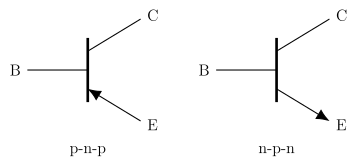
The standard transistor circuit symbol is three leads (Emitter, Base, Collector) with an arrowhead on the emitter lead; the arrow direction shows the direction of conventional current flow in normal (forward-active) operation, and is what distinguishes p-n-p from n-p-n.
A bipolar junction transistor (BJT) is drawn as three leads meeting near a short base line: the Base (B) is the short perpendicular line in the middle; the Collector (C) and Emitter (E) are the two slanted leads coming off it, with the arrowhead always drawn on the emitter lead only. The arrow shows the direction of conventional (hole) current flow across the base-emitter junction when the transistor conducts normally:
- p-n-p transistor: the emitter arrow points INWARD, toward the base (conventional current flows from the p-type emitter into the base). Structure: p-type emitter – n-type base – p-type collector.
- n-p-n transistor: the emitter arrow points OUTWARD, away from the base (conventional current flows from the base out into the n-type emitter). Structure: n-type emitter – p-type base – n-type collector. …
Unlock everything free for 14 days
- Full step-by-step solutions
- Concept-first explanations
- Methods, shortcuts & mistakes
- PYQ mapping + timed mock tests
Full access for 14 days. No credit card required.