Q.What happens to the width of depletion layer in p-n junction diode when it is -
🔒You're viewing a preview — the full solution, concept, methods & PYQ mapping are locked.
🔒 Start your 14-day free trial to unlock the full solution →Concept understanding — P N Junction Biasing
P-N Junction Biasing: The First Meeting
Imagine you have two rooms separated by a door. One room is full of people who want to leave (electrons in the N-side), and the other room is full of empty chairs (holes in the P-side). The door is initially locked — that's the depletion region, a zone with no free charges. Now, what happens if you push on the door from one side, or pull it from the other? That's exactly what biasing does to a P-N junction.
The Unbiased Junction (The Starting Point)
When you bring P-type and N-type semiconductors together, something interesting happens at the boundary. Electrons from the N-side (which has extra electrons) rush toward the P-side (which has extra holes). Holes from the P-side rush toward the N-side. They meet and recombine — an electron falls into a hole, and both disappear as free charges.
This leaves behind a region near the junction with no free charges — just fixed positive ions on the N-side (where electrons left) and fixed negative ions on the P-side (where holes left). This is the depletion region. It acts like a tiny battery: the N-side is positive relative to the P-side, creating a built-in electric field that stops further diffusion. The voltage across this region is about 0.7 V for silicon, 0.3 V for germanium.
The depletion region is not a physical gap — it's a region depleted of mobile charge carriers. The crystal is still continuous.
Forward Bias: Pushing the Door Open
Connect the positive terminal of a battery to the P-side and the negative terminal to the N-side. This is forward bias.
What happens? The external battery's positive terminal repels holes in the P-side toward the junction. The negative terminal repels electrons in the N-side toward the junction. Both carriers are pushed toward each other — they overcome the built-in electric field. The depletion region shrinks.
When the applied voltage exceeds about 0.7 V (for silicon), the depletion region becomes so thin that carriers can cross freely. A large current flows. The junction is now "on" — like a switch closed.
Never apply forward bias without a current-limiting resistor. The junction has very low resistance once forward-biased, and the current can destroy it instantly.
Reverse Bias: Pulling the Door Shut
Now reverse the battery: positive to N-side, negative to P-side. This is reverse bias.
The positive terminal attracts electrons from the N-side away from the junction. The negative terminal attracts holes from the P-side away from the junction. Both carriers are pulled apart. The depletion region widens.
The built-in electric field is now reinforced by the external field. Only a tiny current flows — the reverse saturation current, caused by thermally generated electron-hole pairs in the depletion region. This current is typically in the nanoampere range and is almost independent of the applied voltage (until breakdown).
The junction is "off" — like a switch open.
In reverse bias, the depletion region acts as an insulator. The junction blocks current flow except for a negligible leakage current.
The Precise Statement
I=IS(enkTqV−1)
This is the Shockley diode equation. Here:
- I = diode current
- IS = reverse saturation current (very small, typically 10−12 to 10−15 A for silicon)
- q = electron charge (1.6×10⁻¹⁹ C)
- V = applied voltage (positive for forward bias, negative for reverse bias)
- n = ideality factor (1 for ideal, 1–2 for real diodes)
- k = Boltzmann constant (1.38×10⁻²³ J/K) …
Why this formula?
Why a PN Junction Biases the Way It Does
A PN junction is not a resistor. Its current-voltage behaviour is fundamentally asymmetric — and that asymmetry comes directly from the physics of the depletion region and the energy barrier it creates.
The Unbiased Junction: A Built-in Barrier
When P-type and N-type semiconductors are joined, holes from the P-side diffuse into the N-side, and electrons from the N-side diffuse into the P-side. This diffusion leaves behind fixed, charged ions: negative acceptor ions on the P-side, positive donor ions on the N-side. These ions create an electric field that opposes further diffusion.
The result is a depletion region — a zone with no free carriers — and a built-in potential V0 across it. This potential acts as an energy barrier that prevents net current flow at equilibrium.
At equilibrium (zero bias), the net current is zero. The diffusion current (due to concentration gradient) is exactly balanced by the drift current (due to the built-in electric field).
Forward Bias: Lowering the Barrier
Apply a positive voltage V to the P-side relative to the N-side. This external voltage opposes the built-in potential. The net barrier becomes:
Vnet=V0−V
The depletion width shrinks. More importantly, the energy barrier for majority carriers (holes from P-side, electrons from N-side) is reduced. A larger number of carriers now have enough energy to cross the junction.
The current that flows is diffusion current — carriers injected across the junction become minority carriers on the other side, where they recombine. The relationship is exponential because the number of carriers with energy above the barrier follows a Boltzmann distribution.
I=I0(eqV/kT−1)
Here I0 is the reverse saturation current (very small), q is the electron charge, k is Boltzmann's constant, and T is absolute temperature.
Why the exponential? The fraction of carriers with enough energy to surmount a barrier of height q(V0−V) is proportional to e−q(V0−V)/kT. At equilibrium (V=0), this gives a current that exactly cancels the drift current. When V>0, the barrier drops, and the net current becomes proportional to eqV/kT.
Reverse Bias: Raising the Barrier
Apply a negative voltage to the P-side relative to the N-side. Now the external voltage adds to the built-in potential:
Vnet=V0+VR
The barrier becomes higher. The depletion region widens. Diffusion of majority carriers is almost completely suppressed. The only current that flows is a tiny reverse saturation current I0, carried by minority carriers (electrons from the P-side, holes from the N-side) that are swept across by the electric field.
This current is essentially constant with voltage because the number of minority carriers is fixed by thermal generation — it does not depend on the barrier height once the barrier is large enough to block majority carriers. …
The width of the depletion layer at a p-n junction changes depending on whether the junction is forward or reverse biased. …
Forward bias narrows the depletion layer (allowing current to flow easily); reverse bias widens it (blocking current flow).
At a p-n junction, diffusion of majority carriers across the junction leaves behind a narrow region depleted of free charge carriers, called the depletion layer, with an associated built-in potential barrier.
(i) Forward bias — the p-side is connected to the positive terminal and n-side to the negative terminal of the battery. The applied voltage opposes the built-in barrier potential, so the effective barrier is reduced. This causes the depletion layer to become thinner (narrower), and majority carriers can cross the junction easily once the width becomes negligible, allowing a large current to flow.
…
Showing the 12 most recent of 21 on this concept.
- CBSE 2026Set 55/2/11 markMCQQ.Two statements are given – one labelled Assertion (A) and the other Reason (R). Select the correct answer from the codes below: (A) Both (A) and (R) are true and (R) is the correct explanation of (A). (B) Both (A) and (R) are true, but (R) is not the correct explanation of (A). (C) (A) is true, but (R) is false. (D) (A) is false and (R) is also false. Assertion (A) : On forward biasing a p-n junction diode, the height of the barrier potential increases. Reason (R) : In forward biasing of a p-n junction diode, the direction of the applied voltage is in the same direction as the built-in potential.
›Reveal solutionSolution
The assertion is false because forward biasing decreases the barrier height, not increases it. The reason is also false because the applied voltage opposes the built-in potential, not aligns with it. Hence both statements are false.
The Concept: Barrier Potential in a p-n Junction
A p-n junction has a depletion region at the interface, where mobile charge carriers have recombined, leaving behind fixed positive ions on the n-side and fixed negative ions on the p-side. This creates an internal electric field pointing from n to p, which gives rise to a built-in potential (or barrier potential) Vb. This barrier prevents further diffusion of majority carriers across the junction.
Now, what happens when we apply an external voltage?
Forward bias means connecting the positive terminal of the battery to the p-side and the negative terminal to the n-side. The applied voltage Vf creates an electric field that opposes the built-in field. The net field across the depletion region decreases, the depletion width shrinks, and the barrier height reduces to Vb−Vf.
Reverse bias does the opposite: the applied field adds to the built-in field, increasing the barrier height to Vb+Vr.
So the key idea is simple: forward bias lowers the barrier; reverse bias raises it.
Step-by-Step Analysis
1. Examine the Assertion (A):
"On forward biasing a p-n junction diode, the height of the barrier potential increases."
This directly contradicts the physics we just discussed. In forward bias, the applied voltage reduces the net potential across the depletion region. The barrier height decreases, not increases. Therefore, Assertion (A) is false.
Watch outA common mistake is to think that "forward" means the voltage is pushing carriers forward over the barrier, so the barrier must be higher to stop them. Actually, forward bias helps carriers cross by lowering the barrier — that's why current flows easily.
2. Examine the Reason (R): …
- CBSE 2026Set 55/3/11 markMCQQ.The process named 'minority carrier injection' in a p-n junction diode occurs during : (A) forward biasing (B) reverse biasing (C) no biasing at low temperature (D) no biasing at high temperature
›Reveal solutionSolution
Minority carrier injection happens when a p-n junction is forward biased — the applied voltage reduces the barrier, allowing majority carriers from each side to cross over and become minority carriers on the other side. The correct answer is (A) forward biasing.
The core concept: what "minority carrier injection" really means
In a p-n junction, the p-side has holes as majority carriers and electrons as minority carriers; the n-side has electrons as majority and holes as minority. At equilibrium (no bias), the built-in potential barrier prevents net flow — only a tiny leakage current of minority carriers drifts across.
"Minority carrier injection" is the process where majority carriers from one side are forced across the junction into the opposite side, where they become minority carriers. This is not a spontaneous event — it requires an external voltage to overcome the barrier.
Why forward bias is the only condition that does this
1. Forward bias (p-side positive, n-side negative):
The applied voltage opposes the built-in potential, reducing the barrier height. Majority carriers (holes from p-side, electrons from n-side) now have enough energy to diffuse across the junction. Once across, each hole finds itself surrounded by electrons on the n-side — it is now a minority carrier there. Similarly, electrons that cross become minority carriers on the p-side. This flood of excess minority carriers is precisely what "minority carrier injection" means. The injected carriers then recombine gradually, producing the forward current.
2. Reverse bias (p-side negative, n-side positive):
The applied voltage adds to the built-in potential, making the barrier even larger. Majority carriers cannot cross. The only current is a tiny reverse saturation current due to the existing minority carriers being swept across by the electric field — no new minority carriers are injected. In fact, any minority carriers that do appear are quickly removed, not injected.
3. No biasing (at any temperature):
Without an external voltage, the junction is in equilibrium. The net current is zero. There is no net injection — the small number of minority carriers that diffuse across are exactly balanced by the drift current. Temperature affects the intrinsic carrier concentration, but it does not cause injection; it only changes the equilibrium concentrations.
Watch outA common mistake is to think that reverse bias also injects minority carriers because current still flows. That current comes from already present minority carriers being pulled across, not from majority carriers being forced over. Injection specifically means majority carriers become minority carriers on the other side — that only happens in forward bias.
Step-by-step reasoning …
- CBSE 2026Set ANNUAL1 markQ.Fill in the blank: For germanium diode threshold voltage is nearly ______ volt.
›Reveal solutionSolution
Germanium diode threshold voltage ≈ 0.3 V (silicon is ≈ 0.7 V).
The threshold (knee or cut-in) voltage of a diode is the minimum forward voltage at which the diode starts conducting appreciably. This value depends on the semiconductor's band gap. For germanium (smaller band gap) it …
- CBSE 2025Set D1 markMCQQ.Reverse biased diode is (A) Zener diode (B) LED (C) Photodiode (D) both (A) and (C)
›Reveal solutionSolution
A Zener diode works in its reverse breakdown region and a photodiode operates in reverse bias, so both are reverse-biased devices.
A Zener diode is specially designed to operate in the reverse breakdown region; as a voltage regulator it is connected in reverse bias so it maintains a constant voltage.
…
- CBSE 2025Set ANNUAL1 markQ.Which type of biasing gives a semiconductor diode a very high resistance?
›Reveal solutionSolution
Applying a reverse bias (p-side connected to the negative terminal, n-side to positive) pulls majority carriers further away from the junction, widening the depletion layer and hugely increasing the diode's resistance.
A p-n junction diode can be biased two ways:
- Forward bias (p-side to +, n-side to -): narrows the depletion region, lowers the junction's resistance, and allows a large current to flow once the barrier potential is overcome.
- Reverse bias (p-side to -, n-side to +): pulls majority carriers away from the junction, widening the depletion region and greatly increasing the junction's resistance - only a very small reverse saturation (leakage) current flows, mainly due to minority carriers. …
- CBSE 2025Set ANNUAL1 markMCQQ.Applying forward bias in p-n junction, the potential barrier :(a) decreases.(b) increases.(c) remains unchanged.(d) becomes zero.
›Reveal solutionSolution
Forward bias applies an external voltage that opposes the built-in potential barrier at the p-n junction, reducing its effective height and allowing majority carriers to cross easily.
At an unbiased p-n junction, diffusion of majority carriers across the junction creates a depletion region and a built-in potential barrier. When forward biased (p-side connected to positive terminal, n-side to negative), the applied electric field opposes the internal field of the junction. This narrows the depletion region and **lowers the poten …
- CBSE 2025Set ANNUAL1 markMCQQ.When a junction diode is reverse biased, the flow of current across the junction is mainly due to:(a) diffusion of charges(b) depends on the nature of material(c) drift of charges(d) both drift and diffusion of charges.
›Reveal solutionSolution
Under reverse bias, the small current across a p-n junction is due to drift of minority charge carriers, not diffusion.
In a p-n junction under forward bias, majority carriers diffuse across the junction and diffusion current dominates. Under reverse bias, the applied field opposes diffusion of majority carriers (almost completely stopped), but assists the motion of the minority carriers (electrons in the p-side, holes in the n-side) that are thermally generated near the jun …
- CBSE 2024Set 55/2/11 markMCQQ.When a p-n junction diode is subjected to reverse biasing : (A) the barrier height decreases and the depletion region widens. (B) the barrier height increases and the depletion region widens. (C) the barrier height decreases and the depletion region shrinks. (D) the barrier height increases and the depletion region shrinks.
›Reveal solutionSolution
In reverse bias, the external voltage adds to the built-in potential, raising the barrier height and pushing carriers away, which widens the depletion region. The correct option is (B).
The Concept: What Reverse Bias Does to a p-n Junction
A p-n junction diode has a natural built-in potential (barrier) at the junction, formed by the diffusion of holes from the p-side and electrons from the n-side. This creates a depletion region — a zone depleted of free charge carriers, containing only fixed ions. The barrier height is the voltage that opposes further diffusion.
When you apply reverse bias (positive terminal to n-side, negative to p-side), the external voltage acts in the same direction as the built-in field. It doesn't "help" current flow; instead, it reinforces the barrier. Think of it like pushing a door that's already closed — the door becomes harder to open.
Step-by-Step Reasoning
-
Barrier height increases
The built-in potential V0 is fixed by doping. Reverse bias adds an external voltage VR across the junction, so the total barrier becomes V0+VR. This is larger than V0, so the barrier height increases.
-
Depletion region widens
The stronger electric field pulls majority carriers (holes on p-side, electrons on n-side) further away from the junction. More fixed ions are uncovered, so the depletion region expands on both sides. The width W is proportional to V0+VR, so it widens with increasing reverse bias.
-
What about current? …
-
- CBSE 2024Set ANNUAL1 markQ.Which type of biasing gives a semiconductor diode very high resistance?
›Reveal solutionSolution
Reverse bias widens the depletion region, giving very high resistance to current flow.
When a p-n junction diode is reverse biased, the applied voltage widens the depletion region and increases the potential barrier at the junction, sweeping the majority carriers further away from the junction. This makes the junction offer an extremely high resistance to the flow of (majority-carrier) current, allowing only a very small, nearly-constant reverse saturation current (due to minority carr …
- CBSE 2023Set 55/3/11 markMCQQ.If a p-n junction diode is reverse biased,(a) the potential barrier is lowered.(b) the potential barrier remains unaffected.(c) the potential barrier is raised.(d) the current is mainly due to majority carriers.
›Reveal solutionSolution
Reverse bias raises the potential barrier across a p-n junction by widening the depletion region, making it harder for majority carriers to cross — so the correct option is (C).
Concept and Intuition
A p-n junction diode has a potential barrier (also called the built-in potential) at the junction. This barrier exists because, at equilibrium, diffusion of majority carriers (holes from p-side, electrons from n-side) creates a depletion region with an internal electric field that opposes further diffusion. The height of this barrier is determined by the doping concentrations and temperature — it’s fixed for a given diode at equilibrium.
Now, what happens when you apply an external voltage? The key idea is that the external bias either opposes or aids the internal electric field. In reverse bias, the positive terminal of the battery is connected to the n-side and the negative terminal to the p-side. This external field points in the same direction as the internal field — from n to p. So the net field across the junction increases, pulling more majority carriers away from the junction. This widens the depletion region and raises the potential barrier.
In contrast, forward bias reduces the barrier. And current in reverse bias is due to minority carriers (not majority), which is very small (leakage current).
Watch outCommon Mistake
Many students think reverse bias "lowers" the barrier because they confuse it with forward bias. Remember: reverse bias = barrier raised; forward bias = barrier lowered.
Step-by-Step Reasoning
-
Recall the equilibrium condition: At zero bias, the p-n junction has a built-in potential barrier V0 (typically ~0.7 V for silicon). This barrier prevents net current flow.
-
Apply reverse bias: Connect the positive terminal of a battery to the n-side and negative to the p-side. The external voltage VR creates an electric field from n to p — same direction as the internal field.
-
Effect on the depletion region: The external field adds to the internal field, pulling holes (on p-side) further away from the junction and electrons (on n-side) further away. This widens the depletion region. …
-
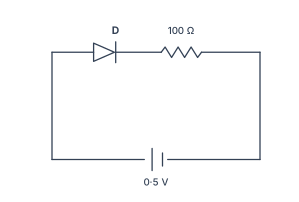
- CBSE 2023Set 55/4/11 markMCQQ.The threshold voltage for a p-n junction diode used in the circuit is 0.7 V. The type of biasing and current in the circuit are : (A) Forward biasing, 0 A (B) Reverse biasing, 0 A (C) Forward biasing, 5 mA (D) Reverse biasing, 2 mA
›Reveal solutionSolution
The diode is forward-biased because the battery’s positive terminal connects to the p-side and negative to the n-side. However, the applied voltage (0.5 V) is less than the threshold voltage (0.7 V), so the diode remains in the “off” state and no current flows. The correct choice is (A).
Figure — CBSE 2023 55/4/1 Q15
The concept: Why a diode doesn’t conduct below its threshold
A p-n junction diode is not a perfect switch that turns on the instant you apply any forward voltage. In forward bias, the external voltage must overcome the built-in potential barrier (about 0.7 V for silicon) before significant current can flow. Below that threshold, the diode’s resistance is extremely high — effectively an open circuit. This is why the circuit current is zero when the battery supplies only 0.5 V.
Watch outA common mistake is to assume that any forward bias automatically produces current. In reality, the diode conducts only when the applied voltage exceeds the threshold (knee) voltage — typically 0.7 V for silicon.
Step-by-step reasoning
-
Identify the biasing from the circuit diagram
The diode symbol shows the p-side (anode) connected to the positive terminal of the 0.5 V cell, and the n-side (cathode) connected to the negative terminal. This is the standard forward-bias configuration: the external field opposes the built-in field, reducing the barrier.
-
Check the applied voltage against the threshold
The battery supplies only 0.5 V. The diode’s threshold voltage is given as 0.7 V. Since 0.5<0.7, the applied voltage is insufficient to overcome the barrier.
-
Determine the diode’s state …
-
- CBSE 2023Set ANNUAL1 markQ.Is the Junction diode D forward or reverse biased in the given diagram?

›Reveal solutionSolution
The anode (p-side) of D is connected (through R) to the higher potential (+5 V) terminal and the cathode (n-side) to the lower potential (+2 V) terminal, so D is forward biased.
A junction diode conducts easily (is forward biased) when its p-side (anode) is at a higher potential than its n-side (cathode). Here the anode of D is joined through the resistor R to the +5 V terminal, while the cathode is joined to the +2 V terminal. Since +5 V > +2 V, the anode side is …
🎓Unlock everything free for 14 days
- ✓Full step-by-step solutions
- ✓Concept-first explanations
- ✓Methods, shortcuts & mistakes
- ✓PYQ mapping + timed mock tests
Full access for 14 days. No credit card required.