Q.To ensure almost 100 per cent transmittivity, photographic lenses are often coated with a thin layer of dielectric material. The refractive index of this material is intermediated between that of air and glass (which makes the optical element of the lens). A typically used dielectric film is MgF2 (n=1.38). What should the thickness of the film be so that at the center of the visible speetrum (5500 A˚) there is maximum transmission.
🔒You're viewing a preview — the full solution, concept, methods & PYQ mapping are locked.
🔒 Start your 14-day free trial to unlock the full solution →Concept understanding — Index Matching
Index Matching
In ray optics, index matching means bringing two materials into contact so their refractive indices are equal (or very nearly equal). When n1=n2 across a boundary, the boundary becomes optically invisible — light passes through as if the interface were not there at all.
Why a mismatched interface bends and reflects light
Whenever light crosses a boundary between media of index n1 and n2, two things happen:
- Refraction, governed by Snell's law:
n1sinθ1=n2sinθ2
- Partial reflection. For light at normal incidence, the fraction reflected is
R=(n2+n1n2−n1)2
Both effects are driven by the difference n2−n1: a bigger mismatch means more bending and more reflected light.
What happens when the indices match
As n2→n1:
- Snell's law gives sinθ1=sinθ2, so θ1=θ2 — the ray does not bend.
- The reflection formula gives R=0 — no light is reflected.
When n1=n2: the ray continues undeviated and the reflected intensity is zero. The interface transmits light as though it were absent.
The classic demonstration — the "disappearing" glass rod
Drop a clear glass rod into water: you still see it, because glass (n≈1.5) and water (n≈1.33) differ, so light reflects and refracts at the glass surface. But immerse the same rod in a liquid tuned to exactly n=1.5 (a glycerine mixture, for example), and the submerged part vanishes from view — with no index difference, its surfaces no longer signal their presence to your eye.
Index matching does not make the glass transparent — it already was. It removes the surface effects (reflection and refraction) by erasing the index difference at the boundary.
Where it is used
- Oil-immersion microscopes: immersion oil (n≈1.5) fills the gap between slide and objective that air would otherwise leave, removing reflection/refraction losses and letting steeply angled rays enter — sharpening the image.
- Optical-fibre splices: an index-matching gel between two fibre ends removes the air gap so almost no signal reflects back at the joint. …
Why this formula?
Index Matching: Why the Formula Holds
Index matching is a powerful technique in combinatorics and probability — it's used to simplify sums over complicated index sets by cleverly re-indexing or pairing terms. The core idea is to match indices so that a double sum (or product) collapses into a simpler expression.
Let's build the reasoning step by step.
The Core Formula
The most common index matching identity is:
∑i=1n∑j=1naibj=(∑i=1nai)(∑j=1nbj)
This looks trivial — it's just the distributive law. But the why matters for deeper applications.
Why It Holds: The Distributive Law in Action
Step 1: Expand the outer sum
The left side means: for each fixed i, sum over all j, then sum over i.
∑i=1n(∑j=1naibj)
Step 2: Factor out ai from the inner sum
Since ai does not depend on j, it can be pulled out:
∑i=1n(ai⋅∑j=1nbj)
Step 3: The inner sum is constant with respect to i
Let Sb=∑j=1nbj. Then:
∑i=1nai⋅Sb=Sb⋅∑i=1nai
Step 4: Recognize the product
This is exactly:
(∑i=1nai)(∑j=1nbj)
Key insight: The double sum over all n2 pairs (i,j) is just the product of the two separate sums. This works because the terms factor as aibj — no cross-dependence between i and j.
Why This Matters for Exam Problems
Index matching is used when you have double sums with constraints (like i<j or i=j). The trick:
- Start with the unconstrained double sum (all i,j)
- Subtract the diagonal terms (i=j) or the off-diagonal terms
- Use index matching to simplify
Example: Sum over i<j
We want ∑1≤i<j≤naibj.
Derivation:
∑i=1n∑j=1naibj=∑i=1n∑j=1i−1aibj+∑i=1naibi+∑i=1n∑j=i+1naibj
The first and third terms are symmetric (just swap i and j). So:
(∑ai)(∑bj)=∑i=1naibi+2∑i<jaibj
Thus:
i<j∑aibj=21[(∑ai)(∑bj)−∑aibi]
Why this works: The unconstrained double sum counts each unordered pair (i,j) twice (once as (i,j) and once as (j,i)), except the diagonal which appears once. Index matching lets us express the constrained sum in terms of the product.
The Deeper "Why": Symmetry and Factorization
The real power of index matching comes from symmetry: …
The key idea is thin-film interference for anti-reflection coatings. Maximum transmission occurs when reflected light from the air-film and film-glass interfaces interferes destructively, cancelling the reflection.
- For normal incidence, a phase change of π (half-wavelength) occurs at both reflections (air to film, film to glass) because the film index n=1.38 lies between air (n=1) and glass (n≈1.5). The two reflected waves are thus in phase at the point of reflection.
- To get destructive interference, the extra path travelled inside the film must be an odd multiple of half-wavelengths in the film: 2t=(m+21)λfilm, where λfilm=λ0/n and λ0=5500 A˚. …
For maximum transmission of light through a coated lens, we need destructive interference in the reflected light. This happens when the optical path difference in the film equals half a wavelength, leading to a minimum film thickness of t=4nλ. For λ=5500 A˚ and n=1.38, the required thickness is t≈996 A˚.
The problem is about anti-reflection coatings — a beautiful application of wave optics. When light hits a lens surface, about 4% of it reflects off each air-glass interface. For a multi-element lens, this adds up to significant light loss and glare. The trick is to deposit a thin transparent film whose refractive index lies between that of air (n=1) and glass (n≈1.5). Here, MgF2 with n=1.38 is used.
Why does this work? Light reflects from two interfaces: air-to-film and film-to-glass. If these two reflected waves are exactly out of phase (by half a wavelength), they cancel each other — destructive interference. That reflected energy is not lost; it is redirected into the transmitted beam, boosting transmission. The condition for cancellation depends on the film thickness and the wavelength.
Let’s work through the calculation step by step.
-
Identify the phase changes on reflection.
When light reflects off a boundary from a lower to a higher refractive index, it undergoes a phase shift of π (equivalent to an extra path of λ/2). From air (n=1) to MgF2 (n=1.38), the index increases, so the first reflected wave gets a π shift. From MgF2 to glass (n≈1.5), the index again increases, so the second reflected wave also gets a π shift. Both reflections suffer the same phase change — so the net phase difference between them comes only from the extra distance travelled by the second wave inside the film.
-
Set up the condition for destructive interference.
The second reflected wave travels an extra distance of 2t (down and back through the film). Inside the film, the wavelength is λ/n, where λ is the vacuum wavelength. So the optical path difference (OPD) is 2nt. For destructive interference, this OPD must equal an odd multiple of half-wavelengths in vacuum:
2nt=(m+21)λ,m=0,1,2,…
The smallest thickness (for m=0) gives the thinnest effective coating.
- Solve for the thickness. …
Method: Finding Anti-Reflection Coating Thickness (Quarter-Wave Condition)
Use this method for any thin-film problem asking for the coating thickness that
gives maximum transmission (equivalently, minimum reflection) at a stated
wavelength.
Steps
Step 1: Work out the phase shift at each reflecting interface
Light reflects at two interfaces: air→film and film→substrate (e.g. glass). A
reflection off a boundary where the index INCREASES (going from lower to
higher n) carries an extra phase shift of π (equivalent to λ/2 of
path); a reflection off a boundary where the index DECREASES carries no such
shift. Check both interfaces:
- If the film's index lies between the two neighbouring media (as it does for a coating chosen to sit between air and glass), BOTH reflections see an index increase, so BOTH pick up the same π shift — these cancel out of the net phase comparison, leaving only the path travelled inside the film to matter.
Step 2: Write the optical path difference between the two reflected waves
The second reflected wave travels an extra distance 2t inside the film
(down to the second interface and back), so its optical path length is 2nt
(using the film's own refractive index n, since light travels at c/n
inside it).
Step 3: Set the destructive-interference condition
Because both reflections carried the same π phase shift (Step 1), those
shifts cancel between the two reflected waves, and the interference condition
depends only on the path travelled in the film. For the reflected light to
cancel (destructive interference in reflection = maximum transmission), the …
- AP EAPCET 2026Set eng-2026-05-18-FN1 markMCQQ.A convex lens of refractive index 23 has a power of 5 D. If it is placed in a liquid of refractive index 2, the new power of the lens is (A) 2.5 D (B) 1.25 D (C) -1.25 D (D) -2.5 D
›Reveal solutionSolution
This tests the lens maker's formula when a lens is immersed in a medium denser than the lens material itself. Answer: power becomes -2.5 D (the lens becomes diverging).
Concept and Intuition
A lens's focal power depends on the relative refractive index of the lens material to its surrounding medium, not the lens's refractive index alone. If a lens is placed in a medium with a higher refractive index than the lens itself (here, lens μ=1.5 vs liquid μ=2), the relative refractive index becomes less than 1, and a convex lens actually behaves like a diverging lens — this is the classic 'lens becomes invisible/inverts behaviour' phenomenon.
Step-by-Step Solution
- Lens maker's formula: f1=(μmediumμlens−1)(R11−R21).
- In air (μmedium=1): Pair=fair1=(μlens−1)(R11−R21).
- Given Pair=5 D and μlens=1.5: 5=(1.5−1)(R11−R21)⇒(R11−R21)=0.55=10. …
- AP EAPCET 2025Set ap-2025-05-19-AN1 markMCQQ.The focal length of a convex lens immersed in a liquid of refractive index 1.2 is f1 and its focal length when immersed in another liquid of refractive index 1.25 is f2. If the refractive index of the material of the lens is 1.5, then f1:f2= (A) 6 : 5 (B) 4 : 5 (C) 3 : 5 (D) 2 : 5
›Reveal solutionSolution
The lens maker's formula in a surrounding medium replaces "nlens−1" with "(nlens/nmedium)−1"; comparing the two liquids gives f1:f2=4:5.
Concept and Intuition
A lens's focal length depends not just on its own refractive index but on the relative refractive index between the lens material and whatever medium surrounds it. Immersing the same lens in two different liquids changes the relative index, and hence the focal length, even though the lens's shape (its radii of curvature) stays the same.
Step-by-Step Solution
- Lens maker's formula (in a medium): f1=(nmediumnlens−1)k, where k=R11−R21 is fixed by the lens's shape.
- In liquid 1 (n=1.2): f11=(1.21.5−1)k=(1.25−1)k=0.25k.
- In liquid 2 (n=1.25): f21=(1.251.5−1)k=(1.2−1)k=0.2k. …
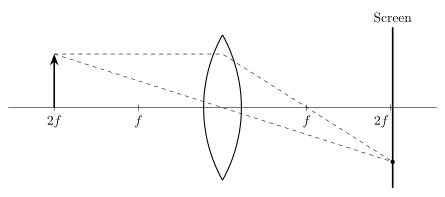
- AP EAPCET 2025Set ap-2025-05-20-FN1 markMCQQ.The formation of a real image using a biconvex lens of material of refractive index 1.5 is shown in the figure. [FIGURE] (a ray diagram of a biconvex lens with an object, drawn as an upward-pointing arrow, placed on the left at the marked distance 2f from the lens; two rays are drawn from the tip of the object passing through/around the lens and converging on a screen placed on the right side, beyond the marked 2f position on that side; the principal focus points f and 2f are marked on the principal axis on both sides of the lens) If this setup is immersed in water (refractive index = 34), then (A) the image disappears from the screen. (B) the image is magnified. (C) the image will be real and erect. (D) no change in the nature of the image.
›Reveal solutionSolution
Immersing the lens in water reduces its refractive power, quadrupling its focal length; the object (fixed at the original 2fair) now lies inside the new (larger) focal length, so no real image forms on the screen — it disappears.
Concept and Intuition
A lens's power comes not from its own refractive index alone, but from the relative refractive index between the lens material and the surrounding medium (lensmaker's equation: f1=(nmediumnlens−1)(R11−R21)). Surrounding a glass lens with water (whose refractive index is much closer to glass's than air's is) sharply reduces this relative index difference, weakening the lens and increasing its focal length. If the focal length grows enough that the (fixed) object distance becomes smaller than the new focal length, the lens can no longer converge the rays to a real image at all.
Step-by-Step Solution
- Lensmaker's equation: f1=(nmediumnlens−1)(R11−R21). The geometric factor (R11−R21) is fixed by the lens shape and doesn't change.
- In air (nmedium=1): relative-index factor =1.5−1=0.5.
- In water (nmedium=4/3): relative-index factor =4/31.5−1=1.125−1=0.125.
- Since f1∝ this factor, fairfwater=0.1250.5=4, so fwater=4fair — the focal length quadruples.
- In the original air setup, the object was at 2fair from the lens (as shown in the figure), forming a real image at 2fair on the screen side.
- In water, the same physical object distance is still 2fair, but the new focal length is fwater=4fair. Since 2fair<4fair, the object now lies inside the (new, larger) focal length of the lens. …
- AP EAPCET 2025Set eng-2025-05-24-FN1 markMCQQ.The ratio of the focal lengths of a convex lens when kept in air and when it is immersed in a liquid is 1:2. If the refractive index of the material of the lens is 1.5, then the refractive index of the liquid is (A) 1.20 (B) 1.30 (C) 1.25 (D) 1.35
›Reveal solutionSolution
This tests the lens-maker's formula with a surrounding medium other than air. Solving the ratio of focal lengths gives the liquid's refractive index as nliq=1.20.
Concept and Intuition
A lens only bends light because its refractive index differs from that of its surroundings. When a lens of index n is immersed in a medium of index nm, its effective 'relative' index becomes n/nm, and its power scales accordingly: f1=(nmn−1)(R11−R21). If the liquid's index is closer to the lens's own index, the lens becomes 'weaker' (larger focal length) — which is exactly what a longer fliquid tells us here.
Step-by-Step Solution
- Let K=R11−R21 (same for both cases, since the lens shape doesn't change).
- In air: fair1=(n−1)K=(1.5−1)K=0.5K.
- In liquid: fliq1=(nliqn−1)K.
- Given fliqfair=21, so fairfliq=2, i.e. 1/fliq1/fair=2. …
- AP EAPCET 2024Set eng-2024-05-18-FN1 markMCQQ.The focal length of a thin converging lens in air is 20 cm. When the lens is immersed in a liquid, it behaves like a concave lens of power 1 D. If the refractive index of the material of the lens is 1.5, the refractive index of the liquid is (A) 35 (B) 34 (C) 45 (D) 47
›Reveal solutionSolution
Using the lensmaker's equation in air to fix the lens's geometric factor, then applying it again in the liquid (where the lens turns diverging) pins down the liquid's refractive index as 5/3.
Concept and Intuition
A converging lens can flip to a diverging one when placed in a medium whose refractive index exceeds the lens material's own index — because then the "relative" refractive index term (nlens/nmedium−1) becomes negative even though the lens shape is unchanged.
Step-by-Step Solution
- In air: fair1=(nL−1)(R11−R21), with fair=0.2 m, nL=1.5:
0.21=0.5(R11−R21)⇒(R11−R21)=10 m−1
- In liquid, the lens behaves as a diverging lens of power 1 D, so fliq=−1 m. …
- AP EAPCET 2024Set eng-2024-05-22-AN1 markMCQQ.When a convex lens is immersed in a liquid of refractive index equal to 80% of the refractive index of the material of the lens, the focal length of the lens increases by 100%. The refractive index of the liquid is (A) 1.27 (B) 1.2 (C) 1.33 (D) 1.4
›Reveal solutionSolution
Apply the lensmaker's formula both in air and in the liquid, use the given ratio of focal lengths to solve for the lens's refractive index, then get the liquid's index from the given 80% relation.
Concept and Intuition
A lens's focal length depends on the relative refractive index between the lens material and the surrounding medium: f1=(nmediumnlens−1)(R11−R21). Immersing a lens in a medium with a refractive index closer to the lens's own index reduces this relative index, which weakens the lens (increases its focal length) — exactly what's described here.
Step-by-Step Solution
- Let n be the lens's refractive index; the liquid's index is nliq=0.8n.
- In air: fair1=(n−1)K, where K=R11−R21.
- In liquid: fliq1=(0.8nn−1)K=(1.25−1)K=0.25K. …
- AP EAPCET 2023Set ap-2023-05-22-AN1 markMCQQ.A thin oil layer floats on water. A ray of light making an angle of incidence of 45∘ shines on oil layer. The angle of refraction of light ray in water is (μoil=1.54, μwater=1.33) (A) sin−1(323) (B) sin−1(323) (C) sin−1(329) (D) sin−1(329)
›Reveal solutionSolution
With parallel interfaces, the intermediate oil layer drops out of Snell's law entirely — apply it directly between air and water.
Concept and Intuition
When light passes through several parallel-faced media (air → oil → water, with the two interfaces parallel to each other), Snell's law applied at each interface can be chained together, and the intermediate refractive index always cancels: n1sinθ1=n2sinθ2=n3sinθ3 reduces to n1sinθ1=n3sinθ3 directly. So the oil's refractive index is a distractor here.
Step-by-Step Solution
- Apply Snell's law directly from air to water (skipping oil since faces are parallel): 1×sin45∘=1.33×sinθw.
- sin45∘=22≈0.7071.
- sinθw=4/30.7071=43×0.7071=832.
- Note (832)2=649×2=6418=329, so sinθw=9/32.
- θw=sin−19/32.
Common Mistakes …
- AP EAPCET 2022Set eng-2022-07-05-FN1 markMCQQ.A needle is lying at the bottom of a water tank of height 12 cm. The apparent depth of the needle measured by a microscope is 9 cm. If the water is replaced by a liquid of refractive index of 1.5 of same height, the distance through which the microscope has to be moved to focus the needle again is (A) 1.2 cm (B) 1.1 cm (C) 1 cm (D) 1.33 cm
›Reveal solutionSolution
This tests apparent-depth refraction: apparent depth = real depth /μ. Comparing the two apparent depths gives the distance the microscope must move.
Concept and Intuition
When you view an object at the bottom of a medium from air, refraction makes it appear closer to the surface than it really is: apparent depth =μreal depth. A microscope focused on the needle must be positioned exactly at this apparent-depth distance above the true bottom. If the medium (and hence μ) changes while the real depth stays the same, the apparent depth changes, and the microscope has to be re-positioned by the difference between the two apparent depths.
Step-by-Step Solution
- Real depth of tank, h=12 cm.
- With water: apparent depth =9 cm ⇒μwater=h/9=12/9=4/3 (consistent with water's known refractive index).
- Liquid is replaced (same real depth h=12 cm), μliquid=1.5.
- New apparent depth =h/μliquid=12/1.5=8 cm.
- The needle's image has shifted from "9 cm below the surface" to "8 cm below the surface" — i.e. it appears to rise by 9−8=1 cm. …
- AP EAPCET 2021Set eng-2021-08-25-FN1 markMCQQ.A thin lens of refractive index 1.5 has optical power of −5 Diopter in air. Its optical power in a liquid medium with refractive index 1.6 is ________ Diopter (A) 1 (B) 2 (C) 4 (D) 3
›Reveal solutionSolution
A lens's power scales with (nlens/nmedium−1), not with (nlens−1) alone. Immersing a lens in a medium whose refractive index is close to the lens's own index sharply reduces (and can even reverse the sign of) its power. Here the power in the 1.6-index liquid works out to about 1 D.
Concept and Intuition
The lensmaker's equation, f1=(nmediumnlens−1)(R11−R21), shows that a lens's power depends on the refractive index of the lens relative to its surroundings, not on the lens index alone. The geometric term (R11−R21) never changes (same physical lens), so power in any medium can be found by scaling the air-power by the ratio of the two (nrel−1) factors. When the surrounding medium's index approaches the lens's own index, (nrel−1)→0 and the lens's power collapses towards zero (it stops behaving like a lens at all when the indices match).
Step-by-Step Solution
- In air: Pair=(nlens−1)G=(1.5−1)G=0.5G=−5 D⇒G=−10 (in the appropriate units), where G=R11−R21.
- In the liquid: relative index nrel=nliquidnlens=1.61.5, which is less than 1 (liquid index exceeds lens index), so (nrel−1) is negative — a lens that was diverging in air can become converging in a denser medium. …
🎓Unlock everything free for 14 days
- ✓Full step-by-step solutions
- ✓Concept-first explanations
- ✓Methods, shortcuts & mistakes
- ✓PYQ mapping + timed mock tests
Full access for 14 days. No credit card required.