Q.In a Young's double slit experiment, the source is white light. One of the holes is covered by a red filter and another by a blue filter. In this case
Concept understanding — Double Slit Interference
Double Slit Interference: From Ripples to Light
Imagine dropping two stones into a still pond at the same time, a short distance apart. Watch the ripples spread. Where a crest from one stone meets a crest from the other, the water rises higher. Where a crest meets a trough, the water flattens out. That is interference — waves adding or cancelling.
Now replace the water with light. Replace the stones with two narrow slits cut into a barrier. Shine a single colour of light (say, red laser light) onto the slits. On a screen behind the barrier, you do not see two bright spots. Instead, you see a pattern of alternating bright and dark bands — like a striped zebra crossing made of light.
That pattern is double slit interference. It is the single most convincing proof that light behaves as a wave.
The Core Idea
Light from a single source passes through two narrow slits. Each slit acts as a new source of waves. These two sets of waves spread out and overlap. At any point on the screen, the light you see is the sum of the waves from slit 1 and slit 2.
Whether they add (bright) or cancel (dark) depends on one thing: the path difference — how much farther one wave has travelled compared to the other.
For constructive interference (bright band): path difference = nλ (whole number of wavelengths)
For destructive interference (dark band): path difference = (n+21)λ (half-integer number of wavelengths)
Here λ is the wavelength of the light, and n=0,1,2,…
The Geometry
Let the slits be separated by distance d. The screen is far away at distance D (D≫d). For a point on the screen at angle θ from the centre:
- The path difference Δx=dsinθ
- Bright bands occur when dsinθ=nλ
- Dark bands occur when dsinθ=(n+21)λ
The position y of the n-th bright band on the screen (measured from the centre) is:
yn=dnλD
The spacing between consecutive bright bands (fringe width) is:
β=dλD
Fringe width β=dλD
What This Tells You
- Larger λ → wider fringes (red light spreads more than blue)
- Larger D → wider fringes (screen further away spreads the pattern)
- Smaller d → wider fringes (slits closer together spread the pattern more)
If you cover one slit, the pattern vanishes — you get a single blurry blob. The stripes only appear when both slits are open, proving that the light from the two slits is interfering.
Why It Matters
Double slit interference is not a classroom toy. It is the foundation of:
- Young's experiment (1801) — which settled the debate: light is a wave
- Diffraction gratings — used in spectrometers to identify elements by their light
- Quantum mechanics — the same experiment with single particles (electrons, atoms) shows that even matter behaves like a wave
A common mistake: thinking the bright bands are caused by light "bouncing" off the edges of the slits. They are not. They are caused by the overlap of waves from the two slits. The slits themselves are just sources — the interference happens in the space beyond them.
The Takeaway
Double slit interference is the simplest example of wave superposition. Two waves, same source, different paths. Where they arrive in step, you get brightness. Where they arrive out of step, you get darkness. The pattern is a direct map of the path difference — a ruler for the wavelength of light itself.
The central result: bright fringes at dsinθ=nλ, dark fringes at dsinθ=(n+21)λ, with fringe width β=λD/d.
Young's double slit experiment and its interference pattern are a cornerstone of the NCERT Class 12 Physics Wave Optics chapter, and "double slit interference formula and fringe width numericals" is among the most searched topics for CBSE boards, JEE Main, and NEET physics preparation. This concept also frequently appears in "wave optics important questions" lists because it tests both conceptual understanding and calculation in a single problem.
Why this formula?
Double Slit Interference: Why the Formula Holds
Let's build the understanding from first principles — not just memorise the formula, but see why it must be true.
1. The Core Idea: Path Difference Creates Phase Difference
Imagine two narrow slits S1 and S2, separated by distance d, illuminated by a single coherent source. Light from each slit travels to a point P on a screen at distance D (where D≫d).
- The two waves start in phase at the slits (same source).
- They travel different distances to reach P.
- This path difference Δx causes a phase difference Δϕ.
Key relation:
Δϕ=λ2π⋅Δx
Why? Because one full wavelength λ corresponds to a phase change of 2π radians.
2. Finding the Path Difference
From the geometry (see diagram in any textbook):
- For a point P at angle θ from the central axis, the extra distance travelled by the wave from the farther slit is approximately:
Δx=dsinθ
Why approximate? Because we assume D≫d, so the two paths are nearly parallel. This is the Fraunhofer (far-field) approximation — valid for most exam setups.
3. Condition for Constructive Interference (Bright Fringes)
Waves interfere constructively when they arrive in phase:
Δϕ=2πm(m=0,±1,±2,…)
Using Δϕ=λ2π⋅dsinθ, we get:
λ2π⋅dsinθ=2πm
Cancel 2π to obtain the bright fringe condition:
dsinθ=mλ
- m is called the order of the fringe.
- m=0 gives the central bright fringe (straight ahead).
4. Condition for Destructive Interference (Dark Fringes)
Waves interfere destructively when they arrive out of phase by π (half a cycle):
Δϕ=(2m+1)π
Substitute again:
λ2π⋅dsinθ=(2m+1)π
Cancel π to get the dark fringe condition:
dsinθ=(m+21)λ
5. From Angle to Position on Screen
For small angles (typical in exam problems), sinθ≈tanθ=Dy, where y is the distance from the central maximum on the screen.
Bright fringe position:
ym=dmλD
Dark fringe position:
ym=d(m+21)λD
Fringe width (distance between two consecutive bright or dark fringes):
β=dλD
6. Why This Makes Physical Sense
- Larger slit separation d → fringes get closer (smaller β). Reason: path difference changes faster with angle.
- Larger wavelength λ → fringes get wider. Reason: longer waves need more path difference to shift phase.
- Larger screen distance D → fringes spread out. Reason: same angular separation translates to larger linear separation.
7. Exam-Ready Summary
| Condition | Formula | Why |
|---|---|---|
| Bright fringe | dsinθ=mλ | Waves arrive in phase |
| Dark fringe | dsinθ=(m+21)λ | Waves arrive exactly out of phase |
| Fringe width | β=dλD | From small-angle approximation |
Remember: The derivation rests on three pillars:
- Path difference = dsinθ
- Phase difference = λ2π× path difference
- Constructive/destructive conditions from wave superposition
Master the why, and the formula becomes unforgettable.
Concept: Double Slit Interference — interference requires coherent sources (same frequency and constant phase difference). Filters of different colours produce light of different wavelengths, hence different frequencies.
- The red filter transmits only red light (frequency fr), and the blue filter transmits only blue light (frequency fb). Since fr=fb, the two emerging waves have different frequencies.
- For sustained interference, the sources must be coherent — same frequency and a fixed phase relationship. Here, the two waves have different frequencies, so their phase difference changes continuously with time.
- The time-averaged intensity at any point on the screen becomes uniform — no stationary bright or dark fringes are formed.
Option (c). No interference pattern is observed because the two sources are incoherent (different frequencies).
The interference pattern disappears because the two slits now emit coherent light of different wavelengths, which cannot produce a stable, sustained interference pattern — the condition for interference (same frequency/wavelength) is violated. This matches option (c): no interference fringes.
The Core Idea: Why Interference Needs Identical Wavelengths
Young's double slit experiment works because light from a single source is split into two coherent beams. Coherence means the waves maintain a constant phase difference — they come from the same source and have the same frequency (and therefore the same wavelength in a given medium).
When you place a red filter over one slit and a blue filter over the other, you are fundamentally changing the light emerging from each slit:
- Red filter transmits only red light (longer wavelength, ~700 nm)
- Blue filter transmits only blue light (shorter wavelength, ~450 nm)
These are different colours — different frequencies, different wavelengths. The two beams are no longer coherent with each other in the sense required for sustained interference.
Step-by-Step Reasoning
1. The fundamental condition for interference
For two waves to produce a stable interference pattern (bright and dark fringes that don't shift randomly), they must have:
- The same frequency (or wavelength)
- A constant phase difference at each point
This is why Young used a single source split into two paths — it guarantees both conditions.
2. What the filters do
A red filter allows only red wavelengths to pass; a blue filter allows only blue wavelengths. The light emerging from slit 1 is red (λR≈700 nm), and from slit 2 is blue (λB≈450 nm). These are different frequencies — the red light oscillates at a lower frequency than the blue light.
A common mistake is to think that because both are "light", they will still interfere. But interference requires identical frequencies — two waves of different frequencies produce a beating pattern that averages to zero over time, not stationary fringes.
3. What happens at the screen
At any point on the screen, the electric fields from the two slits add:
Etotal=ERsin(ωRt+ϕR)+EBsin(ωBt+ϕB)
Since ωR=ωB, the phase difference (ωR−ωB)t+(ϕR−ϕB) changes continuously with time. The eye (or any detector) averages over many cycles, and the time-averaged intensity becomes simply the sum of the individual intensities:
I=IR+IB
There is no interference term 2IRIBcos(Δϕ) because Δϕ is not constant — it varies so rapidly that its average is zero.
Think of it like two musicians playing different notes — you hear both notes, but you don't get a stationary "interference" pattern of loud and quiet spots. The same principle applies to light waves.
4. What you actually see on the screen
You will see:
- A uniform red glow from the red slit's light
- A uniform blue glow from the blue slit's light
- Where they overlap, you see purple/magenta (the additive mixture of red and blue)
But there are no alternating bright and dark fringes — no interference pattern. This rules out options (a), (b), and (d), all of which assume some form of interference pattern persists.
This is a classic exam trap: students assume that because both slits are illuminated, interference must occur. The key insight is that coherence requires identical wavelengths, and filters destroy that condition.
The Final Answer
Option (c). No interference pattern is observed; the screen shows a uniform mixture of red and blue light (appearing purple/magenta where they overlap).
Method: Checking Whether Two Sources Remain Coherent
Use this whenever a double-slit (or similar interference) setup is modified — e.g. by filters, different media, or unequal path lengths — and you need to decide whether fringes still form.
Steps
Step 1: Recall the two conditions for sustained interference
Stable, observable fringes require the two interfering waves to be coherent: (a) the same frequency/wavelength, and (b) a phase difference that stays constant in time.
Step 2: Identify exactly what the modification changes
Ask specifically: does the change alter the frequency of the light reaching each slit? A colour filter, for instance, restricts each slit to a different narrow wavelength band — a direct violation of condition (a).
Step 3: Reason about the resulting phase relationship
If the two waves now have different frequencies ω1=ω2, their relative phase (ω1−ω2)t+Δϕ0 changes continuously with time rather than staying fixed. Any detector (eye, screen, sensor) averages over many cycles, so this time-varying term averages to zero.
Step 4: Determine what is observed as a result
With no constant interference term, the observed intensity is simply the incoherent sum I=I1+I2 — a steady overlap/mixture with no bright-dark fringes, rather than the usual I=I1+I2+2I1I2cosϕ pattern.
Step 5: Generalize
Any change that makes the two paths carry different frequencies (differently coloured filters, one path passing through a frequency-shifting element, etc.) destroys interference this same way — this reasoning chain applies regardless of the specific colours or setup named in the question.
Showing the 12 most recent of 43 on this concept.
- AP EAPCET 2026Set eng-2026-05-12-FN1 markMCQQ.Two waves of amplitude 'A' and frequency 'ν' are superimposed with each other. After super position, the maximum intensity is (A) A (B) A2 (C) 2A (D) 4A2
›Reveal solutionSolution
This tests superposition of waves: constructive interference gives resultant amplitude 2A, so maximum intensity scales as (2A)2=4A2.
Concept and Intuition
When two coherent waves of the same amplitude and frequency overlap, their displacements add algebraically. At points where they are exactly in phase, the amplitudes add directly, giving the largest possible resultant amplitude. Since intensity is proportional to the square of amplitude (not the amplitude itself), doubling the amplitude quadruples the intensity — interference is a much bigger multiplier on intensity than it is on amplitude.
Step-by-Step Solution
- Each wave has amplitude A, so its own intensity is I∝A2.
- At a point of constructive interference (path difference = integer multiple of λ), the resultant amplitude is Amax=A+A=2A.
- Maximum intensity Imax∝(Amax)2=(2A)2=4A2.
Common Mistakes
- Assuming intensity simply doubles (linear addition) instead of squaring the resultant amplitude.
- Confusing the amplitude answer (2A) with the intensity answer (4A2) — the question specifically asks for intensity.
✓Final answerThe correct option is (D) — 4A2.
ANSWER: D
- AP EAPCET 2026Set eng-2026-05-12-FN1 markMCQQ.Young's double slit experiment is conducted in water. The refractive index of water is 1.33. Wavelength of incident light is 6000 Å and the separation between the slits is 2 mm. Fringe width is given by 0.63 mm. The distance between screen and slits is (A) 1.4 m (B) 1.04 m (C) 2.79 m (D) 1.72 m
›Reveal solutionSolution
This tests YDSE fringe width when the experiment is performed inside a refractive medium; the wavelength inside the medium must be used, giving D≈2.79 m.
Concept and Intuition
Fringe width in Young's double-slit experiment depends on the wavelength inside the medium where the interference actually happens, not the vacuum/air wavelength. When the whole setup is submerged in water, the effective wavelength shrinks by a factor of μ (the medium's refractive index), which in turn changes the fringe width for the same slit separation and screen distance — so we must first find the water wavelength before applying the standard fringe-width relation.
Step-by-Step Solution
- Wavelength in water: λ′=μλ=1.336000 A˚≈4511.3 A˚=4.5113×10⁻⁷ m.
- Fringe width formula: β=dλ′D, so D=λ′βd.
- Substitute values: β=0.63×10⁻³ m, d=2×10⁻³ m.
- D=4.5113×10⁻⁷(0.63×10⁻³)(2×10⁻³)=4.5113×10−71.26×10−6≈2.79 m.
Common Mistakes
- Using the air wavelength (6000 Å) directly instead of dividing by μ first.
- Mixing up units (mm vs m) for β and d when substituting into the formula.
✓Final answerThe correct option is (C) — 2.79 m.
ANSWER: C
- AP EAPCET 2026Set eng-2026-05-13-FN1 markMCQQ.In a Young's double slit experiment, the intensity at a point where the path difference is 6λ (λ being the wavelength of the light used) is I. If I0 denotes the maximum intensity, I0I is (A) 21 (B) 23 (C) 21 (D) 43
›Reveal solutionSolution
Converts a path difference into a phase difference and applies the two-slit interference intensity law I=I0cos2(δ/2); the answer is I/I0=3/4.
Concept and Intuition
In YDSE, the resultant intensity at any point depends on the phase difference δ between the two coherent waves arriving there, which comes directly from the path difference Δx: δ=λ2πΔx. The standard two-source interference result is
I=4a2cos2(2δ)=Imaxcos2(2δ)
where Imax=I0 is the intensity at a bright fringe (δ=0). So knowing the path difference in terms of λ immediately gives the fractional intensity, without needing the individual slit intensities.
Step-by-Step Solution
- Path difference given: Δx=λ/6.
- Phase difference: δ=λ2π⋅6λ=3π.
- Half-angle: δ/2=π/6=30∘.
- I/I0=cos2(30∘)=(23)2=43.
Common Mistakes
- Forgetting the factor of 2π/λ and using δ=Δx directly (mixing radians and path length).
- Using I=I0cos2δ instead of cos2(δ/2) — the half-angle is essential to the two-source interference formula.
✓Final answerThe correct option is (D) — 43.
ANSWER: D
- AP EAPCET 2026Set eng-2026-05-14-FN1 markMCQQ.In Young's double slit experiment, the ratio of intensities of maxima and minima in the interference experiment is 25:9. The ratio of intensities of two slits is (A) 18:3 (B) 4:1 (C) 8:1 (D) 16:1
›Reveal solutionSolution
This tests the standard fringe-visibility relation between Imax/Imin and the ratio of the two slit intensities. Answer: 16:1.
Concept and Intuition
In Young's double-slit experiment, the resultant intensity varies between Imax=(I1+I2)2 (constructive) and Imin=(I1−I2)2 (destructive). The ratio Imax/Imin depends only on the ratio of the individual slit intensities, so given the fringe contrast we can back out how unequal the two slits are.
Step-by-Step Solution
- IminImax=(I1−I2I1+I2)2=925.
- Taking square roots: I1−I2I1+I2=35.
- Let r=I1/I2. Dividing numerator and denominator by I2: r−1r+1=35.
- Cross-multiplying: 3(r+1)=5(r−1)⇒3r+3=5r−5⇒8=2r⇒r=4.
- So I2I1=r2=16, i.e. the ratio is 16:1.
Common Mistakes
- Forgetting to square-root 25/9 before setting up the r equation (working directly with 25/9 instead of 5/3 leads to a wrong quadratic).
- Reporting r=4 itself as the answer instead of r2=16 — the question asks for the intensity ratio, not the amplitude ratio.
✓Final answerThe correct option is (D) — 16:1.
ANSWER: D
- AP EAPCET 2026Set eng-2026-05-13-AN1 markMCQQ.The correct relation between fringe width (β) and distance between the slits(d) is (A) [FIGURE: graph of β vs d — a straight line with negative slope, decreasing] (B) [FIGURE: graph of β vs d — a curve decreasing steeply and flattening (inverse-like), concave up] (C) [FIGURE: graph of β vs d — a straight line through the origin with positive slope, increasing] (D) [FIGURE: graph of β vs d — a curve rising from the origin and flattening to a constant value]
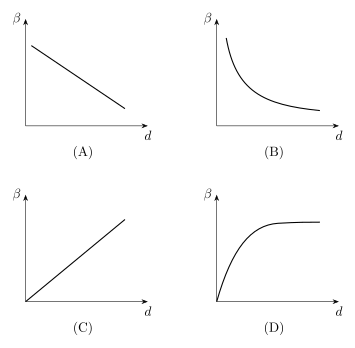
›Reveal solutionSolution
This tests the exact functional form of fringe width versus slit separation in Young's double slit experiment: β=λD/d is an inverse relationship, so its graph is a decreasing hyperbola, not a straight line.
Concept and Intuition
In Young's double-slit interference, the fringe width — the spacing between consecutive bright (or dark) fringes on the screen — is given by
β=dλD,
where λ is the wavelength of light, D is the distance from the slits to the screen, and d is the separation between the two slits. For fixed λ and D, β is inversely proportional to d: β∝1/d. This is a hyperbola-type relationship: as d→0, β→∞ (very widely spaced fringes), and as d increases, β falls off rapidly at first and then more gradually, asymptotically approaching (but never touching) the horizontal axis. It is emphatically not a straight line, since a straight line would mean β is directly proportional (or linearly related) to d, which contradicts the 1/d form.
Step-by-Step Solution
- Start from the standard fringe-width formula β=λD/d.
- Treat λD as a constant k (for fixed source wavelength and fixed screen distance), so β=k/d.
- This is the equation of a rectangular hyperbola in the β–d plane: β⋅d=k (constant).
- For small d, β is large; as d grows, β decreases steeply at first, then the curve flattens as it approaches the d-axis — this is a decreasing, concave-up curve, never crossing to negative values and never becoming a straight line.
- This matches the description of a curve that decreases steeply and flattens as d increases.
Common Mistakes
- Assuming fringe width increases with d (confusing it with fringe width's direct proportionality to D or λ, not d) — larger slit separation actually gives narrower-spaced fringes.
- Mistaking the inverse relationship for a straight-line (negative-slope) decrease — a straight line would mean β hits zero at a finite d and could go negative, which is unphysical; the true relation only approaches zero asymptotically.
✓Final answerThe correct option is (B) — a curve decreasing steeply and flattening (inverse-like), concave up.
ANSWER: B
- AP EAPCET 2026Set eng-2026-05-15-AN1 markMCQQ.In Young's double slit experiment, the fringe width is β. If the distance between slit and screen is doubled and separation between slits is made ¼ of initial value, then new fringe width is (A) 4β (B) 4β (C) 8β (D) 8β
›Reveal solutionSolution
Direct application of the YDSE fringe-width formula's dependence on screen distance and slit separation. Doubling D and quartering d multiplies the fringe width by 8. Answer: 8β.
Concept and Intuition
In Young's double slit experiment, the fringe width (spacing between consecutive bright or dark fringes) is
β=dλD
where D is the slit-to-screen distance and d is the slit separation. Physically, moving the screen farther away (D increases) spreads the interference pattern out (fringes get wider), while moving the slits closer together (d decreases) also spreads the pattern out (the diffracted/interfering beams overlap over a wider angular range for the same fringe order). Both changes here act in the same direction — both increase β — so their effects multiply together rather than partially cancel.
Step-by-Step Solution
- Original fringe width: β=dλD.
- New conditions: D′=2D (doubled), d′=4d (quartered).
- New fringe width:
β′=d′λD′=(d/4)λ(2D)=2D×d4×λ=8⋅dλD=8β
Common Mistakes
- Treating the two changes (D doubling, d quartering) as if they partially cancel, rather than recognizing both act to increase the fringe width, so their factors multiply: 2×4=8.
- Forgetting that β is inversely proportional to d, so quartering d multiplies β by 4 (not divides).
✓Final answerThe correct option is (D) — 8β.
ANSWER: D
- AP EAPCET 2026Set eng-2026-05-15-FN1 markMCQQ.Interference fringes produced by a double slit arrangement using a monochromatic light of wave length 5,890Å, have an angular fringe width 0.28∘. If the entire arrangement is immersed in water, the new angular fringe width will be (aμω=4/3) (A) 0.24∘ (B) 0.21∘ (C) 0.18∘ (D) 0.36∘
›Reveal solutionSolution
Immersing the double-slit setup in water shortens the wavelength of light by a factor 1/μw, which shrinks the angular fringe width by the same factor, from 0.28∘ to 0.21∘.
Concept and Intuition
Angular fringe width in a Young's double slit experiment is θ=λ/d, depending only on the wavelength (in the medium the light is actually traveling through) and the slit separation d (a fixed mechanical quantity, unaffected by immersion). When the whole setup (slits, screen, and the medium between them) is immersed in water, the wavelength of light in that medium shortens to λwater=λair/μw, so the fringe pattern compresses proportionally.
Step-by-Step Solution
- In air: θair=λair/d=0.28∘.
- In water: λwater=λair/μw, and d is unchanged, so θwater=λwater/d=θair/μw.
- Substitute μw=4/3: θwater=0.28×43=0.21∘.
Common Mistakes
- Multiplying by μw instead of dividing (getting the fringe width to increase, which is physically backward — a denser medium shortens wavelength and hence fringe spacing).
- Forgetting that d (slit separation) is a fixed geometric quantity that doesn't change with the medium.
✓Final answerThe correct option is (B) — 0.21∘.
ANSWER: B
- AP EAPCET 2026Set ap-2026-05-19-FN1 markMCQQ.If Young's double slit experiment is done in air first and then if the experiment is conducted by immersing the apparatus in water, the fringe width (A) remains same (B) decreases (C) increases (D) Becomes zero
›Reveal solutionSolution
Tests how immersing Young's double-slit setup in a medium changes fringe width — the wavelength shrinks in a denser medium, so the fringes get closer together.
Concept and Intuition
Fringe width in YDSE, β=λD/d, is set by the wavelength of light inside the medium the light is travelling through, not its vacuum/air wavelength. Water has a refractive index greater than air, so light slows down and its wavelength shrinks proportionally (λmedium=λair/n), which directly shrinks the fringe spacing since everything else (D, d) is unchanged by the medium.
Step-by-Step Solution
- Fringe width formula: β=dλD, where λ is the wavelength in the medium the interference is occurring in, D is slit-to-screen distance, d is slit separation.
- In air, λ=λair (essentially, since nair≈1).
- When immersed in water (refractive index nw≈1.33), the wavelength becomes λwater=nwλair, which is smaller than λair.
- D and d are geometric quantities of the apparatus and don't change on immersion.
- So βwater=λairλwaterβair=nwβair<βair — the fringe width decreases.
Common Mistakes
- Assuming fringe width depends only on the frequency of light (which indeed stays constant across media) rather than the wavelength, which is what actually appears in the fringe-width formula.
- Thinking immersion only affects the source, not realizing the entire optical path (and hence the effective wavelength used in the interference pattern) is inside water.
✓Final answerThe correct option is (B) — decreases.
ANSWER: B
- AP EAPCET 2026Set ap-2026-05-20-FN1 markMCQQ.Young's double slit experiment setup is in such a way that, when path difference is λ, then intensity at a point is I. If the path difference is 4λ, then intensity at the same point is (A) 2I (B) 2I (C) 2I (D) 2I
›Reveal solutionSolution
Using the two-slit intensity formula I(δ)=4I0cos2(δ/2), calibrating with the given path-difference-λ case shows the intensity at path difference λ/4 is I/2.
Concept and Intuition
In Young's double slit experiment, the resultant intensity at a point depends on the phase difference δ between the two interfering waves, via I=4I0cos2(δ/2), where I0 is the intensity due to a single slit alone and δ=λ2π×Δ for a path difference Δ. A path difference of a full wavelength (Δ=λ) gives δ=2π, which is constructive interference (maximum intensity), letting us calibrate I0 from the given information.
Step-by-Step Solution
- At path difference Δ=λ: phase δ=λ2π×λ=2π.
- I=4I0cos2(2π/2)=4I0cos2(π)=4I0(1)2=4I0. Given this equals I: I0=I/4.
- At path difference Δ=λ/4: phase δ=λ2π×4λ=2π.
- I′=4I0cos2(4π)=4I0×21=2I0.
- Substituting I0=I/4: I′=2×4I=2I.
Common Mistakes
- Forgetting the factor of 1/2 inside the phase argument (using δ instead of δ/2 inside the cosine-squared).
- Assuming intensity scales linearly with path difference (it doesn't — it's a cos2 relationship).
✓Final answerThe correct option is (B) — 2I.
ANSWER: B
- AP EAPCET 2025Set eng-2025-05-21-FN1 markMCQQ.In Young's double slit experiment, the wavelengths of red and blue lights used are 7.5×10⁻⁵ cm and 5×10⁻⁵ cm respectively. If nth bright fringe of red color coincides with (n+1)th bright fringe of blue colour, then the value of 'n' is (A) 1 (B) 2 (C) 4 (D) 8
›Reveal solutionSolution
This tests fringe coincidence in Young's double-slit experiment for two wavelengths. Answer: n=2.
Concept and Intuition
In YDSE the bright fringe positions for a given wavelength form an evenly-spaced set, yn=dnλD. Two different colours have different fringe spacings, so their bright fringes drift apart and occasionally land at the same point on the screen — this is fringe coincidence. At the coincidence point, the physical position y must be identical for both colours, even though the fringe order n differs.
Step-by-Step Solution
- Position of nth red bright fringe: y=dnλredD.
- Position of (n+1)th blue bright fringe: y=d(n+1)λblueD.
- Equate (same D,d, so they cancel): nλred=(n+1)λblue.
- Substitute λred=7.5×10⁻⁵ cm, λblue=5×10⁻⁵ cm: 7.5n=5(n+1)=5n+5.
- 2.5n=5⇒n=2.
Common Mistakes
- Equating nλred=nλblue (ignoring the stated (n+1) shift in fringe order).
- Swapping which colour gets the n and which gets n+1 — re-check against the problem statement.
✓Final answerThe correct option is (B) — 2.
ANSWER: B
- AP EAPCET 2025Set eng-2025-05-22-AN1 markMCQQ.In Young's double slit experiment, the wavelength of monochromatic light is increased by 20% and the distance between the two slits is decreased by 25%. If the initial fringe width is 0.3 mm, then the final fringe width is (A) 0.72 mm (B) 0.60 mm (C) 0.16 mm (D) 0.48 mm
›Reveal solutionSolution
Fringe width in YDSE scales directly with wavelength and inversely with slit separation. Increasing λ by 20% and decreasing d by 25% together multiply the fringe width by 1.6, giving 0.48 mm.
Concept and Intuition
In Young's double slit experiment, bright fringes form where path difference is an integer multiple of λ; the spacing between adjacent fringes on the screen is β=λD/d. Increasing the wavelength spreads the fringes further apart (a 'wider' interference pattern), while increasing slit separation squeezes them closer together — hence β scales directly with λ and inversely with d. Both changes here work in the SAME direction (increasing β): a longer wavelength directly increases it, and a smaller slit separation ALSO increases it.
Step-by-Step Solution
- Fringe width formula: β=dλD.
- New wavelength: λ′=λ+20%λ=1.2λ.
- New slit separation: d′=d−25%d=0.75d.
- New fringe width: β′=d′λ′D=0.75d1.2λD=0.751.2β=1.6β.
- Given β=0.3 mm: β′=1.6×0.3=0.48 mm.
Common Mistakes
- Treating the 20% increase and 25% decrease as roughly cancelling (they don't — the wavelength factor and the 1/d factor multiply, giving 1.6×, not ≈1×).
- Forgetting that decreasing d INCREASES β (since β∝1/d), and mistakenly decreasing β instead.
✓Final answerThe correct option is (D) — 0.48 mm.
ANSWER: D
- AP EAPCET 2025Set eng-2025-05-23-FN1 markMCQQ.In Young's double slit experiment, the distance between the slits is 0.2 cm, the distance between the screen and the slits is 1 m. If the wavelength of light used in the experiment is 5000 Å, then the distance between two consecutive dark fringes on the screen is (A) 0.25 mm (B) 0.26 mm (C) 0.27 mm (D) 0.28 mm
›Reveal solutionSolution
The spacing between consecutive dark (or bright) fringes in YDSE equals the fringe width β=λD/d. Answer: 0.25 mm.
Concept and Intuition
In Young's double slit experiment, both bright and dark fringes are equally spaced (they alternate), so the distance between any two consecutive dark fringes is the same as the fringe width β, which depends on the wavelength of light, the slit separation, and the screen distance.
Step-by-Step Solution
- Convert values to SI: d=0.2 cm=2×10⁻³ m; D=1 m; λ=5000 A˚=5000×10−10 m=5×10⁻⁷ m.
- Fringe width: β=dλD=2×10−35×10−7×1.
- Compute: β=2.5×10⁻⁴ m=0.25 mm.
- This is also the spacing between consecutive dark fringes.
Common Mistakes
- Unit conversion slip-ups (Å to m, cm to m) which throw off the final answer by orders of magnitude.
- Trying to derive a different formula for "dark fringe spacing" vs "bright fringe spacing" — they are identical in YDSE.
✓Final answerThe correct option is (A) — 0.25 mm.
ANSWER: A
🎓Unlock everything free for 14 days
- ✓Full step-by-step solutions
- ✓Concept-first explanations
- ✓Methods, shortcuts & mistakes
- ✓PYQ mapping + timed mock tests
Full access for 14 days. No credit card required.