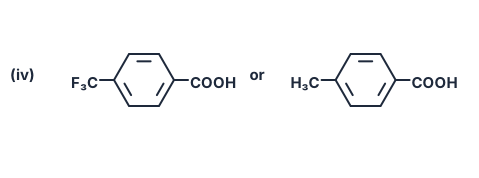
Q.Which acid of each pair shown here would you expect to be stronger?
You're viewing a preview — the full solution, concept, methods & PYQ mapping are locked.
Start your 14-day free trial to unlock the full solution →The key idea is the inductive effect — electron-withdrawing groups (like halogens) stabilise the conjugate base by pulling electron density away from the carboxylate anion, making the acid stronger. The closer and more electronegative the halogen, the stronger the acid.
(i) is stronger than .
(ii) is stronger than .
(iii) is stronger than .
(iv) is stronger than .
The Concept: Why Inductive Effect Decides Acidity
Acidity is about how easily a molecule gives up a proton (). When an acid loses , it leaves behind its conjugate base . The more stable that conjugate base is, the stronger the acid.
For carboxylic acids (), the conjugate base is a carboxylate ion (), which already has the negative charge spread over two oxygen atoms. But if the group pulls electron density toward itself (an electron-withdrawing inductive effect), it further stabilises the negative charge on the carboxylate — making the acid stronger. If pushes electrons away (electron-donating), it destabilises the negative charge and makes the acid weaker.
Halogens (F, Cl, Br, I) are electron-withdrawing by induction because they are more electronegative than carbon. The strength of this effect depends on two things:
- Electronegativity of the halogen (F > Cl > Br > I)
- Distance from the carboxyl group — the closer the halogen, the stronger its pull.
Now let’s apply this to each pair.
(i) vs
-
In , the group attached to the carboxyl is a methyl (). Methyl is weakly electron-donating (it pushes electron density toward the carboxylate), which destabilises the conjugate base slightly. So acetic acid is a weak acid ().
-
In , one hydrogen on the methyl has been replaced by fluorine. Fluorine is highly electronegative — it pulls electron density away from the carboxyl group through the sigma bonds. This withdrawal stabilises the negative charge on the conjugate base, making the acid stronger.
-
The inductive effect of fluorine is strong and operates through only one carbon-carbon bond. So is significantly more acidic than .
A common mistake is to think that because fluorine is small, its effect is weak. In fact, fluorine’s high electronegativity makes it the strongest inductive withdrawer among halogens — even though it has no d-orbitals for resonance, its pull through sigma bonds is powerful.
Result for (i): is stronger.
(ii) vs
-
Both acids have a halogen on the alpha carbon (the carbon directly attached to the carboxyl). The difference is the halogen: fluorine vs chlorine.
-
Fluorine is more electronegative than chlorine (4.0 vs 3.2 on the Pauling scale). So fluorine pulls electron density more strongly than chlorine does.
-
Even though chlorine is larger and has more electrons, its inductive effect is weaker because electronegativity is the dominant factor here. The distance from the carboxyl is the same (one bond away), so the comparison is purely about how strongly each halogen withdraws.
A quick way to remember: For halogens at the same position, the order of acid-strengthening is , which follows electronegativity. This is the opposite of what you might guess from size alone.
Result for (ii): is stronger.
(iii) vs
- Here the acids are longer-chain carboxylic acids. Both have a fluorine atom, but at different positions relative to the carboxyl group. …
Unlock everything free for 14 days
- Full step-by-step solutions
- Concept-first explanations
- Methods, shortcuts & mistakes
- PYQ mapping + timed mock tests
Full access for 14 days. No credit card required.