Electromagnetic induction is the phenomenon in which a changing magnetic flux through a circuit produces an electromotive force (emf) — and hence a current, if the circuit is closed. It is the single idea behind generators, transformers, inductors, and the entire AC power grid.
The Central Discovery
Michael Faraday found (1831) that a current is induced in a coil not when a magnet sits still near it, but only while the magnet moves — that is, only while the magnetic flux linked with the coil is changing. A steady magnet, however strong, induces nothing.
Magnetic Flux
The key quantity is magnetic flux ΦB through a surface of area A in a field B:
ΦB=B⋅A=BAcosθ
where θ is the angle between B and the area's normal. Its SI unit is the weber (Wb), where 1Wb=1T⋅m2.
Flux can change in three distinct ways, and any of them induces an emf:
the field strength B changes,
the area A of the loop changes,
the orientation θ changes (a coil rotating in a field — the basis of the generator).
Faraday's Law
The induced emf equals the negative rate of change of flux. For a coil of N turns:
E=−NdtdΦB
The faster the flux changes, the larger the emf. This is why a magnet dropped quickly through a coil gives a bigger deflection than one moved slowly.
Lenz's Law — the Minus Sign
The negative sign expresses Lenz's law: the induced current flows in the direction that opposes the change producing it. Push a magnet's north pole toward a coil, and the coil's near face becomes a north pole to repel it; pull it away, and the face becomes a south pole to attract it. This is simply energy conservation — you must do work against this opposition, and that work becomes the electrical energy of the induced current.
Motional emf
A special, very useful case: a conducting rod of length l moving with speed v perpendicular to a field B sweeps out area and develops an emf
E=Blv
Here the emf arises because the free charges in the rod experience a magnetic force qv×B, which drives them along the rod. …
Why this formula?
Electromagnetic Induction
Electromagnetic induction is the effect discovered by Faraday: a changing magnetic flux through a circuit drives an induced EMF (and hence a current). The key word is changing — a steady field, however strong, induces nothing.
Magnetic flux
Flux measures how many field lines thread a surface bounded by the loop:
ΦB=∫B⋅dA=BAcosθ
It can change three ways: by changing B, by changing the area A, or by rotating the loop (changing θ).
Faraday's law
The induced EMF equals the rate of change of flux:
E=−dtdΦB
For a coil of N turns, E=−NdtdΦB. The EMF depends on how fast the flux changes, not on the flux itself — a slow change gives a small EMF, a rapid change a large one.
A plate heats through Joule dissipation I2R, so any conduction current — direct (a) or direct/alternating (d) — heats it. A time-varying magnetic field induces eddy currents (ε=−dΦB/dt=0) that also heat it (b). A field that varies only in space, not in time, gives no changing f …
A plate heats whenever a current dissipates energy in it (I2R) — from a direct or alternating conduction current, or from eddy currents induced by a time-varying magnetic field. A steady (only space-varying) field on a stationary plate induces nothing. Correct options: (a), (b), (d).
Concept understanding. Heating in a conductor is Joule heating: power P=I2R. So the plate heats whenever a current flows in it, whatever the source of that current.
Why (a) and (d): A direct current through the plate dissipates I2R and heats it (a). More generally, any conduction current — direct or alternating — does the same, so (d) is also true. …
Method: Reasoning Pattern for "What Causes This Heating/Effect?" Multi-Select Questions
Use this systematic elimination approach for any conceptual multi-select MCQ built around a single governing physical requirement — here, Joule heating requires an actual current, so the question reduces to "does each scenario produce a current?"
Steps
Step 1: Identify the one physical mechanism the question is really testing
Heating in a conductor is always P=I2R — so the real question hiding behind every option is simply: does this scenario produce a current in the plate?
Step 2: Check each option against the relevant law
For an option describing a conduction current directly (direct or alternating), current obviously flows — Ohm's law applies trivially. For an option describing a magnetic field instead of a direct current, you must instead check Faraday's law: does the flux through (or linking) the plate actually change with time? Only a genuinely time-varying field induces eddy currents.
Step 3: Eliminate options with no time variation …
Same / Similar Concept — real previous-year questions on the same or a closely similar concept, not this exact question.
AHSEC Higher Secondary (HS) Final Examination 2026Set ANNUAL1 mark
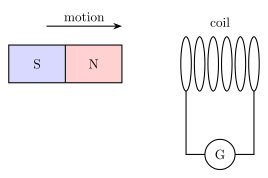
Q.A bar magnet is brought near a coil as shown in the figure. What would be the direction of induced current in the coil, if you look at the coil from the side of the magnet?
›Reveal solutionSolution
The approaching N pole is opposed, so the coil's near face becomes a N pole; viewed from the magnet the induced current flows anticlockwise.
As given in the figure, the magnet's N pole faces and moves toward the coil, so the magnetic flux linked with the coil increases (out of the coil, toward the magnet).
By Lenz's law the induced current opposes this increase, so the face of the coil nearest the magnet must become a north pole to repel the incoming N pole.
AHSEC Higher Secondary (HS) Final Examination 2025Set ANNUAL1 mark
Q.What is the unit of magnetic flux? Whether it is a vector or scalar quantity? (1/2+1/2=1)
›Reveal solutionSolution
Magnetic flux is measured in weber (Wb) and is a scalar quantity.
Magnetic flux through a surface is defined as ΦB = B⃗ · A⃗ = BA cosθ, the dot product of the magnetic field and the area vector. Although both B⃗ and A⃗ are vectors, their dot product (flux) is a single number (scalar) — it has magnitude only, no direction. …
AHSEC Higher Secondary (HS) Final Examination 2022Set ANNUAL1 mark
Q.Fill up the blank in the expression Wb = ___ m^2. (Fill in the blank)
›Reveal solutionSolution
The weber (unit of magnetic flux) equals one tesla times one square metre: Wb = T m².
Magnetic flux through a surface of area A in a uniform field B is defined as Φ_B = B·A cosθ, where θ is the angle between B and the normal to the surface. Since B is measured in tesla (T) and area in square metres (m²), the SI unit of flux Φ_B works out to tesla × metre², …