Question of 27
Q.Describe the structure and functions of human eye with the help of a diagram.
Bihar BsebBihar Board Intermediate 1st Year 2026Subjective· 5mImportance★★★★★
0% · 0/27 Questions
You're viewing a preview — the full solution, concept, methods & PYQ mapping are locked.
Start your 14-day free trial to unlock the full solution →The human eye has three layers (sclera, choroid, retina), a lens that focuses light on the retina, and photoreceptors (rods and cones) that send impulses via the optic nerve to the brain for vision.
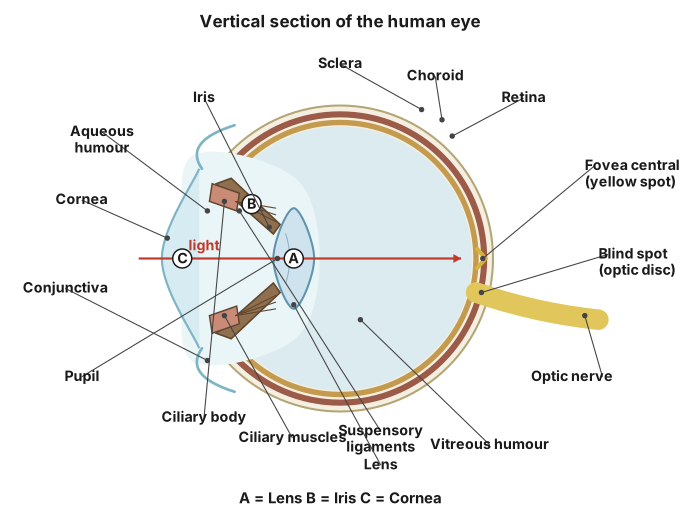
Structure of the human eye:
The eyeball is roughly spherical and has three layers (coats):
- Sclera (outermost) — a tough, white fibrous layer that protects and gives shape; its transparent front part is the cornea, through which light enters.
- Choroid (middle) — a dark, vascular layer that supplies blood and prevents internal reflection of light. In front it forms the coloured iris, which surrounds a central opening, the pupil. The ciliary body holds the lens.
- Retina (innermost) — the light-sensitive layer containing photoreceptor cells: rods (for dim light and black-and-white vision) and cones (for bright light and colour vision). The point of sharpest vision is the yellow spot (fovea); the region where the optic nerve leaves has no receptors and is the blind spot.
The biconvex lens, held by the ciliary muscles, focuses light onto the retina. The space in front of the lens has aqueous humour and behind it has vitreous humour, which maintain the eye's shape.
Functions of the human eye:
- Light enters through the cornea and pupil; the iris adjusts the size of the pupil to control the amount of light.
- The lens focuses the light and forms a real, inverted, smaller image on the retina; the ciliary muscles change the lens's curvature for focusing near or distant objects (accommodation).
- Rods and cones convert the light stimulus into nerve impulses. …
Unlock everything free for 14 days
- Full step-by-step solutions
- Concept-first explanations
- Methods, shortcuts & mistakes
- PYQ mapping + timed mock tests
Full access for 14 days. No credit card required.