Q.Which of the following molecules is chiral in nature ? (A) Propan-2-ol (B) Butan-2-ol (C) 1-Bromobutane (D) 2-Bromopropane
You're viewing a preview — the full solution, concept, methods & PYQ mapping are locked.
Start your 14-day free trial to unlock the full solution →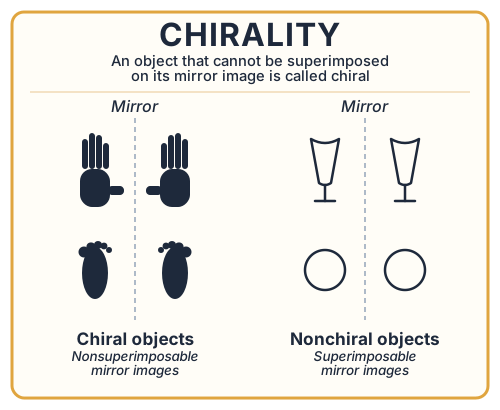
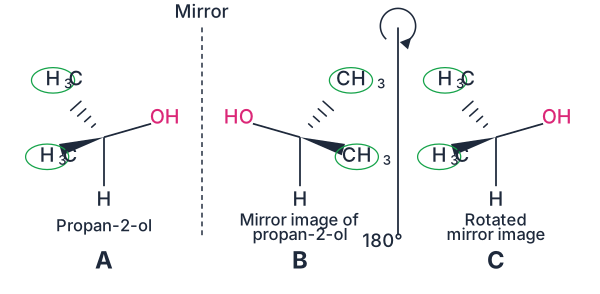
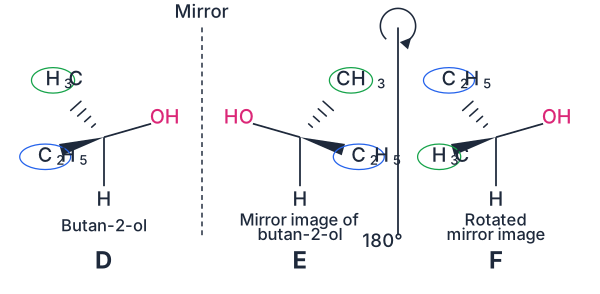
A molecule is chiral if it has a carbon atom bonded to four different groups. Among the given options, only Butan-2-ol has such a carbon, making it the chiral molecule.
The Concept: What Makes a Molecule Chiral?
Chirality in organic chemistry is a property of "handedness" — a molecule is chiral if it is not superimposable on its mirror image. For most simple organic compounds (like the ones in this question), chirality arises from the presence of a stereocenter (often called a chiral centre or asymmetric carbon). This is a carbon atom that is bonded to four different substituents.
If a carbon has even two identical groups attached, its mirror image can be rotated to match the original — it is achiral. So the task is to check each molecule for a carbon with four distinct groups.
A common mistake is to look for any carbon with four bonds and assume it's a chiral centre. The key is four different groups — not just four bonds. A carbon with two identical groups (like two hydrogens) is never a chiral centre.
Step-by-Step Analysis
Let's examine each molecule one by one.
1. Propan-2-ol — Structure:
The central carbon (the one with the -OH group) is bonded to:
- A hydrogen atom (H)
- A hydroxyl group (-OH)
- A methyl group ()
- Another methyl group ()
Since two of the groups are identical (both are ), this carbon is not a chiral centre. The molecule is achiral.
2. Butan-2-ol — Structure:
Look at the carbon that carries the -OH group (the second carbon in the chain). Its four bonds go to:
- A hydrogen atom (H)
- A hydroxyl group (-OH)
- A methyl group ()
- An ethyl group ()
Are all four groups different? Yes — H, -OH, , and are all distinct. This carbon is a stereocenter, so Butan-2-ol is chiral.
Butan-2-ol is a classic example of a chiral alcohol. In fact, it is often used in textbooks to introduce optical isomerism because it has exactly one chiral centre and no symmetry.
3. 1-Bromobutane — Structure:
Scan each carbon: …
Unlock everything free for 14 days
- Full step-by-step solutions
- Concept-first explanations
- Methods, shortcuts & mistakes
- PYQ mapping + timed mock tests
Full access for 14 days. No credit card required.