Q.What are the IUPAC names of the insecticide DDT and benzenehexachloride? Why is their use banned in India and other countries?
You're viewing a preview — the full solution, concept, methods & PYQ mapping are locked.
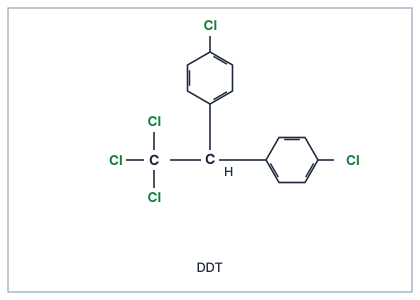
Start your 14-day free trial to unlock the full solution →DDT is 2,2-bis(4-chlorophenyl)-1,1,1-trichloroethane and benzenehexachloride (BHC) is 1,2,3,4,5,6-hexachlorocyclohexane. Both are banned because they are persistent organic pollutants that bioaccumulate, cause toxicity in non-target organisms (including humans), and remain in the environment for decades.
Why these compounds were used — and why they became a problem
DDT and BHC are organochlorine insecticides. They were once hailed as miracle chemicals: cheap, stable, and deadly to a wide range of insect pests. DDT alone is credited with controlling malaria and typhus in the mid-20th century. But that very stability turned into a curse. These compounds do not break down easily in the environment. They dissolve in fats, not water, so they accumulate in the fatty tissues of animals and move up the food chain — a process called biomagnification.
At the top of the food chain — birds of prey, fish, and humans — the concentrations become high enough to cause reproductive failure, neurological damage, and cancer. Rachel Carson’s 1962 book Silent Spring brought this to public attention, and by the 1970s most countries began banning or severely restricting their use.
The IUPAC names — step by step
1. DDT
The common name DDT comes from Dichloro-Diphenyl-Trichloroethane. Let’s build the IUPAC name systematically.
- The parent structure is ethane (2 carbons).
- On one carbon (C1), three chlorine atoms are attached — that’s the trichloro part.
- On the other carbon (C2), two phenyl groups (benzene rings) are attached. But each phenyl ring has a chlorine atom at the para position (position 4).
- So each ring is a 4-chlorophenyl group.
Putting it together: the central carbon (C2) carries two 4-chlorophenyl groups, and C1 carries three chlorines. The full IUPAC name is:
2,2-bis(4-chlorophenyl)-1,1,1-trichloroethane
The prefix bis is used instead of di because the two identical substituents are complex groups (4-chlorophenyl), not simple atoms.
A common mistake is to write “dichlorodiphenyl” — but the correct locants are 2,2 for the phenyl groups and 1,1,1 for the chlorines. The “bis” notation avoids ambiguity.
2. Benzenehexachloride (BHC)
The name “benzenehexachloride” is misleading — it suggests a benzene ring with six chlorines attached, but the actual structure is a saturated ring. The correct chemical name is 1,2,3,4,5,6-hexachlorocyclohexane.
- The parent is cyclohexane (a six-carbon ring, all single bonds).
- Six chlorine atoms replace six hydrogen atoms, one on each carbon.
- The locants 1,2,3,4,5,6 indicate that every carbon bears a chlorine.
BHC is often confused with lindane (the gamma isomer of hexachlorocyclohexane). Lindane is the only isomer with significant insecticidal activity, but technical BHC is a mixture of isomers. The IUPAC name above refers to the generic compound, not a specific stereoisomer.
Why they are banned …
Unlock everything free for 14 days
- Full step-by-step solutions
- Concept-first explanations
- Methods, shortcuts & mistakes
- PYQ mapping + timed mock tests
Full access for 14 days. No credit card required.