Q.Match the structures of compounds given in Column I with the classes of compounds given in Column II.
Column I:
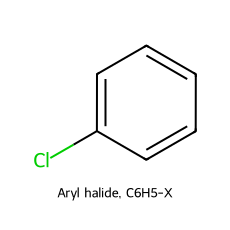
(iii)
Column II:
You're viewing a preview — the full solution, concept, methods & PYQ mapping are locked.
Start your 14-day free trial to unlock the full solution →The key is to identify the carbon directly attached to the halogen (X) and classify it by its hybridization and the type of carbon skeleton. The matches are: (i)→ (b), (ii)→ (d), (iii)→ (a), (iv)→ (c).
This question tests your grasp of structural isomerism in organic halides — specifically, how the position of the halogen relative to a double bond or an aromatic ring changes the compound’s classification. The names (alkyl, vinyl, allyl, aryl) aren’t arbitrary; they tell you exactly what kind of carbon the halogen is bonded to.
Let’s break each one down.
-
Compound (i):
The halogen X is attached to a carbon that is sp³ hybridized and part of a saturated chain (no double bonds, no aromatic ring). This carbon is simply an alkyl carbon.
→ This is an alkyl halide.
Match: (i) → (b).
-
Compound (ii):
Here, X is attached to a carbon that is one carbon away from a C=C double bond. That carbon is sp³ hybridized, but it’s “allylic” — meaning it’s adjacent to a vinylic carbon. The name allyl halide specifically refers to a halogen on a carbon next to a double bond.
→ This is an allyl halide.
Match: (ii) → (d).
-
Compound (iii): (halobenzene)
The halogen is directly attached to a carbon of a benzene ring. That carbon is part of an aromatic system (sp² hybridized, but in a ring with delocalized π electrons). The term aryl halide is used when X is bonded directly to an aromatic ring.
→ This is an aryl halide.
Match: (iii) → (a).
-
Compound (iv): …
Unlock everything free for 14 days
- Full step-by-step solutions
- Concept-first explanations
- Methods, shortcuts & mistakes
- PYQ mapping + timed mock tests
Full access for 14 days. No credit card required.