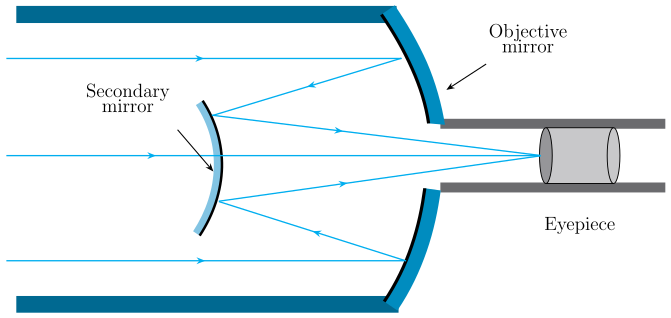
Q.A Cassegrain telescope uses two mirrors as shown in Fig. 9.26.
You're viewing a preview — the full solution, concept, methods & PYQ mapping are locked.
Start your 14-day free trial to unlock the full solution →The Cassegrain telescope uses two mirrors to fold the optical path. For an object at infinity, the primary mirror forms an image at its focus; this image becomes a virtual object for the secondary mirror. Using the mirror formula twice, the final image is formed 315 mm behind the primary mirror (i.e., to the right of the primary, where the eyepiece is placed).
Why This Approach Works
A Cassegrain telescope is essentially a clever combination of two mirrors: a large concave primary and a small convex secondary. The primary mirror collects parallel light from a distant object and would normally form an image at its focal point. But instead of letting that image form, we place a convex secondary mirror in the path to intercept the converging rays before they meet. The secondary then reflects these rays back through a hole in the primary, forming a final image behind the primary mirror — right where an eyepiece can view it.
The key insight: we treat this as two successive reflections, each governed by the mirror formula , with careful attention to sign conventions. The image from the first mirror becomes the object for the second mirror. The trickiest part is getting the signs right for the secondary mirror — especially when the object is virtual (rays are converging toward a point behind the mirror).
The most common mistake here is forgetting that the image formed by the primary lies between the two mirrors. When this image acts as an object for the secondary (convex) mirror, it is a virtual object — its distance for the secondary mirror must be taken as positive (since it lies on the incident side of the secondary). Many students blindly use the sign convention and get the sign wrong.
Step-by-Step Solution
1. Find the focal length of the primary (large concave) mirror.
The radius of curvature . For a spherical mirror, focal length . Since it's concave, the focal length is negative by the Cartesian sign convention (light travels from left to right; the centre of curvature is to the left of the mirror).
2. Locate the image formed by the primary mirror alone.
For an object at infinity (), the mirror formula gives:
So . The negative sign means the image is formed in front of the primary mirror (to its left), at a distance of 110 mm from it. This is the primary focus .
3. Determine the position of this image relative to the secondary mirror.
The two mirrors are 20 mm apart. The primary is at the back, the secondary is 20 mm in front of it. So the primary's image at 110 mm in front of the primary is at a distance of in front of the secondary mirror.
Since the secondary mirror is convex and faces the primary, the incoming rays from the primary are converging toward a point 90 mm behind the secondary (i.e., to its right). This means the object for the secondary mirror is virtual — the rays would meet at that point if the secondary weren't there.
A virtual object occurs when incident rays are converging toward a point behind the mirror. In the Cartesian sign convention, the object distance for a virtual object is taken as positive because the object lies on the incident side of the mirror (the side from which light approaches). This is a common point of confusion — remember: is positive if the object is on the same side as the incoming light, regardless of whether the object is real or virtual.
4. Find the focal length of the secondary (small convex) mirror. …
Unlock everything free for 14 days
- Full step-by-step solutions
- Concept-first explanations
- Methods, shortcuts & mistakes
- PYQ mapping + timed mock tests
Full access for 14 days. No credit card required.