Political Science · Ch 9 — Constitution as a Living Document
Special Majority
Special Majority
The makers of the Constitution wanted it to be both 'flexible' (open to change) and 'rigid' (resistant to casual change) at the same time, so that it could be corrected where it had genuine faults, without being so easy to change that any ruling party could rewrite it to suit itself.
Drawn by us to help you understand the concept clearly, and verified to make sure it's accurate. For exams, practice from your NCERT textbook's own diagram.
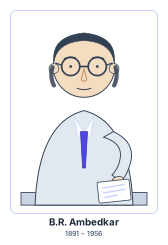
Dr. B.R. Ambedkar, seated at his desk, pointing at a document, illustrating his Constituent Assembly remarks on amendment procedure and public opinion. Own-illustrated for this platform from the real NCERT page's own facts (composition, labels, and content are recreated; the specific artistic rendering of any real photo …
Many articles of the Constitution can be amended by a simple law of Parliament — the wording of such articles typically says Parliament 'may by law' do something (for example, Article 2 lets Parliament admit new states into the Union 'by law', and Article 3 lets it alter the area of a State 'by law'). These are the flexible parts of the Constitution: there is no difference at all between passing an ordinary law and amending these provisions.
For the remaining, more sensitive parts of the Constitution, Article 368 lays down a stricter procedure — special majority. Ordinarily, a bill needs only the support of a simple majority of members present and voting. An amendment bill needs two things at once: (i) support of a majority of the total membership of that House (not merely of those present that day), and (ii) support of at least two-thirds of the members who are actually present and voting. Both Houses of Parliament must pass the bill separately in this manner — there is no joint sitting for a constitutional amendment. Once passed, the bill goes to the President for assent, but — unlike an ordinary bill — the President has no power to send an amendment bill back for reconsideration. …