Political Science · Ch 7 — Federalism
Division of Powers
Division of Powers
The Indian Constitution creates two distinct sets of government: one for the entire nation, called the Union (or central) government, and one for each individual unit, called the State government. Both of these are constitutionally recognised, and each has a clearly identified area of activity that it is responsible for. Whenever a genuine dispute arises over whether a particular power belongs to the Union or to a State, it is the judiciary that resolves the matter, based strictly on what the Constitution actually provides.
Drawn by us to help you understand the concept clearly, and verified to make sure it's accurate. For exams, practice from your NCERT textbook's own diagram.
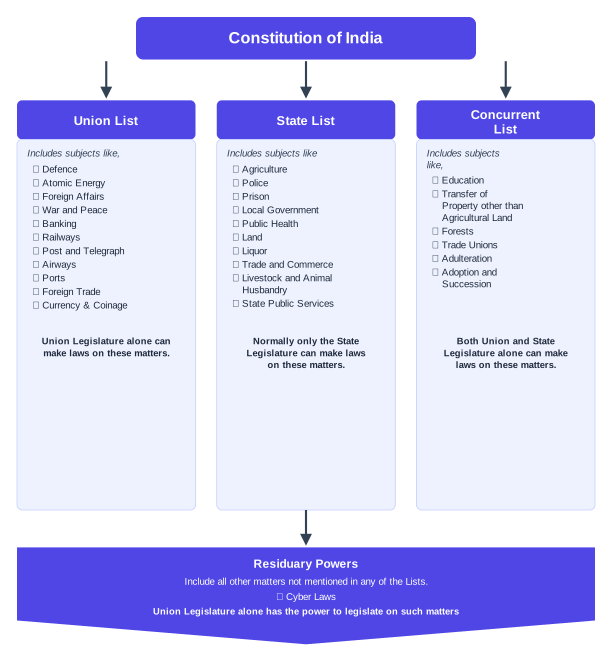
Flowchart showing the Constitution of India branching into the Union List (Defence, Atomic Energy, Foreign Affairs, War and Peace, Banking, Railways, Post and Telegraph, Airways, Ports, Foreign Trade, Currency & Coinage), the State List (Agriculture, Police, Prison, Local Government, Public Health, Land, Liquor, Trade and Commerce, Livestock and Animal Husbandry, State Public Services), the Concurrent List (Education, Transfer of Property other than Agricultural Land, Forests, Trade Unions, Adulteration, Adoption and Succession), and Residuary Powers (all other matters, e.g. Cyber Laws) reserved to the Union Legislature. Own-illustrated for this platform from the real NCERT page's own facts (composition, labels, and …
To make this division workable, the Constitution sets out three separate lists of subjects, along with a category of "residuary" powers for anything left over.
The Union List covers subjects on which only Parliament (the Union Legislature) can make laws. Examples given in the Constitution's own list include Defence, Atomic Energy, Foreign Affairs, War and Peace, Banking, Railways, Post and Telegraph, Airways, Ports, Foreign Trade, and Currency and Coinage — in short, matters that affect the country as a single unit and need one uniform national policy.
The State List covers subjects on which, normally, only the State Legislature can make laws. Examples include Agriculture, Police, Prisons, Local Government, Public Health, Land, Liquor, Trade and Commerce (within the State), Livestock and Animal Husbandry, and State Public Services — matters that are best handled close to the people they affect, at the regional level.
The Concurrent List covers subjects on which both the Union and the State Legislatures are allowed to make laws. Examples include Education, Transfer of Property (other than agricultural land), Forests, Trade Unions, Adulteration of goods, and Adoption and Succession — areas where both a national framework and State-level rules can coexist.
Finally, Residuary Powers cover any matter that is not mentioned in any of the three lists at all — Cyber Laws are given as an example of such a subject. For these residual, unlisted matters, the power to legislate belongs to the Union Legislature alone, which means that when something entirely new comes up that the original lists never anticipated, the default authority to make law on it rests with Parliament, not the States. …