Political Science · Ch 7 — Federalism
Introduction
Introduction
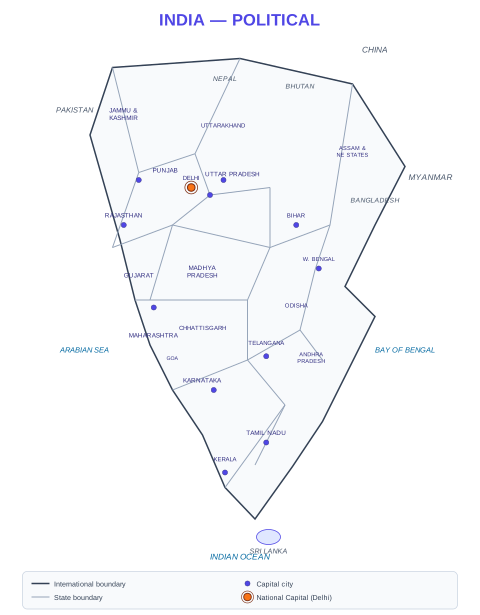
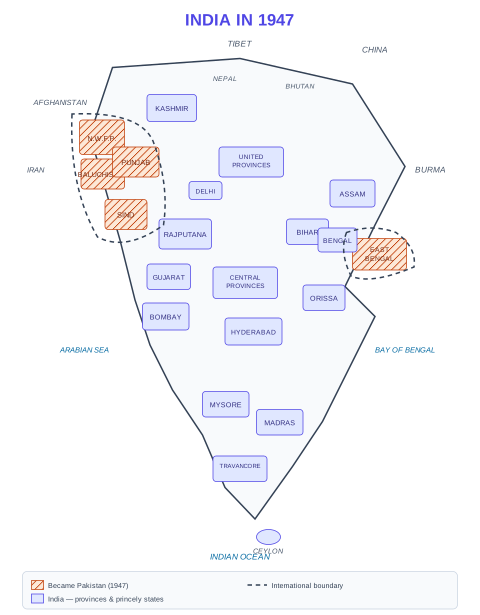
Two political maps of India -- one from 1947, one from the present day -- look strikingly different from each other. State boundaries have been redrawn again and again since independence, new States have been carved out, and several States have even been renamed to reflect what their own people wanted -- the old Mysore State, for instance, became Karnataka, and Madras became Tamil Nadu.
Drawn by us to help you understand the concept clearly, and verified to make sure it's accurate. For exams, practice from your NCERT textbook's own diagram.
Simplified schematic current political map of India, showing major state boundaries with a selection of labelled states, generic dot markers for state capitals, a ringed marker for New Delhi as the National Capital, and neighbouring countries (Pakistan, China, Nepal, Bhutan, Bangladesh, Myanmar, Sri Lanka). Own-illustrated for this platform from the real NCERT page's own facts (composition, labels, and content are recreated; the specific artistic rendering of any real photograph or cartoon on that page is never traced or copied).
Drawn by us to help you understand the concept clearly, and verified to make sure it's accurate. For exams, practice from your NCERT textbook's own diagram.
Simplified schematic map of India in 1947, showing the British Indian provinces and princely states that formed India, the regions (Baluchistan, Sind, N.W.F.P., western Punjab, and East Bengal) that became Pakistan, the international boundary, and neighbouring countries such as Afghanistan, Tibet/China, Nepal, Bhutan, Burma and Ceylon. Own-illustrated for this platform from the real NCERT page's own facts (composition, labels, and content are recreated; the specific artistic rendering of any real photograph or cartoon on that page is never traced or copied).
These repeated changes are not a sign of instability. In many ways, the two maps tell the story of how India's federal system has actually worked in practice over more than seven decades -- adjusting to regional and linguistic aspirations while still holding the country together as one nation. This chapter looks at why India adopted a federal system of government at all, what the Constitution's own federal provisions actually are, what tensions and issues arise out of centre-State relations, and why certain States are given special constitutional treatment because of their own distinct composition and history.