Psychology · Ch 5 — Learning
Classical Conditioning
Classical Conditioning
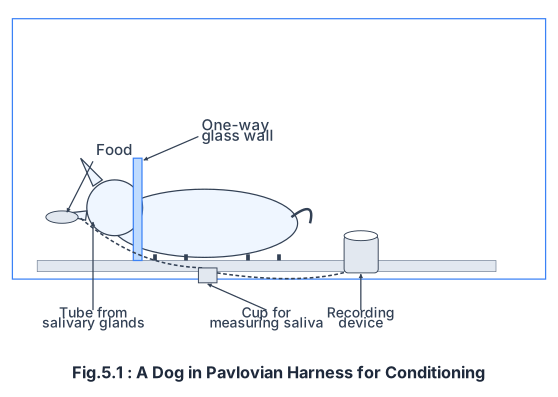
Classical conditioning was discovered by the Russian physiologist Ivan Pavlov while he was actually studying digestion in dogs, not learning at all. Pavlov noticed that his experimental dogs began salivating as soon as they saw the empty plate in which their food was normally served — well before any food was actually presented — even though salivation is supposed to be a reflex triggered directly by food or something similar in the mouth. Intrigued, Pavlov designed a controlled experiment. A hungry dog was harnessed in a chamber, with one end of a small tube surgically placed in its jaw and the other end leading to a measuring glass, so that the amount of saliva produced could be recorded.
Drawn by us to help you understand the concept clearly, and verified to make sure it's accurate. For exams, practice from your NCERT textbook's own diagram.
Fig.5.1: A Dog in Pavlovian Harness for Conditioning — the classic experimental setup, showing a dog in a harness frame behind a one-way glass wall, a food dish, and a tube running from the dog's salivary glands to a measuring cup and recording device. Own-illustrated for this platform from the real NCERT page's own facts (composition, labels, and layout are recreated; the specific …
In the procedure, a bell was sounded and immediately afterward meat powder was given to the dog to eat; this pairing of bell-then-food was repeated over many trials across several days. Eventually, a test trial was introduced in which the bell was sounded but no food followed — and the dog still salivated at the sound of the bell alone, "expecting" food because the bell had become linked with it.
This experiment illustrates the basic vocabulary of classical conditioning. Food, which reflexively triggers salivation without any learning at all, is called the Unconditioned Stimulus (US), and the salivation it triggers is the Unconditioned Response (UR). The bell, which originally produced no specific response (only alertness), becomes able to trigger salivation purely because it was repeatedly paired with food; once this happens, the bell is called the Conditioned Stimulus (CS) and the salivation it now produces is called the Conditioned Response (CR). Because the essence of the procedure is that one stimulus (the bell) comes to signal the likely arrival of another stimulus (the food), classical conditioning is described as a form of stimulus–stimulus (S–S) learning. …