Psychology · Ch 5 — Learning
Key Learning Processes
Key Learning Processes
Certain psychological processes occur across both classical and operant conditioning whenever learning takes place: reinforcement, extinction, generalisation, discrimination, and spontaneous recovery.
Reinforcement is the operation of administering a reinforcer by the experimenter (or, more broadly, by the environment). Reinforced responses increase in rate, while non-reinforced responses decrease in rate.
Drawn by us to help you understand the concept clearly, and verified to make sure it's accurate. For exams, practice from your NCERT textbook's own diagram.
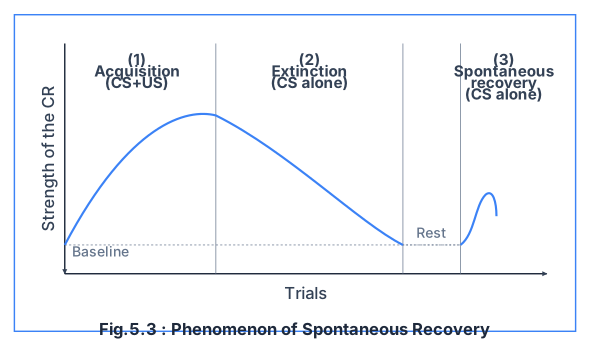
Fig.5.3: Phenomenon of Spontaneous Recovery — a line graph of CR strength across three phases (Acquisition, Extinction, Spontaneous recovery after a rest), plotted against trials. Own-illustrated for this platform from the real NCERT page's own facts (composition, labels, and layout are recreated; the specific artistic r …
Reinforcers may be primary — biologically important because they are tied directly to survival, such as food for a hungry organism — or secondary, meaning they have acquired their reinforcing power through an organism's own experience with the environment; money, praise, and grades are common examples of secondary reinforcers. By systematically reinforcing successive approximations to a desired response — that is, rewarding responses that come closer and closer to the target behaviour — even complex responses that would never occur on their own can gradually be shaped.
Extinction is the disappearance of a learned response once reinforcement is removed from the situation in which the response used to occur — for instance, if the sound of a bell (CS) is no longer followed by food, or if lever pressing in a Skinner box is no longer followed by food pellets, the learned response weakens over successive unreinforced trials and eventually disappears. Learning shows resistance to extinction, meaning a learned response continues to occur for some time even without reinforcement before it fully stops; how long this resistance lasts depends on factors such as the number of reinforced trials during acquisition (more reinforced trials up to a point increase resistance, though beyond a certain level of stabilised performance further trials reduce it), the amount of reinforcement given, whether reinforcement was delayed, and — most importantly — whether reinforcement was continuous or partial, with partially reinforced responses being distinctly harder to extinguish (called the partial reinforcement effect).
Generalisation and discrimination are complementary processes. Generalisation occurs when a learned response is triggered by a new stimulus that is similar to the original conditioned stimulus — for example, a child conditioned to fear a person with a moustache wearing black clothes may also show fear on meeting a different bearded stranger dressed in black. Discrimination is the opposite: it is a differential response based on a difference between stimuli, such as when the same child shows no fear of a clean-shaven stranger in grey clothing. Generalisation is due to similarity between stimuli, while discrimination is a response due to a difference between them; the occurrence of generalisation, in fact, signals a failure of discrimination, and how well an organism discriminates depends on its discrimination capacity or discrimination learning.
Spontaneous recovery occurs after a learned response has been extinguished. If, after extinction, a period of time is allowed to pass and the conditioned stimulus is then presented again, the learned response often reappears to some degree on its own, without any further pairing with the unconditioned stimulus. The amount of such spontaneous recovery depends on how long a gap was allowed after extinction — the longer the gap, the greater the recovery tends to be — which shows that extinction weakens a response's expression rather than erasing the underlying learning completely. …