Psychology · Ch 5 — Learning
Operant/Instrumental Conditioning
Operant/Instrumental Conditioning
Operant or instrumental conditioning was first investigated by the American psychologist B.F. Skinner, who focused on a different category of behaviour from Pavlov's reflexes. Skinner studied "operants" — behaviours or responses that animals and human beings emit voluntarily and that are under their own control, so called because the organism operates on its environment to produce them. The conditioning of such voluntary behaviour is called operant conditioning.
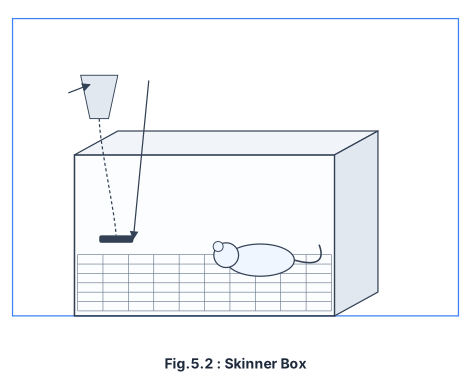
Skinner conducted his classic studies using rats and pigeons placed one at a time in a specially built chamber now known as the Skinner Box.
Drawn by us to help you understand the concept clearly, and verified to make sure it's accurate. For exams, practice from your NCERT textbook's own diagram.
Fig.5.2: Skinner Box — a glass-walled, wire-mesh-floored chamber with a rat, a wall-mounted lever, and a food-pellet dispenser connected to the lever by a tube. Own-illustrated for this platform from the real NCERT page's own facts (composition, labels, and layout are recreated; the specific artistic rend …
Inside the box, a hungry rat could move around freely but could not escape. The chamber contained a lever connected to a food container mounted above it; pressing the lever caused a food pellet to drop onto a nearby plate. Left alone in the box, the hungry rat would explore — moving around and pawing at the walls — and would eventually press the lever by accident, causing a pellet to drop, which the rat would then eat. Over repeated trials, the rat's exploratory behaviour gradually reduced, and the time it took to press the lever after being placed in the chamber grew shorter and shorter, until the rat pressed the lever almost immediately upon being placed in the box — at which point conditioning is considered complete. …