Psychology · Ch 4 — Sensory, Attentional and Perceptual Processes
Figure-Ground Segregation
Figure-Ground Segregation
When we look at any visual surface, certain aspects of that surface clearly stand out as separate entities, while others do not. For example, when we look at words printed on a page, or a painting hanging on a wall, or birds flying across the sky, the words, the painting, and the birds themselves stand out as figures, while the page, the wall, and the sky remain behind them and are perceived as the background.
Drawn by us to help you understand the concept clearly, and verified to make sure it's accurate. For exams, practice from your NCERT textbook's own diagram.
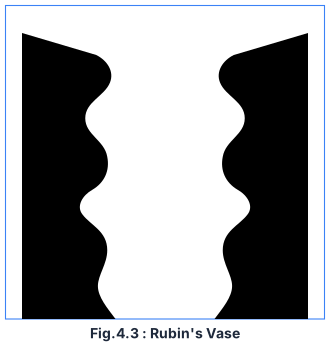
Fig.4.3: Rubin's Vase — a classic bistable figure-ground image; the black areas at the left and right edges form two facing profiles, while the white middle area forms a symmetric vase. Own-illustrated for this platform from the real NCERT page's own facts (composition, labels, and layout are recreated; the specific artistic …
We distinguish figure from ground on the basis of a set of characteristic differences: (1) the figure has a definite form, while the background is comparatively formless; (2) the figure is more organised than its background; (3) the figure has a clear contour, or outline, while the background is essentially contourless; (4) the figure stands out in front of the background, while the background stays behind the figure; and (5) the figure appears clearer, more limited in extent, and relatively nearer to us, while the background appears comparatively unclear, unlimited in extent, and farther away. …