Psychology · Ch 4 — Sensory, Attentional and Perceptual Processes
Perceptual Processes
Perceptual Processes
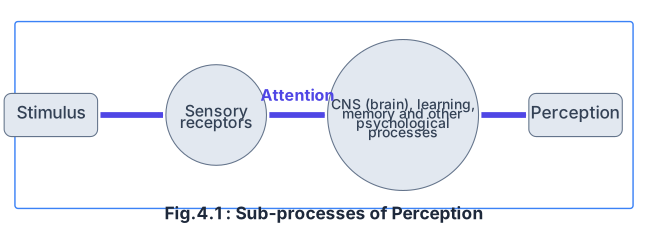
The stimulation of our sense organs gives us an elementary experience -- a flash of light, a sound, a smell -- but this basic experience, called sensation, does not by itself tell us anything about the stimulus that produced it; it does not, for example, tell us the actual source of the light, the sound, or the fragrance. In order to make proper sense of this raw material supplied by our sensory system, we process it further, drawing on our learning, memory, motivation, emotions, and other psychological processes to give it meaning. The process through which we recognise, interpret, or give meaning to the information supplied by our sense organs is called perception. In interpreting stimuli or events, we often end up constructing them in our own individual way -- so perception is not merely an interpretation of objects or events exactly as they exist in the external or internal world, but also, in a genuine sense, a construction of those objects and events from the particular perceiver's own point of view. This overall process of meaning-making can be broken down into a chain of sub-processes: a stimulus first activates sensory receptors, attention then determines what gets passed on for further handling, and this information reaches the CNS (brain), where it interacts with learni …
Drawn by us to help you understand the concept clearly, and verified to make sure it's accurate. For exams, practice from your NCERT textbook's own diagram.
Fig.4.1: Sub-processes of Perception — a flow diagram: Stimulus, an arrow to Sensory receptors, an 'Attention' arrow to CNS (brain), learning, memory and other psychological processes, and an arrow to Perception. Own-illustrated for this platform from the real NCERT page's own facts (composition, labels, and layout are recreated; the specific artis …