Psychology · Ch 4 — Sensory, Attentional and Perceptual Processes
Geometrical Illusions
Geometrical Illusions
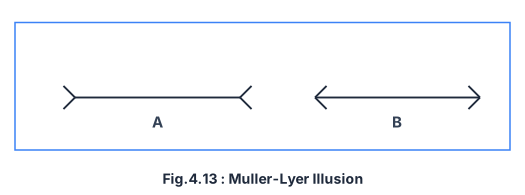
One of the best-known geometrical illusions is the Muller-Lyer illusion, in which two horizontal line segments of exactly equal length are shown, labelled A and B.
Drawn by us to help you understand the concept clearly, and verified to make sure it's accurate. For exams, practice from your NCERT textbook's own diagram.
Fig.4.13: The Muller-Lyer Illusion — two physically equal-length horizontal lines, one (A) with outward-splayed end-fins that make it look shorter, the other (B) with inward-converging end-fins that make it look longer. Own-illustrated for this platform from the real NCERT page's own facts (composition, labels, and layout are recreated; the specific arti …
Line A is fitted with short fin-like marks at each end that point outward, away from the shaft, so the whole figure looks like a standard two-headed arrow with visible arrowhead tips at both ends, while line B is fitted with short fin-like marks at each end that curve inward, toward the shaft, so the whole figure looks like a stretched pair of brackets hugging each endpoint. Although both shafts are mathematically identical in length, we perceive line A (with the outward-pointing, arrowhead-like marks) as shorter than line B (with the inward-pointing, bracket-like marks). This illusion is experienced even by young children, and some research even suggests that certain animals experience a comparable illusion in a broadly similar way. …
Drawn by us to help you understand the concept clearly, and verified to make sure it's accurate. For exams, practice from your NCERT textbook's own diagram.
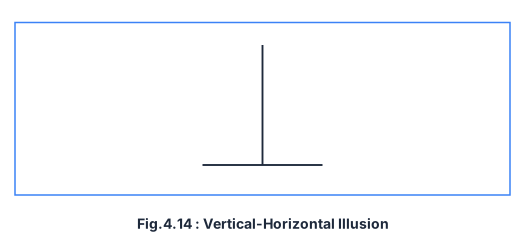
Fig.4.14: The Vertical-Horizontal Illusion — a vertical line and a horizontal line of equal physical length, meeting in an inverted-T shape; the vertical line is perceived as longer. Own-illustrated for this platform from the real NCERT page's own facts (composition, labels, and layout are recreated; the specific artistic …