Physical Education · Ch 4 — Physical Education & Sports for CWSN (Children With Special Needs)
Physical Disability
Physical Disability
A physical disability is the long-term loss or impairment of part of an individual's body function, resulting in a limitation of physical functioning, mobility, dexterity or stamina. Because of this functional loss, the person has difficulty performing normal body movements — walking and moving about, sitting and standing, using the hands and arms, controlling the muscles, and so on. As there are many different forms of physical disability, the Paralympics Committee groups athletes according to the degree of activity limitation their impairment causes and the specific demands of their sport.
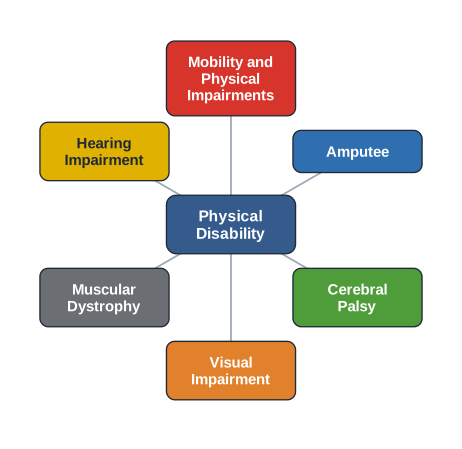
Drawn by us to help you understand the concept clearly, and verified to make sure it's accurate. For exams, practice from your NCERT textbook's own diagram.
A radial hub-and-spoke chart: a central node reads 'Physical Disability', and six labelled nodes branch out from it — Mobility and Physical Impairments, Amputee, Cerebral Palsy, Visual Impairment, Muscular Dystrophy and Hearing Impairment. It summarises, at a glance …
The textbook describes the following forms of physical disability:
A. Mobility and Physical Impairment (Locomotor Disabilities)
The person is unable to carry out the distinctive activities associated with the movement of the self and of objects, because of a problem of the musculoskeletal or nervous system, or both.
B. Amputation
The removal of a limb by trauma, medical illness or surgery. As a surgical measure it is used to control pain or a disease process (such as malignancy or gangrene) in the affected limb. A person whose limb has been amputated is called an amputee.
C. Cerebral Palsy
Cerebral means "to do with the brain" and palsy means weakness or problems with body movement. Cerebral Palsy (CP) is a group of non-progressive neurological conditions affecting body movement and muscle coordination, caused by damage to one or more specific areas of the brain that control movement, balance and posture — damage that usually occurs before, during or shortly after birth.
D. Dwarfism
A medical or genetic condition resulting in an adult height of 4 feet 10 inches (147 cm) or less.
E. Muscular Dystrophy
A group of hereditary genetic muscle diseases that weaken the muscles that move the body. Incorrect and missing information in the genes prevents the body from making the proteins it needs for healthy muscle, so the condition is marked by progressive skeletal-muscle weakness and the death of muscle cells and tissue.
F. Visual Impairment
Often defined as a best-corrected visual acuity worse than 20/40 or 20/60; blindness refers to complete or nearly complete loss of vision. It can make everyday activities such as reading, socialising and walking difficult.
- Blindness (after best correction) means any of: total absence of sight; visual acuity less than 3/60 (or less than 10/200 Snellen) in the better eye; or a field of vision subtending an angle of less than 10 degrees.
- Low-vision means any of: visual acuity not exceeding 6/18 (or less than 20/60 down to 3/60 or 10/200 Snellen) in the better eye with best correction; or a field of vision subtending an angle of less than 40 degrees down to 10 degrees.
G. Hearing Impairment
The inability to hear sounds adequately, due to improper development, damage or disease in any part of the hearing mechanism. Because hearing is a prerequisite for normal speech and language, it matters greatly for a child's development.
- Deaf — a person with 70 dB hearing loss in speech frequencies in both ears.
- Hard of hearing — a person with 60 dB to 70 dB hearing loss in speech frequencies in both ears.
H. Speech and Language Disability
A permanent disability arising out of conditions such as laryngectomy or aphasia, affecting one or more components of speech and language due to organic or neurological causes. …