Physical Education · Ch 5 — Physical Fitness, Wellness and Lifestyle
Components of Skill-Related Fitness
Components of Skill-Related Fitness
The skill-related components - also called motor-fitness components - are the parts of fitness that most affect performance in sport. There are six of them.
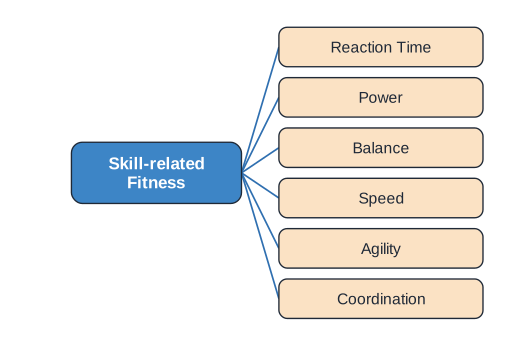
Drawn by us to help you understand the concept clearly, and verified to make sure it's accurate. For exams, practice from your NCERT textbook's own diagram.
Diagram showing the six skill-related (motor) components of physical fitness - speed, power, agility, balance, coordination and reaction time - arranged as spokes around the shared idea of sporting performance. Each spoke names one component; read together, the chart shows that a skilled performer rarely relies on just one of these abilities but draws on several of them at once - for example, a footballer dribbling past a defender combines agility, …
1. Reaction time
The ability to respond quickly to a stimulus - the interval between the presentation of a stimulus and the start of the muscular response. Examples: reacting to the starter's gun in a sprint, or a goalkeeper responding to a penalty kick.
2. Power
The ability to act fast against a resistance - a combination of strength and speed (explosive strength). Throwing the shot put, the long jump and a karate kick are power-dominant actions.
3. Balance
The ability to maintain equilibrium while moving or stationary. There are two kinds - static balance (equilibrium in a stationary position) and dynamic balance (equilibrium during motion).
4. Speed
The ability to perform a movement in the shortest possible time - the minimum time to complete the task. Examples: the 100 m and 200 m sprints, and ice hockey.
5. Agility
The ability to change the direction of the body rapidly and accurately. It is a combination of speed, balance, power and coordination. Rugby, football and hockey all demand agility.
6. Coordination
The ability to perform a motor task by using body movements and the senses accurately and fluently. Juggling in football, hitting a tennis ball and kicking a football are good examples.
How the six components combine in real sport
Few sporting actions use just one skill-related component in isolation - most actions blend two or more at once. A footballer dribbling past a defender uses agility (changing direction), balance (staying upright under contact), coordination (controlling the ball with the foot) and speed (accelerating away) almost simultaneously. Common field tests used to estimate these components include the shuttle run (agility), the standing broad jump or medicine-ball throw (power), the ruler-drop test (reaction time), the stork stand (static balance) and simple ball-and-wall coordination drills. …