Chemistry · Ch 5 — Thermodynamics
Work
Work
Work
Let us first examine how the internal energy changes when only work is done. Imagine a system containing some water inside a thermos flask or an insulated beaker. The walls of this container do not allow any heat to flow between the system and its surroundings. Such a wall is called an adiabatic wall, and the process that occurs inside is called an adiabatic process.
An adiabatic process is one in which no heat is transferred between the system and the surroundings ().
Now, we want to change the state of this system by doing work on it. Let the initial state be called state A, with temperature and internal energy . We can change the system to a new state state B in two different ways.
First way: We do mechanical work — say, 1 kJ — by rotating a set of small paddles that churn the water. The new state B has a temperature , and we find that . The change in temperature is , and the change in internal energy is .
Second way: We do an equal amount of electrical work — again, 1 kJ — using an immersion rod. We measure the temperature change and find it is exactly the same as before: .
These experiments were performed by J. P. Joule between 1840 and 1850. He showed that a given amount of work done on the system, no matter how it was done (irrespective of the path), produced the same change of state, as measured by the change in temperature of the system.
This leads to a crucial idea: we can define a quantity, the internal energy , whose value is characteristic of the state of the system. The adiabatic work, , required to bring about a change of state is equal to the difference between the value of in one state and that in another state.
Therefore, internal energy, , of the system is a state function. Its value depends only on the current state of the system, not on how that state was reached.
By IUPAC convention in chemical thermodynamics, is positive when work is done on the system (the internal energy of the system increases). If the system does work on the surroundings, is negative (the internal energy decreases). This is the opposite of the sign convention still used in some physics textbooks. …
Drawn by us to help you understand the concept clearly, and verified to make sure it's accurate. For exams, practice from your NCERT textbook's own diagram.
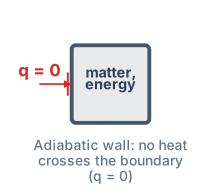
The figure shows a cylindrical container placed inside a larger region labelled "surroundings." The container itself is the system. A thick, prominent arrow is drawn crossing the boundary of the cylinder, and beside it is written . This arrow is the entire point of the diagram: it tells you that no heat flows across the wall of the container, even though the system and surroundings are in contact.
The wall of the cylinder is drawn as a thick, solid line — this represents an adiabatic wall. An adiabatic wall is a perfect thermal insulator. It does not allow heat to pass through it, regardless of the temperature difference between the inside and the outside. The diagram makes this explicit by showing the arrow labelled crossing the boundary, meaning the heat transfer is zero.
Inside the vessel, the labels "Matter" and "Energy" with looping arrows show that both remain confined within the system — whatever conversions happen inside (a reaction releasing heat, energy changing form), nothing crosses the wall as heat. The blocked white arrow at the wall, marked , is the visual statement of that restriction.
Do not confuse an adiabatic system with an isolated system. An isolated system (like a thermos flask) allows no exchange of either matter or energy in any form. An adiabatic system allows no exchange of heat, but it can still exchange energy as work (e.g., a piston compressing the gas inside). The figure shows only the heat barrier; work can still cross the boundary.
The physical idea the figure teaches is the first law of thermodynamics applied to a special case. The first law states:
where is the change in internal energy of the system, is the heat transferred into the system, and is the work done on the system. For the adiabatic system in the figure, , so the first law reduces to:
This is the key formula the textbook develops with this figure. It means that in an adiabatic process, any change in the internal energy of the system is entirely due to work done on or by the system. If you compress the gas (work done on the system, ), the internal energy increases and the temperature rises. If the gas expands against a piston (work done by the system, ), the internal energy decreases and the temperature falls. No heat is involved. …