Mathematics · Ch 1 — Sets
Difference of Sets
Difference of Sets
The Difference of Two Sets
The difference of two sets is a fundamental operation that tells us what is in one set but not in the other. The order matters here — is not the same as in general.
Definition. For two sets and , the difference (read as "A minus B") is the set of all elements that belong to but do not belong to .
In set-builder notation:
The operation is also sometimes written as , but the textbook uses .
Do not confuse with subtraction of numbers. It is a set operation, not arithmetic. The result is always a set, never a number.
Venn Diagram Representation
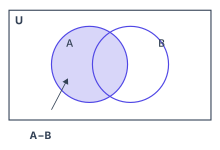
The shaded region in the Venn diagram below represents — the part of that lies outside .
[Venn diagram: Two overlapping circles labelled A and B. The region of A that does not overlap with B is shaded.]
The diagram makes it clear: is the part of that is exclusive to , not shared with .
A Key Property: Mutual Disjointness
The three sets , , and are mutually disjoint. This means the intersection of any two of them is the empty set .
Why is this true? Consider any element .
- If , then and . So cannot be in (which requires ) and cannot be in (which requires ).
- If , then , so and .
- If , then and , so and . …
Drawn by us to help you understand the concept clearly, and verified to make sure it's accurate. For exams, practice from your NCERT textbook's own diagram.
Fig 1.8 is the standard Venn diagram for the difference of two sets. The rectangle represents the universal set. Inside it are two overlapping circles, labelled (on the left) and (on the right). The region that is shaded is the part of that does not overlap with — that is, the crescent-shaped portion of lying entirely outside . An arrow points to this shaded region, and it is labelled .
The physical idea is simple: you take everything in , and then you remove whatever also belongs to . What remains is the difference. The diagram makes it visually clear that and are completely different regions — would be the crescent of outside , which is not shaded here.
Every symbol in this definition has a precise meaning:
- is read as “A minus B” — the order matters.
- is set-builder notation: “the set of all such that …”.
- means is an element of .
- means is not an element of .
The figure also sets up an important observation that the textbook makes in the remark: the three sets , , and are mutually disjoint — no two of them share any element. You can see this in Fig 1.8 alone: the shaded region () does not touch the overlapping region (), and the unshaded crescent of () is separate from both. Their intersections are all empty. …
Drawn by us to help you understand the concept clearly, and verified to make sure it's accurate. For exams, practice from your NCERT textbook's own diagram.
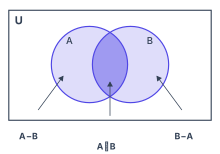
Fig 1.9 is a Venn diagram that shows the three mutually disjoint pieces into which any two sets A and B partition the universal set U. The rectangle U contains two overlapping circles labelled A and B. The diagram is divided into three distinct regions, each marked with an arrow and a label:
- The left crescent (the part of A that does not overlap B) is labelled A − B.
- The central lens where the two circles overlap is labelled A ∩ B and is shaded with a deeper tone to distinguish it from the other two regions.
- The right crescent (the part of B that does not overlap A) is labelled B − A.
The key idea the figure teaches is that these three regions — A − B, A ∩ B, and B − A — are mutually disjoint. No two of them share any element. Their union is the entire set A ∪ B, and together with the region outside both circles (which is (A ∪ B)′), they form a partition of U.
The sets , , and are pairwise disjoint:
The textbook uses this figure to reinforce the definition of set difference. For any two sets A and B:
The diagram makes it visually clear that A − B and B − A are generally different sets (unless A = B, in which case both are empty). It also shows why the remark in the textbook holds: the three pieces are disjoint because an element cannot simultaneously belong to A and not belong to A, nor can it be both in A ∩ B and outside the overlap.
A common mistake is to think that A − B and B − A are complements of each other within A ∪ B. They are not — the complement of A − B inside A ∪ B is (A ∩ B) ∪ (B − A), not just B − A. The figure helps avoid this confusion by showing all three pieces separately. …