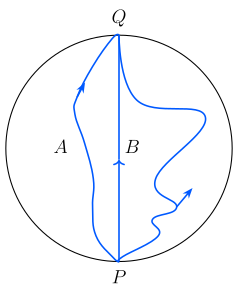
Q.Three girls skating on a circular ice ground of radius 200 m start from a point P on the edge of the ground and reach a point Q that is diametrically opposite to P, each following a different path across the ground. The first girl follows a curved path that bulges out to the left, the second girl travels along the straight diameter directly from P to Q, and the third girl follows a wavy (zig-zag) path that bulges out to the right, as shown below.
🔒You're viewing a preview — the full solution, concept, methods & PYQ mapping are locked.
🔒 Start your 14-day free trial to unlock the full solution →Concept understanding — Displacement Magnitude
Displacement Magnitude — The Straight-Line Shortcut
Imagine you walk 3 steps east, then 4 steps north. You end up at a spot that's not 7 steps away from where you started — it's only 5 steps away, diagonally. That 5 steps is your displacement magnitude.
Here's the core idea: displacement magnitude is the straight-line distance between where you began and where you ended. It doesn't care about the twists and turns of your actual path. It's the "as the crow flies" distance.
The Precise Definition
Displacement is a vector — it has both a direction and a magnitude. The magnitude of displacement (often written as ∣s∣ or simply s) is the length of that vector. Mathematically, if your initial position is (x1,y1) and your final position is (x2,y2), then:
∣s∣=(x2−x1)2+(y2−y1)2
This is just the distance formula from coordinate geometry. For the 3-step east, 4-step north example:
∣s∣=32+42=9+16=25=5 units
Never confuse displacement magnitude with total distance travelled. In the example above, the total distance walked was 3+4=7 units, but the displacement magnitude was only 5 units. They are equal only when you move in a perfectly straight line without changing direction.
Why This Matters in Physics
In kinematics problems, displacement magnitude tells you the net effect of motion. When a car drives around a circular track and returns to the starting point, its displacement magnitude is zero — even though it travelled hundreds of metres. The car ended up exactly where it began.
For motion along a straight line (say, the x-axis), the displacement magnitude simplifies to:
∣s∣=∣x2−x1∣
That's just the absolute difference between final and initial positions. No square roots needed.
A Quick Check
If a particle moves from x=2 m to x=−3 m, what's the displacement magnitude? …
The displacement is the straight P-to-Q line, which equals the diameter 2R=400 m for all three girls. It equals the path length only for the girl who skates along the straight diameter.
Displacement depends only on the endpoints. Since P and Q are diametrically opposite, ∣displacement∣=2R=2×200=400 m for every girl. Path length equals this only when the route is a straight line — the middle girl on the diame …
All three girls start at P and finish at the diametrically opposite point Q, so each has the same displacement — a straight P-to-Q line whose magnitude equals the diameter, 2×200=400 m. Only the girl who skates along the straight diameter has a path length equal to this displacement.
Concept
The displacement is the straight-line vector from the initial position to the final position; its magnitude depends only on the endpoints, not on the route taken. The path length depends on the actual route travelled and is always greater than or equal to the displacement magnitude.
Given
- Radius of the ground R=200 m.
- P and Q are diametrically opposite, so the segment PQ is a diameter.
Displacement magnitude
Because all three girls begin at P and end at Q,
∣displacement∣=PQ=2R=2×200=400 m
for each of them, regardless of the curved route followed.
Path length equal to displacement …
Concept: Coordinates Plus the Shortest-Path Theorem
Method: Place P,Q on Coordinates, Compute Displacement by the Distance Formula, Then Invoke the Shortest-Path Theorem for the Path-Length Comparison
Rather than reasoning purely verbally ("displacement only depends on endpoints"), this method sets up explicit coordinates for P and Q, computes the displacement vector's magnitude directly by the distance formula, and then settles the path-length question by citing the general mathematical theorem that a straight line is the unique shortest curve joining two points.
Step 1 -- Place the circle on coordinates
Let the centre of the circular ground be the origin, with radius R=200 m. Since P and Q are diametrically opposite, place them at the two ends of a diameter along the x-axis:
P=(−200,0),Q=(200,0)
Step 2 -- Displacement vector, by the distance formula
The displacement for any of the three girls is the same vector PQ, since all three start at P and end at Q -- regardless of the route taken between:
PQ=Q−P=(200−(−200), 0−0)=(400, 0)
∣PQ∣=4002+02=400 m
Step 3 -- Invoke the shortest-path theorem for the path-length question
A standard theorem of Euclidean geometry states: among all curves connecting two given points, the straight-line segment joining them is the unique curve of minimum length; every other curve connecting the same two points is strictly longer.
Applying this directly:
- The middle girl's path is the straight segment PQ itself, so her path length equals exactly ∣PQ∣=400 m -- matching the displacement magnitude exactly. …
Showing the 12 most recent of 14 on this concept.
- CBSE 2026Set ANNUAL1 markQ.A boy went to market from his home, the distance of market to his home is 5 km. He found that market was closed, then he returned to his home. Total displacement covered by boy is ............. .
›Reveal solutionSolution
Displacement depends only on the start and end points; since the boy returns to his starting point, his net displacement is zero.
Displacement is a vector quantity equal to the straight-line change in position, i.e. (final position) − (initial position). Distance, by contrast, is the total path length actually travelled, regardless of direction.
The boy starts at home, walks 5 km to the market (distance = 5 km), finds it closed, and walks back the same 5 km to home (distance = 5 km). So the total distance covered is 5+5=10 km.
…
- CBSE 2025Set ANNUAL1 markMCQQ.A particle moves along the curved path of a quarter circle, calculate the ratio of distance to displacement:(a) 11 : 7(b) 11 : 7√2(c) 7 : 11(d) 7 : 11√2
›Reveal solutionSolution
Distance is the arc length along the quarter circle; displacement is the straight-line chord joining the start and end points. Their ratio works out to 11:72 when π is taken as 22/7.
Let the radius of the circle be r.
Distance travelled (arc length of a quarter circle):
d=(1/4)(2πr)=πr/2
Using π=22/7: d=(22/7)(r)/2=11r/7
…
- CBSE 2024Set ANNUAL1 markMCQQ.A particle completes circular path of radius r, displacement of particle will be :(a) 2πr(b) 2π(c) πr(d) zero
›Reveal solutionSolution
Completing one full circle brings the particle back to its starting point, so displacement = 0 (even though distance travelled = 2πr).
Displacement is defined as the shortest straight-line vector joining the initial and final positions of the particle, irrespective of the path taken. Distance, by contrast, is the total length of the actual path travelled.
For a particle that completes one full revolution of a circle of radius r:
- Distance travelled = circumference = 2πr …
- CBSE 2023Set annual1 markQ.A man arrived at Delhi Railway Station and wanted to go to his relative's house 10 km away from the station. He hired a taxi to reach the destination. The driver followed a long path of 25 km to reach the destination in one hour and charged for 25 km from the man. Comment on the behaviour of driver.
›Reveal solutionSolution
The driver behaved dishonestly by taking an unnecessarily long route and overcharging the passenger for it.
The straight-line distance between the railway station and the relative's house is only 10 km, but the driver deliberately drove a longer path of 25 km and then charged the passenger the fare for the full 25 km travelled.
This behaviour is dishonest and unethical: the driver exploited the passenger's unfamiliarity with the city to take a needlessly longer route purely to increase his fare/earnings, at the direct cost of the passenger's money and time. A responsible and honest driver should take the shortest practical route to the destination and charge fairly for the actual necessary distance, not deliberately inflate it.
…
- CBSE 2023Set ANNUAL1 markMCQQ.An object is moving on circular path of radius R. Displacement of object in T/2 time will be:(a) πR(b) 2R(c) 2πR(d) πR^2
›Reveal solutionSolution
Displacement in half a revolution = diameter = 2R.
In one full period T the particle completes one revolution. In time T/2 it covers half the circle and arrives at the point diametrically opposite its start.
…
- CBSE 2022Set TERM11 markMCQQ.A runner covers a circular path of radius R in 40 seconds. His displacement after 2 minute 20 seconds is(1) zero(2) 2 R(3) 2 pi R(4) 7 pi R
›Reveal solutionSolution
2 minutes 20 seconds = 3.5 revolutions of the 40-second lap. After a half-integer number of laps, the runner sits at the point diametrically opposite the start -- displacement = diameter = 2R.
Time for one complete circuit = 40 s.
Total time elapsed = 2 min 20 s = 140 s.
Number of laps = 140 / 40 = 3.5 laps.
…
- CBSE 2022Set TERM11 markMCQQ.A body starts from a point A, travels to a point B at a distance of 1.5 km and returns to A. If he takes one hour to do so, his average velocity is(1) 3 km/h(2) zero(3) 1.5 km/h(4) 2 km/h
›Reveal solutionSolution
Average velocity depends on DISPLACEMENT (a vector), not distance. A round trip back to the start has zero net displacement, so average velocity is zero even though the body clearly moved and took time to do so.
Average velocity = (total displacement) / (total time taken).
…
- CBSE 2022Set ANNUAL1 markMCQQ.A particle completes semicircular path of radius r, displacement travelled by particle will be:(a) r/4(b) r/2(c) 2r(d) 4r
›Reveal solutionSolution
On a semicircular path of radius r, the particle's displacement is the diameter, 2r — not the arc length πr.
Concept. Distance is the total path length covered; displacement is the vector from the initial position to the final position (straight line).
For a particle moving along a semicircular arc of radius r:
- Distance travelled =πr (half the circumference). …
- CBSE 2022Set ANNUAL1 markQ.A body covers a distance L m along a semicircular path. What is the magnitude of displacement of the body?
›Reveal solutionSolution
For a semicircular path of arc length L, the displacement equals the diameter of the circle, which works out to 2L/π.
Step 1: Relate arc length to radius.
For a semicircle of radius r, the arc length (the "distance" travelled along the curved path) is:
L = πr
So the radius is:
r = L/π
Step 2: Identify the displacement.
The body starts at one end of the semicircular arc and ends at the diametrically opposite end. Displacement is the straight-line vector from start to finish — for a semicircle, that straight line is exactly the diameter of the circle.
Displacement = 2r
Step 3: Substitute r = L/π. …
- CBSE 2021Set ANNUAL1 markMCQQ.A particle completes semicircular path of radius r. The ratio of distance travelled and displacements of particle will be :(a) π/4(b) π/2(c) 3π/4(d) π
›Reveal solutionSolution
Distance travelled along a semicircle is half the circumference; displacement is just the diameter joining the start and end points.
For a particle moving along a semicircular arc of radius r:
Distance travelled = arc length of a semicircle =πr (half of the full circumference 2πr).
…
- CBSE 2021Set TERM11 markMCQQ.A person starts his journary from his home at 9.00 A.M. to his office and come back to his home at 5.00 P.M. His office is 30 Km from his home, then the displacement in his motion is:(a) 30 Km(b) Zero(c) Not defined(d) None of these
›Reveal solutionSolution
Displacement depends only on the initial and final position, not on the path taken; leaving home and returning home means the final position coincides with the initial position, so displacement = 0.
Displacement is defined as the vector joining the initial position to the final position of a body, irrespective of the actual path followed. Distance, on the other hand, is the total length of the path travelled.
…
- CBSE 2020Set ANN1 markQ.Four pairs of initial and final positions of a body along an x axis are given. Which pair gives a positive displacement of the body ?(a) -10 m, +15 m(b) -5 m, -12 m(c) 2 m, -5 m(d) 2 m, 1m
›Reveal solutionSolution
Displacement = final position − initial position. Only the pair (-10 m, +15 m) gives a positive value.
For each pair (initial position x₁, final position x₂), displacement Δx = x₂ − x₁:
- x₁ = −10 m, x₂ = +15 m → Δx = 15 − (−10) = +25 m (positive)
- x₁ = −5 m, x₂ = −12 m → Δx = −12 − (−5) = −7 m (negative) …
🎓Unlock everything free for 14 days
- ✓Full step-by-step solutions
- ✓Concept-first explanations
- ✓Methods, shortcuts & mistakes
- ✓PYQ mapping + timed mock tests
Full access for 14 days. No credit card required.