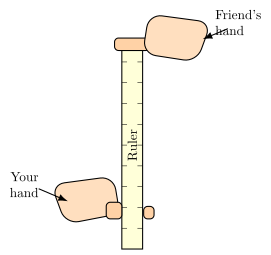
Q.Reaction time: When a situation demands our immediate action, it takes some time before we really respond. Reaction time is the time a person takes to observe, think and act. For example, if a person is driving and suddenly a boy appears on the road, then the time elapsed before he slams the brakes of the car is the reaction time. Reaction time depends on complexity of the situation and on an individual. You can measure your reaction time by a simple experiment. Take a ruler and ask your friend to drop it vertically through the gap between your thumb and forefinger. After you catch it, find the distance d travelled by the ruler. In a particular case, d was found to be 21.0 cm. Estimate reaction time.
🔒You're viewing a preview — the full solution, concept, methods & PYQ mapping are locked.
🔒 Start your 14-day free trial to unlock the full solution →Concept understanding — Reaction Time Measurement
Reaction Time Measurement – From Intuition to Precision
Imagine you're sitting in a car at a traffic light. The moment it turns green, you need to lift your foot off the brake and press the accelerator. There's a tiny gap between seeing the green light and actually moving your foot. That gap is your reaction time — the delay between a stimulus (the light) and your response (the foot movement).
This delay isn't laziness or slowness. It's a fundamental property of how your nervous system works. Your eyes detect the light, send a signal to your brain, your brain processes it and decides to move, then sends a command down your spinal cord to your leg muscles. All of that takes time — typically a few tenths of a second.
The core idea
Reaction time measurement is simply the process of quantifying that delay under controlled conditions. You present a stimulus (a flash, a sound, a touch) and record exactly when the person responds. The difference between the two timestamps is the reaction time.
Reaction time is not the same as reflex. A reflex (like pulling your hand from a hot stove) bypasses the brain entirely — it's faster and involuntary. Reaction time involves conscious decision-making.
How it's measured in practice
The simplest setup is a ruler drop test. One person holds a ruler vertically, and the other places their thumb and forefinger at the bottom, ready to catch it. The holder drops the ruler without warning. The catcher grabs it as fast as possible. The distance the ruler falls before being caught tells you the reaction time — because you know the acceleration due to gravity (g≈9.8m/s2).
The formula comes from kinematics:
s=21gt2
Rearranging for time:
t=g2s
If the ruler fell 20 cm (0.2m), the reaction time is:
t=9.82×0.2≈0.0408≈0.202seconds
That's about 200 milliseconds — a typical human reaction time for a visual stimulus.
The precise statement
Reaction time=tresponse−tstimulus
Where tstimulus is the moment the stimulus is presented, and tresponse is the moment the response is detected. Both must be measured with the same clock or synchronized timing system.
What affects reaction time
- Stimulus modality: Sound reaches the brain faster than light (auditory reaction times are about 140–160 ms, visual about 180–200 ms).
- Age: Children and elderly people tend to have slower reaction times.
- Fatigue, alcohol, distractions: All increase reaction time.
- Practice: Repeated exposure can slightly improve it, but there's a biological lower limit.
A common mistake to avoid …
The key idea is that the ruler is in free fall under gravity during the reaction time, so the distance it falls relates directly to the time elapsed.
- The ruler starts from rest (u=0) and falls with acceleration g=9.8 m/s2 (taking standard value).
- Using the equation of motion: d=21gt2, where d=21.0 cm=0.210 m. …
The reaction time is estimated by modelling the ruler’s fall as free fall under gravity. Using d=21gt2 with d=21.0 cm and g=9.8 m/s2, we get t≈0.207 s.
The idea behind this experiment is beautifully simple. When your friend releases the ruler, it begins to fall freely under gravity. Your job is to catch it as fast as you can after you see it drop. The distance the ruler falls before you catch it is directly related to how long it took your brain and muscles to react — that’s your reaction time. Because the ruler starts from rest and accelerates uniformly (ignoring air resistance), we can use the equations of motion for constant acceleration.
The key assumption is that the ruler’s motion is pure free fall, so its acceleration is g=9.8 m/s2 downward. The distance d it falls in time t is given by d=21gt2, since initial velocity is zero. We just need to solve for t.
-
Convert distance to metres. The given d=21.0 cm must be in SI units to match g in m/s2.
d=21.0 cm=0.210 m.
-
Write the free-fall equation.
d=21gt2
- Solve for t.
t2=g2d
t=g2d
- Substitute the numbers.
t=9.82×0.210=9.80.420
Compute the fraction:
9.80.420=0.042857…
Then take the square root:
t=0.042857≈0.207 s …
Concept: Deriving the Free-Fall Distance Formula from the v-t Graph, Then Inverting It
Method: Build the d=21gt2 Relation from Its Graph, Rather Than Recalling It
Instead of directly quoting d=21gt2 and solving for t, this method derives that formula from scratch as the area under the ruler's v-t graph, which also makes clear why the exponent on t is exactly 2.
Steps
-
Model the ruler's fall. Released from rest, the ruler undergoes free fall: v(t)=0+gt=gt — a straight line through the origin on a v-t graph, with slope g.
-
Distance fallen = area under this line, from 0 to t. That region is a triangle with base t and height v(t)=gt:
d=21×base×height=21t(gt)=21gt2
This is the formula used by the direct method — here it's derived, not recalled.
- Convert the measured distance to SI units:
d=21.0 cm=0.210 m
- Invert the relation to solve for t:
t=g2d
- Substitute g=9.8 m s−2: …
Showing the 12 most recent of 21 on this concept.
- TG EAPCET 2026Set eng-2026-05-10-FN1 markMCQQ.For a body thrown vertically upwards from the ground, if the time interval between the two instances when the body is at a height of 60 m is 4 s, then the maximum height reached by the body is (Acceleration due to gravity =10 ms−2) (A) 150 m (B) 90 m (C) 120 m (D) 80 m
›Reveal solutionSolution
The problem uses the symmetry of vertical motion to find the velocity at a given height, which then allows us to calculate the initial projection velocity and finally the maximum height. The maximum height reached by the body is 80 m.
The key to solving this problem efficiently lies in understanding the symmetry of motion under gravity. When a body is thrown vertically upwards, it follows a symmetrical path. This means:
- The time taken to reach a certain height while going up is equal to the time taken to fall back to that same height while coming down.
- The speed of the body at any given height while going up is equal in magnitude to its speed at the same height while coming down.
- The time taken to travel from a certain height to the maximum height is equal to the time taken to fall from the maximum height back to that same height.
In this problem, the body is at a height of 60 m at two instances, separated by 4 s. This 4 s interval represents the time it takes for the body to travel from 60 m (while going up) to its maximum height, and then fall back down to 60 m (while coming down). Due to symmetry, the time taken to go from 60 m to the maximum height is exactly half of this interval.
Let's use this insight to solve the problem step-by-step. We will take the upward direction as positive and the acceleration due to gravity g=10 ms−2 as acting downwards, so a=−g=−10 ms−2.
- Determine the velocity of the body at the height of 60 m: The time interval between the two instances when the body is at 60 m is 4 s. This means the time taken for the body to travel from 60 m upwards to the maximum height and then fall back to 60 m is 4 s. By symmetry, the time taken to travel from the height of 60 m to the maximum height is half of this interval:
tup from 60m=24 s=2 s
At the maximum height, the final velocity of the body is $0\ \mathrm{ms}^{-1}$. Let $v_{60}$ be the velocity of the body when it is at $60\ \mathrm{m}$ and moving upwards. We can use the first equation of motion for the journey from $60\ \mathrm{m}$ to the maximum height:v=v60+at
Here, $v = 0\ \mathrm{ms}^{-1}$ (at max height), $a = -g = -10\ \mathrm{ms}^{-2}$, and $t = 2\ \mathrm{s}$.0=v60+(−10)(2)
0=v60−20
v60=20 ms−1
So, the speed of the body when it is at a height of $60\ \mathrm{m}$ (while going up) is $20\ \mathrm{ms}^{-1}$.2. Determine the initial velocity of projection from the ground: …
- TG EAPCET 2026Set eng-2026-05-11-AN1 markMCQQ.A body is projected from a point which is at a height of 5m from the ground with a velocity of 28ms−1 at an angle of 30∘ above the horizontal. The horizontal distance travelled by the body when it reaches a point which is at a height of 2m from the ground is (Acceleration due to gravity =10ms−2) (A) 1263 m (B) 213 m (C) 423 m (D) 283 m
›Reveal solutionSolution
The key is to treat the motion as a projectile launched from a height, solve the vertical quadratic for the time when height = 2 m, then multiply the horizontal velocity by that time. The horizontal distance is 423 m, so the correct option is (C).
We start by recalling that projectile motion separates into independent horizontal and vertical components. The horizontal velocity stays constant (no air resistance), while the vertical motion is uniformly accelerated by gravity. The problem gives a launch from 5 m above ground, and we want the horizontal distance when the projectile is at 2 m above ground — that is, a vertical displacement of –3 m from the launch point.
-
Resolve initial velocity into components
Launch speed u=28 m/s, angle θ=30∘.
Horizontal: ux=ucos30∘=28⋅23=143 m/s.
Vertical: uy=usin30∘=28⋅21=14 m/s.
-
Set up the vertical displacement equation
Take upward as positive. Launch height y0=5 m, final height y=2 m, so vertical displacement sy=y−y0=−3 m.
Using sy=uyt+21at2 with a=−g=−10 m/s2:
−3=14t−5t2.
- Solve the quadratic for time Rearranging: 5t2−14t−3=0. Multiply by –1 if preferred: 5t2−14t−3=0. Discriminant: Δ=(−14)2−4⋅5⋅(−3)=196+60=256. Δ=16. …
-
- TG EAPCET 2026Set ap-2026-05-04-AN1 markMCQQ.A body is projected from certain height with an initial velocity 'u' making an angle 'θ' above the horizontal. The time taken for its vertical and horizontal displacements to become equal is (A) g2u(sinθ+cosθ) (B) g2usinθ (C) gu(sinθ−cosθ) (D) gusinθ
›Reveal solutionSolution
This problem asks for the time when the horizontal and vertical displacements of a projectile become equal. While "equal displacements" strictly means x=y, in multiple-choice questions, it can sometimes imply "equal magnitudes of displacement" (∣x∣=∣y∣). Assuming the latter, and considering the case where the body has fallen below its projection height, the time taken is g2u(sinθ+cosθ).
When a body is projected, its motion can be analyzed by separating it into horizontal and vertical components. The key idea is that these two components of motion are independent, except that they share the same time duration.
- Horizontal Motion: There is no acceleration in the horizontal direction (assuming negligible air resistance). Thus, the horizontal velocity remains constant.
- Vertical Motion: The body experiences constant acceleration due to gravity, acting downwards.
Let's set up the equations for displacement. We'll take the point of projection as the origin (0,0), the horizontal direction as the positive x-axis, and the upward vertical direction as the positive y-axis.
-
Resolve the initial velocity:
The initial velocity 'u' is given at an angle 'θ' above the horizontal. We resolve it into its horizontal and vertical components:
- Horizontal component of initial velocity: ux=ucosθ
- Vertical component of initial velocity: uy=usinθ
-
Write expressions for horizontal and vertical displacement:
Using the equations of motion:
- For horizontal displacement (x): Since there is no horizontal acceleration, x=uxt.
x=(ucosθ)t(1)
* For vertical displacement ($y$): The acceleration is $a_y = -g$ (downwards). Using $s = ut + \frac{1}{2}at^2$:y=(usinθ)t−21gt2(2)
-
Interpret "displacements to become equal":
The phrase "vertical and horizontal displacements to become equal" can be interpreted in two ways:
- Strict interpretation: The actual displacement values are equal, i.e., x=y.
- Common interpretation in competitive exams (sometimes): The magnitudes of the displacements are equal, i.e., ∣x∣=∣y∣.
Let's analyze both:
- Case 1: Strict interpretation (x=y) Set equation (1) equal to equation (2):
(ucosθ)t=(usinθ)t−21gt2
Rearrange the terms to form a quadratic equation in $t$:21gt2+(ucosθ−usinθ)t=0
Factor out $t$:t(21gt+u(cosθ−sinθ))=0
This gives two possible solutions for $t$: 1. $t = 0$: This is the initial moment when both displacements are zero, so they are equal. This is a trivial solution. 2. $\frac{1}{2}gt + u (\cos\theta - \sin\theta) = 0$ $\frac{1}{2}gt = -u (\cos\theta - \sin\theta)$ $\frac{1}{2}gt = u (\sin\theta - \cos\theta)$t=g2u(sinθ−cosθ)
For this time $t$ to be positive (a physically meaningful time *after* projection), we must have $\sin\theta - \cos\theta > 0$, which means $\sin\theta > \cos\theta$, or $\tan\theta > 1$. This implies $\theta > 45^\circ$. If $\theta \le 45^\circ$, then $x=y$ only at $t=0$. This result, $\frac{2u (\sin\theta - \cos\theta)}{g}$, is not directly available in the given options. Option (C) is $\frac{u (\sin\theta - \cos\theta)}{g}$, which is half of this value. This suggests a potential error in the options or the question's intended meaning. * **Case 2: Magnitudes of displacements are equal ($|x| = |y|$)** Since the body is projected with an angle $\theta$ above the horizontal (implying $0 < \theta < 90^\circ$), the horizontal displacement $x = (u \cos\theta) t$ will always be positive for $t > 0$. So, $|x| = x$. Thus, we need $x = |y|$. This leads to two sub-cases: * **Sub-case 2a: $x = y$** (This is the same as Case 1 above). This gives $t = \frac{2u (\sin\theta - \cos\theta)}{g}$, valid for $\theta > 45^\circ$. * **Sub-case 2b: $x = -y$** (This means the vertical displacement is negative, i.e., the body has fallen below its initial projection height). Set equation (1) equal to the negative of equation (2): $$(u \cos\theta) t = - \left( (u \sin\theta) t - \frac{1}{2}gt^2 \right)$$ … - TG EAPCET 2025Set eng-2025-05-02-FN1 markMCQQ.A helicopter flying horizontally with a velocity of 288 kmph drops a bomb. If the line joining the point of dropping the bomb, and the point where bomb hits the ground makes an angle 45∘ with the horizontal, then the height at which the bomb was dropped is (Acceleration due to gravity = 10 ms−2) (A) 1320 m (B) 1280 m (C) 320 m (D) 640 m
›Reveal solutionSolution
The bomb keeps the helicopter's horizontal speed 80 m/s while falling freely. A 45∘ release-to-impact line means the vertical drop equals the horizontal range, giving h=1280 m — option (B).
Concept
Dropped from the helicopter, the bomb has constant horizontal velocity and free-fall vertical motion. The straight line from release to impact makes 45∘ with the horizontal, so its vertical drop h equals its horizontal range R.
Solution
Convert the speed: 288 km/h=288×36001000=80 m/s.
The 45∘ condition gives …
- TG EAPCET 2025Set eng-2025-05-02-FN1 markMCQQ.The initial and final velocities of a body projected vertically from the ground are 20 ms−1 and 18 ms−1 respectively. The maximum height reached by the body is (Acceleration due to gravity =10 ms−2) (A) 20 m (B) 16.2 m (C) 19 m (D) 18.1 m
›Reveal solutionSolution
With air resistance, the upward retardation exceeds the downward one, so the return speed (18 ms−1) is less than the launch speed (20 ms−1). Combining both legs gives H=18.1 m — option (D).
Concept
The launch speed is 20 ms−1 but the body returns at only 18 ms−1, so a constant resistive force f acts opposite to motion. Going up the deceleration is g+f/m; coming down the acceleration is g−f/m. The same maximum height H appears in both legs.
Solution
Upward leg (start 20, top 0):
202=2(g+mf)H.
Downward leg (top 0, ground 18): …
- TG EAPCET 2025Set eng-2025-05-02-AN1 markMCQQ.A body projected vertically up with an initial speed of 10ms−1 reaches the point of projection after sometime with a speed of 8ms−1. The maximum height reached by the body is (Acceleration due to gravity =10ms−2) (A) 5m (B) 3.2m (C) 4.1m (D) 4.5m
›Reveal solutionSolution
The body loses mechanical energy due to air resistance, so we use the work–energy theorem between launch and the top of the path. The maximum height is found to be 4.1m, which corresponds to option (C).
The key idea is that the body does not return to the starting point with the same speed — it comes back at 8m/s instead of 10m/s. This tells us that some non‑conservative force (air resistance) has done negative work. We cannot simply use conservation of mechanical energy. Instead, we apply the work–energy theorem to relate the loss in kinetic energy to the work done against air resistance, and then use that to find the maximum height.
- Identify the energy loss When the body is projected upward with speed u=10m/s, its initial kinetic energy is
Ki=21mu2=21m(10)2=50m.
When it returns to the same point, its speed is v=8m/s, so its final kinetic energy is
Kf=21mv2=21m(8)2=32m.
The loss in kinetic energy is
ΔK=Kf−Ki=32m−50m=−18m.
This energy is dissipated by air resistance over the whole round trip.
- Work done by air resistance on the upward journey Air resistance always opposes motion. On the way up, it does negative work; on the way down, it also does negative work. Because the path up and down are symmetric in distance (same height h), and the resistive force depends only on speed (not direction), the work done by air resistance on the upward leg equals the work done on the downward leg. Let Wair be the work done by air resistance on the upward journey. Then the total work done over the round trip is 2Wair. By the work–energy theorem, the total work done by all forces equals the change in kinetic energy. Gravity does zero net work over the round trip (since the body returns to the same height), so
2Wair=ΔK=−18m.
Hence
Wair=−9m.
- Apply work–energy theorem to the upward journey only On the way up, the body starts at ground level with speed 10m/s and reaches maximum height h where its speed is 0. The forces acting are gravity (doing negative work) and air resistance (doing work Wair=−9m). …
- TG EAPCET 2025Set ap-2025-04-30-FN1 markMCQQ.A body X is allowed to fall freely from a height of 125 m from the ground and another body Y is thrown at the same instant vertically upwards with a velocity of 50ms−1 from the ground. The relative velocity of the body Y with respect to the body X when they cross each other is (A) 125ms−1 (B) 100ms−1 (C) 50ms−1 (D) 25ms−1
›Reveal solutionSolution
Both bodies have the same acceleration (gravity), so their relative velocity is constant and equals the initial relative velocity. The answer is 50ms−1.
The key insight here is that when two objects move under the same uniform acceleration — in this case, gravity — their relative acceleration is zero. That means their relative velocity does not change with time. So instead of finding the moment they cross and calculating velocities then, we can simply use the initial relative velocity.
Let’s see why.
-
Set up the motion equations.
Take upward as positive. For body X (dropped from height 125 m):
Initial velocity uX=0, acceleration aX=−g (taking g=10ms−2 for convenience, though the exact value cancels).
For body Y (thrown upward from ground):
Initial velocity uY=+50ms−1, acceleration aY=−g.
-
Relative acceleration.
aYX=aY−aX=(−g)−(−g)=0.
Since relative acceleration is zero, the relative velocity vYX is constant throughout the motion.
-
Initial relative velocity.
At t=0,
vYX(0)=uY−uX=50−0=50ms−1.
Because relative acceleration is zero, this remains the relative velocity at every instant — including the moment they cross.
Watch outA common mistake is to first find the time of crossing, then compute individual velocities at that time, and subtract. That works but is unnecessary work. The constancy of relative velocity under equal acceleration is the shortcut.
- Check the crossing time (optional, for verification). …
-
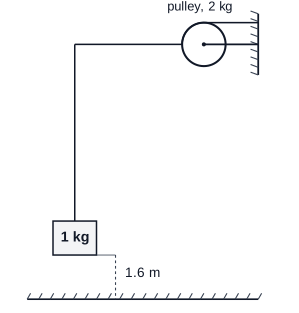
- KCET 2024Set D-21 markMCQQ.A body of mass 1kg is suspended by a weightless string which passes over a frictionless pulley of mass 2kg as shown in the figure. The mass is released from a height of 1.6m from the ground. With what velocity does it strike the ground?
 (A) 16ms−1
(B) 8ms−1
(C) 42ms−1
(D) 4ms−1
(A) 16ms−1
(B) 8ms−1
(C) 42ms−1
(D) 4ms−1›Reveal solutionSolution
Conserve mechanical energy, but remember the pulley is massive — part of the lost potential energy goes into its rotational kinetic energy, not just the block's translational KE.
1. Model the pulley
A pulley of mass M=2 kg and radius R is treated as a uniform disc:
I=21MR2
Since the string does not slip, the rim speed equals the block's speed:
v=ωR⟹ω=Rv
2. Energy conservation
The string is weightless and the pulley frictionless, so no energy is dissipated. As the 1 kg block falls a height h=1.6 m from rest:
PE lostmgh=block’s KE21mv2+pulley’s rotational KE21Iω2
3. Eliminate I and ω
21Iω2=21(21MR2)(Rv)2=41Mv2
Notice R cancels — the radius never matters. So:
mgh=21mv2+41Mv2=21(m+2M)v2
4. Solve for v
v=m+2M2mgh
Substituting m=1 kg, M=2 kg, h=1.6 m, g=10 ms−2: …
- TG EAPCET 2024Set ap-2024-05-08-FN1 markMCQQ.Starting from rest a car accelerates with uniform acceleration of 4 ms−2 for some time after which it comes to rest with uniform deceleration of 6 ms−2. If the total time of travel is 5 s, then the total distance travelled by the car is (A) 25 m (B) 30 m (C) 60 m (D) 125 m
›Reveal solutionSolution
The car speeds up and then slows down, both uniformly. The key is that the maximum speed reached is the same for both phases. Using the total time and the two accelerations, we find the distance is 30 m.
The problem gives you two uniform acceleration phases — first speeding up, then slowing down — with no constant-speed coasting in between. The car starts from rest and ends at rest. The total time is fixed at 5 seconds. The accelerations are 4 ms−2 (forward) and −6 ms−2 (deceleration, which we treat as a magnitude of 6 ms−2 in the opposite direction).
The central idea: the car reaches some maximum speed vmax at the end of the acceleration phase, then immediately begins decelerating from that same vmax down to zero. Because both phases are uniform, the distance in each is just the average speed times the time for that phase. And the average speed in each phase is simply vmax/2.
Let’s work it through.
-
Let the acceleration time be t1 and the deceleration time be t2.
Total time: t1+t2=5 s.
-
Relate vmax to each phase.
For the acceleration phase: vmax=4t1.
For the deceleration phase: 0=vmax−6t2, so vmax=6t2.
Equating the two expressions for vmax:
4t1=6t2⇒t1=23t2.
- Solve for the times. Substitute into t1+t2=5:
23t2+t2=5⇒25t2=5⇒t2=2 s.
Then t1=3 s.
-
Find the maximum speed.
vmax=4×3=12 m/s (or 6×2=12 m/s — consistent).
-
Compute the distance for each phase using average speed. …
-
- TG EAPCET 2024Set eng-2024-05-09-FN1 markMCQQ.The half-life of a radioactive substance is 12 minutes. The time gap between 28% decay and 82% decay of the radioactive substance is (A) 6 minutes (B) 18 minutes (C) 12 minutes (D) 24 minutes
›Reveal solutionSolution
The key idea is that radioactive decay follows an exponential law, so the time between two percentage decays depends only on the ratio of the remaining fractions, not on the initial amount. The time gap is 24 minutes, corresponding to option (D).
The problem asks for the time interval between two specific decay milestones: when 28% has decayed (so 72% remains) and when 82% has decayed (so 18% remains). Since decay is exponential, the time to go from one fraction to another is determined by the half-life and the ratio of those fractions.
Why this works:
Radioactive decay is a first-order process: the number of atoms decreases by a constant fraction per unit time. The half-life (t1/2) is the time for half the atoms to decay. The fraction remaining after time t is N/N0=(1/2)t/t1/2. To find the time between two different remaining fractions, we take the ratio of the two exponential expressions, which cancels the initial amount and gives a simple logarithmic relation.
Step-by-step solution:
- Set up the decay law. Let N0 be the initial number of atoms. After time t, the number remaining is
N(t)=N0(21)t/12,
where 12 minutes is the half-life.
- Find the time for 28% decay. If 28% has decayed, then 72% remains:
N0N(t1)=0.72=(21)t1/12.
Taking natural logs:
ln(0.72)=12t1ln(21)=−12t1ln2.
So
t1=−12⋅ln2ln(0.72).
- Find the time for 82% decay. If 82% has decayed, then 18% remains:
N0N(t2)=0.18=(21)t2/12.
Similarly,
t2=−12⋅ln2ln(0.18).
- Compute the time gap Δt=t2−t1. Δt=−12⋅ln2ln(0.18)−(−12⋅ln2ln(0.72))=−12⋅ln2ln(0.18)−ln(0.72). …
- TG EAPCET 2024Set ap-2024-05-07-AN1 markMCQQ.If a substance decays from 32 g to 1 g in 25 days, then its half life is (A) 3 days (B) 4 days (C) 5 days (D) 6 days
›Reveal solutionSolution
The half-life is found by counting how many half-lives it takes to go from 32 g to 1 g, then dividing the total time by that number. The answer is 5 days.
The key idea here is that radioactive decay follows a simple pattern: after each half-life, the mass is cut in half. So instead of plugging into a complicated exponential formula right away, you can just ask: how many times do you need to halve 32 to get 1? That’s a much cleaner way to think about it.
-
Start with 32 g. After one half-life, you have 16 g. After two, 8 g. After three, 4 g. After four, 2 g. After five, 1 g. So it takes 5 half-lives to go from 32 g to 1 g.
-
The problem says this whole process takes 25 days. If 5 half-lives take 25 days, then one half-life is simply 25÷5=5 days. …
-
- TG EAPCET 2023Set eng-2023-05-13-FN1 markMCQQ.Velocities (V) and accelerations(a) in two systems of units 1 and 2 are related as V2=m2nV1 and a2=mna1 respectively. Here m and n are constants. Dimensionally relations between distances (S1 and S2) and times (t1 and t2) in the two systems are respectively (A) S2=(mn)3S1 & t2=mn2t1 (B) S2=(mn)S1 & t2=n2mt1 (C) S2=n2mS1 & t2=n4m2t1 (D) S2=mn2S1 & t2=n4m2t1
›Reveal solutionSolution
Let length scale λL and time scale λT; use the velocity and acceleration ratios to solve for both, giving S2=(n/m)3S1 and t2=(n2/m)t1 — option (A).
Let distances scale as S2=λLS1 and times as t2=λTt1. Then velocity (∝L/T) and acceleration (∝L/T2) scale as:
V1V2=λTλL=m2n,a1a2=λT2λL=mn1.
Find λT by dividing the velocity ratio by the acceleration ratio:
λT=λL/λT2λL/λT=1/(mn)n/m2=m2n⋅mn=mn2.
So t2=mn2t1. …
🎓Unlock everything free for 14 days
- ✓Full step-by-step solutions
- ✓Concept-first explanations
- ✓Methods, shortcuts & mistakes
- ✓PYQ mapping + timed mock tests
Full access for 14 days. No credit card required.