Q.In which of the following examples of motion, can the body be considered approximately a point object:
Concept understanding — Point Object Approximation
Point Object Approximation — The First Encounter
Imagine you're looking at a bus moving on a road. If someone asks you "where is the bus right now?", you'd probably point to a spot on the road and say "it's near that tree." You don't care about the bus's length, its shape, or which part of the bus is exactly at the tree — you treat the whole bus as if it were a single dot at that location.
That's the core intuition behind the point object approximation: when the size and internal structure of an object don't matter for the problem you're solving, you can replace the entire object with a single point — usually its centre of mass — and analyse its motion as if all its mass were concentrated there.
When does this approximation work?
The approximation is valid when the size of the object is negligible compared to the distances involved in the problem. More precisely:
distance travelled or distance from referencesize of object≪1
If this ratio is very small (say, less than 0.01), the object's shape and orientation won't affect the answer significantly.
Examples where it works:
- A cricket ball thrown from one end of a field to the other — the ball's diameter (~7 cm) is tiny compared to the 70 m throw.
- Earth orbiting the Sun — Earth's radius (~6400 km) is negligible compared to the 150 million km distance to the Sun.
- A car moving from Delhi to Agra — the car's length (~4 m) is insignificant compared to the 200 km journey.
Examples where it fails:
- A rotating fan blade — you cannot treat it as a point because different parts move at different speeds.
- A person walking — if you're studying their gait, the shape matters.
- A train entering a tunnel — the train's length is comparable to the tunnel's length, so you cannot ignore it.
The precise statement
An object can be treated as a point object (or a particle) if, during the entire motion under consideration, its size and internal structure are irrelevant to the description of its motion. In such cases, the object's translational motion is fully described by the motion of a single point — typically its centre of mass.
This means:
- You ignore rotation, vibration, or any deformation of the object.
- You only care about the path traced by that one point.
- All forces acting on the object are assumed to act at that single point.
A common misconception
Many students think "small object = point object". That's not always true. A tiny grain of sand is small, but if you're studying how it tumbles in a fluid, its shape matters — so it's not a point object. Conversely, a huge planet can be a point object if you're only interested in its orbit around the Sun.
The key is relevance, not size alone.
Why do we use it?
Physics becomes dramatically simpler. Instead of tracking every atom in a bus, you write one equation:
Fnet=ma
where m is the total mass and a is the acceleration of the centre of mass. That's the power of the approximation — it reduces a complex extended body to a single mathematical point, letting you focus on the big picture of motion.
Quick check for yourself
A 2 m long rod is sliding on a frictionless table. Can you treat it as a point object if:
- You want to find how long it takes to travel 10 m? → Yes (size << distance)
- You want to find how fast its ends are moving? → No (rotation matters)
The first time you meet this idea, remember: when the object's size is irrelevant to the question, shrink it to a point and move on.
Point Object Approximation is introduced at the very start of the NCERT Class 11 Physics chapter on Motion in a Straight Line, matching searches like "point object: definition physics" or "kinematics important questions class 11 physics". Understanding when an object's size can be ignored is foundational groundwork for every later mechanics topic tested in CBSE boards and is an important topic for JEE Main and NEET as well.
The key idea here is the Point Object Approximation.
A body can be considered approximately a point object if its size is negligible compared to the distance it travels or the dimensions of the space in which its motion is being studied. In such cases, the rotational motion or internal structure of the body is not relevant to the problem.
- (a) a railway carriage moving without jerks between two stations: The distance between two stations is typically many kilometers, which is vastly larger than the length of a railway carriage (tens of meters). For describing its motion between stations, its size is negligible.
- (b) a monkey sitting on top of a man cycling smoothly on a circular track: The combined size of the man and monkey is small compared to the radius or circumference of the circular track. Their individual dimensions or internal motions are not relevant for describing the overall motion on the track.
- (c) a spinning cricket ball that turns sharply on hitting the ground: The "spinning" and "turning sharply" aspects explicitly depend on the ball's size, shape, and rotational motion. Treating it as a point object would ignore these crucial details.
- (d) a tumbling beaker that has slipped off the edge of a table: "Tumbling" implies rotational motion. To describe this motion, the beaker's size and shape are essential. A point object cannot tumble.
The bodies in examples (a) a railway carriage moving without jerks between two stations and (b) a monkey sitting on top of a man cycling smoothly on a circular track can be considered approximately point objects.
A body can be treated as a point object when its size is negligible compared to the scale of the motion being described, and its internal/rotational motion doesn't matter to the problem. Both the railway carriage (a) and the monkey-on-cyclist (b) satisfy this; the spinning cricket ball (c) and the tumbling beaker (d) do not, since their rotation is exactly what the problem describes.
The Point-Object Test
A body is (approximately) a point object when:
- Its own size is much smaller than the distance/scale over which its motion is being studied, and
- Its internal structure, shape, or rotation is not relevant to the question being asked.
Applying this to each case:
(a) Railway carriage moving without jerks between stations
A carriage is a few tens of metres long; the distance between two stations is several kilometres. The carriage's length is negligible compared to this distance, and "moving without jerks" means we only care about its overall straight-line translation, not its shape or any internal motion.
Point object: YES.
(b) Monkey sitting on top of a man cycling on a circular track
The man-monkey system is a couple of metres tall, while the track itself has a radius/circumference many times larger — typically tens of metres or more for a circular cycling track. Since we are only interested in the smooth motion of the man+monkey around the track (not the monkey's posture, balance, or motion relative to the man), the combined size is negligible compared to the scale of the track, and no rotational/internal detail matters to describing that motion.
Point object: YES.
(c) Spinning cricket ball that turns sharply on hitting the ground
Here the whole point of the question is the ball's spin and how it makes the ball turn sharply — this is a rotational effect that depends directly on the ball's finite size and its contact with the ground. You cannot answer "why does it turn?" while treating the ball as having no size or rotation.
Point object: NO.
(d) Tumbling beaker that has slipped off a table
"Tumbling" is explicitly a description of rotational motion — the beaker's orientation keeps changing as it falls. Capturing this needs the beaker's shape, extent, and moment of inertia; a point has none of these.
Point object: NO.
Conclusion
Both (a) and (b) describe motions where the body's size is negligible on the relevant scale and where rotation/internal structure is irrelevant to the question asked, so both qualify as (approximately) point objects. (c) and (d) are explicitly about rotational behaviour, so they do not.
The body can be considered approximately a point object in (a) and (b).
Concept: The Point-Object Idealisation as a Counterfactual Test
Method: The "Could a Point Do This?" Thought Experiment
Rather than checking two separate conditions (small relative size, and whether rotation matters) as a checklist, this method asks one sharper question for each case: if the body were shrunk to a mathematical point — zero size, no orientation, no spin — could the described phenomenon still happen at all? If yes, the point-object idealisation is safe; if the phenomenon is itself defined by the body's finite size or rotation, a point cannot reproduce it, and the idealisation fails.
Steps — apply the test to each case
-
(a) Railway carriage moving without jerks between stations. The question only concerns the carriage's overall position along the track over a distance of kilometres. A point moving along the same track traces exactly the same journey — nothing about "moving without jerks" requires the carriage to have any length or shape.
→ Point idealisation valid.
-
(b) Monkey on a cyclist moving smoothly around a circular track. The question only concerns the man+monkey system's path around the track (radius far larger than their combined size). A point moving along that same circular path reproduces the described motion completely — the monkey's balance or posture is never asked about.
→ Point idealisation valid.
-
(c) A spinning cricket ball that turns sharply on hitting the ground. Here the very phenomenon being described — the sideways turn upon impact — is caused by the ball's spin, which requires the ball to have a surface making contact with the ground and rotating about its own axis. A point has no surface and no axis to spin about; shrink the ball to a point and the "turning sharply" effect vanishes entirely, because the physics being asked about is the finite-size/rotation effect.
→ Point idealisation fails.
-
(d) A tumbling beaker that has slipped off a table. "Tumbling" means the beaker's orientation is continuously changing as it falls — that is literally a statement about its finite shape and rotation. A point object has no orientation to tumble.
→ Point idealisation fails.
Why this test is sharper than a checklist
A scale-only check (comparing sizes) can mislead if applied carelessly — a cricket ball is also "small" compared to the pitch, the same way a carriage is small compared to the distance between stations. The counterfactual question cuts straight to what actually matters: is the described behaviour itself a consequence of finite size/rotation, regardless of how small the object is on some other scale?
Final Answer
The body can be treated as a point object in (a) and (b); not in (c) or (d), because the very motion described there — spin-induced turning, and tumbling — cannot occur for an object with no size or orientation.
- TG EAPCET 2024Set eng-2024-05-10-FN1 markMCQQ.Which of the following statements regarding nature of physical laws is NOT correct? (A) All conserved quantities are necessarily scalars (B) The laws of nature do not change with time (C) The laws of nature are same everywhere in the universe (D) The law of gravitation is the same both on the moon and the earth
›Reveal solutionSolution
The key idea is to test your understanding of fundamental symmetries and conservation laws in physics. The incorrect statement is (A), because conserved quantities like momentum and angular momentum are vectors, not scalars.
The question asks which statement about the nature of physical laws is NOT correct. Let’s examine each option carefully, using core principles from physics.
Concept and Intuition:
Physical laws are built on symmetries—they are universal in space and time (homogeneity and isotropy) and are the same everywhere. However, conservation laws come in different mathematical types: some quantities are scalars (like energy), but others are vectors (like momentum) or even tensors. A common mistake is to assume all conserved quantities are scalars, which is false.
-
Option (A): “All conserved quantities are necessarily scalars”
- In physics, conserved quantities arise from symmetries via Noether’s theorem. For example:
- Time symmetry → conservation of energy (a scalar).
- Translational symmetry → conservation of linear momentum (a vector).
- Rotational symmetry → conservation of angular momentum (a vector).
- Since momentum and angular momentum are vectors, this statement is false.
- Pitfall: Many students think only of energy, forgetting momentum and angular momentum.
- In physics, conserved quantities arise from symmetries via Noether’s theorem. For example:
-
Option (B): “The laws of nature do not change with time”
- This is the principle of time invariance—a cornerstone of physics. Experiments today give the same results as centuries ago (e.g., Newton’s laws still hold).
- This is correct.
-
Option (C): “The laws of nature are same everywhere in the universe”
- This is the cosmological principle—the laws are universal. Gravity works the same on Earth, in distant galaxies, and at the edge of the observable universe.
- This is correct.
-
Option (D): “The law of gravitation is the same both on the moon and the earth”
- Newton’s law of gravitation applies universally. The gravitational acceleration differs (due to different masses and radii), but the law itself (inverse-square relation) is identical.
- This is correct.
Watch outDo not confuse the value of a physical quantity (like g) with the law itself. The law is the same; the numbers change because of different conditions.
TipA quick way to spot the wrong statement: look for an absolute claim like “all conserved quantities are scalars”—it’s almost always false because vectors like momentum are conserved.
✓Final answerThe correct option is (A).
ANSWER: A
-
- KCET 2023Set A-31 markMCQQ.The moment of inertia of a rigid body about an axis (A) does not depend on its shape. (B) depends on the position of axis of rotation. (C) does not depend on its size. (D) does not depend on its mass.
›Reveal solutionSolution
I=∑miri2 depends on mass, on how that mass is distributed (shape and size) and on where the axis is — so only statement (B) is true.
Step 1 — The definition.
For a rigid body,
I=∑imiri2orI=∫r2dm,
where ri is the perpendicular distance of the mass element from the axis of rotation. Every quantity in that definition — the masses, and their distances from the chosen axis — matters.
Step 2 — Test each option.
- (A) "does not depend on its shape" — false. A ring and a disc of the same mass and radius have MR2 and 21MR2 respectively: different shape, different I.
- (C) "does not depend on its size" — false. I∝R2 for a given shape; a bigger disc has a larger I.
- (D) "does not depend on its mass" — false. I is directly proportional to M.
- (B) "depends on the position of the axis of rotation" — true. This is exactly the content of the parallel-axis theorem:
I=Icm+Md2,
where d is the distance of the new axis from the parallel axis through the centre of mass. Move the axis (d changes) and I changes, even though the body is unchanged. E.g. for a rod of length L: I=12ML2 about the centre but 3ML2 about one end.
✓Final answerThe correct option is (B) — depends on the position of axis of rotation.
ANSWER: B
- TG EAPCET 2022Set eng-2022-07-19-FN1 markMCQQ.Assertion(A): In an elastic collision of two billiard balls, both kinetic energy and linear momentum remain conserved. Reason (R) : During the collision of the balls, as the collision is elastic there is no exchange of energy. Therefore, both energy and momentum are conserved. The correct option among the following is (A) (A) is true, (R) is true and (R) is the correct explanation for (A) (B) (A) is true, (R) is true but (R) is not the correct explanation for (A) (C) (A) is true but (R) is false (D) (A) is false but (R) is true
›Reveal solutionSolution
Elastic collision ⇒ total KE and total momentum are conserved (A is true). But energy is exchanged between the balls; "elastic" only means none is lost to heat/sound. So R is false: option (C).
The concept: what "elastic" actually conserves
For two bodies colliding with no external force:
m1u1+m2u2=m1v1+m2v2(momentum — always)
Momentum conservation follows from Newton's third law: the internal forces are equal and opposite and cancel. It holds for every collision, elastic or not.
An elastic collision additionally satisfies
21m1u12+21m2u22=21m1v12+21m2v22(kinetic energy — only if elastic)
The balls do deform momentarily, storing energy elastically, but they give all of it back as KE; none is degraded into heat, sound or permanent deformation.
Step 1 — Judge the Assertion
"Both kinetic energy and linear momentum remain conserved" is exactly the pair of equations above. True.
Step 2 — Judge the Reason
"...as the collision is elastic there is no exchange of energy." This is false, and instructively so. Take the standard head-on elastic collision of two equal masses, one at rest:
v1=0,v2=u1
The moving ball stops dead and the struck ball moves off with the full speed — a complete transfer of kinetic energy from one ball to the other, in a perfectly elastic collision. Elasticity constrains the total, not the individual shares.
Step 3 — Conclude
A true, R false ⇒ the printed option "(A) is true but (R) is false", which is (C).
✓Final answerThe Assertion is true; the Reason is false, because energy is exchanged between the balls even though the total is conserved.
ANSWER: C
- KCET 2021Set B-21 markMCQQ.In figure E and Vcm represent the total energy and speed of centre of mass of an object of mass 1kg in pure rolling. The object is
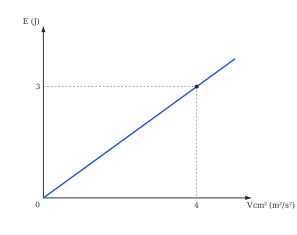 (A) sphere
(B) ring
(C) disc
(D) Hollow Cylinder
(A) sphere
(B) ring
(C) disc
(D) Hollow Cylinder›Reveal solutionSolution
For a rolling body E=21mvcm2(1+k2/R2), so the slope of the E vs vcm2 line fixes the moment-of-inertia factor k2/R2; slope 3/4 with m=1 kg gives k2/R2=21 — a disc.
Step 1 — Why the graph is a straight line.
In pure rolling there is no slipping, so the contact point is instantaneously at rest and vcm=ωR. The total energy of the object is entirely kinetic (translation of the centre of mass + rotation about it):
E=21mvcm2+21Iω2.
Step 2 — Express I through the radius of gyration.
Write I=mk2, where k is the radius of gyration. Using ω=vcm/R,
E=21mvcm2+21mk2R2vcm2=21m(1+R2k2)vcm2.
So E is directly proportional to vcm2 — which is exactly why the printed graph, whose x-axis is vcm2 (not vcm), is a straight line through the origin. Its slope is
slope=vcm2E=21m(1+R2k2).
Step 3 — Read the slope off the graph.
The one marked point is E=3 J at vcm2=4 m2s−2, so
slope=43=0.75.
Step 4 — Solve for k2/R2.
With m=1 kg,
21(1)(1+R2k2)=43⟹1+R2k2=23⟹R2k2=21.
Step 5 — Identify the body.
Standard values of k2/R2 for rolling bodies:
Body I k2/R2 Predicted E at vcm2=4 Solid sphere 52mR2 0.4 2.8 J Disc / solid cylinder 21mR2 0.5 3.0 J Ring / hollow cylinder mR2 1 4.0 J Only the disc reproduces the printed point E=3 J at vcm2=4 m2s−2. (Note the ring and the hollow cylinder share k2/R2=1, so options (B) and (D) are in any case the same physical case and both give 4 J.)
✓Final answerThe correct option is (C) — disc.
ANSWER: C
- TG EAPCET 2021Set eng-2021-08-05-FN1 markMCQQ.Three bodies a ring, a solid cylinder and a solid sphere roll down an inclined plane without slipping. They start from rest. Which of the bodies reaches bottom of plane with minimum velocity? (A) ring (B) solid cylinder (C) solid sphere (D) both ring & solid sphere
›Reveal solutionSolution
For pure rolling down an incline, the final velocity depends only on the moment of inertia factor k2/R2 — the body with the largest rotational inertia gains the least translational speed. The ring has the largest k2/R2=1, so it reaches the bottom with the minimum velocity. The correct option is (A).
When a body rolls without slipping down an incline, its gravitational potential energy converts into two forms: translational kinetic energy and rotational kinetic energy. The steeper the rotational "cost" (i.e., the larger the moment of inertia relative to mass and radius), the less energy remains for translation — and therefore the lower the final speed.
The key quantity is the radius of gyration k, defined by I=mk2. For pure rolling, the ratio k2/R2 determines how much of the total kinetic energy goes into rotation. A larger k2/R2 means more energy is "locked" in rotation, leaving less for translation.
- Write the energy conservation equation. Starting from rest at height h, the loss in gravitational potential energy equals the total kinetic energy at the bottom:
mgh=21mv2+21Iω2
For pure rolling without slipping, ω=v/R. Substituting I=mk2:
mgh=21mv2+21(mk2)(Rv)2=21mv2(1+R2k2)
- Solve for the final speed v. Cancel m (mass does not matter) and rearrange:
v2=1+R2k22gh⇒v=1+R2k22gh
Since g and h are the same for all bodies, the final speed depends only on k2/R2 — and it decreases as this ratio increases.
-
Compare the values of k2/R2 for the three bodies.
- Ring: I=mR2⇒k2=R2⇒R2k2=1
- Solid cylinder: I=21mR2⇒k2=2R2⇒R2k2=21
- Solid sphere: I=52mR2⇒k2=52R2⇒R2k2=52=0.4
The ring has the largest k2/R2, so it has the smallest v.
Watch outA common mistake is to think the body that reaches first (shortest time) also has the minimum velocity. That is false — the ring is slowest at the bottom but also takes the longest time. Speed and time are not the same thing; here we are asked only about velocity.
TipYou never need to compute v numerically. Just remember the ordering of k2/R2: ring (1) > solid cylinder (0.5) > solid sphere (0.4). The larger this number, the smaller the final speed.
✓Final answerThe ring reaches the bottom with the minimum velocity, so the correct option is (A).
- KCET 2019Set A-11 markMCQQ.If P, Q and R are physical quantities having different dimensions, which of the following combinations can never be a meaningful quantity ? (A) RP−Q (B) PQ−R (C) RPQ (D) RPR−Q2
›Reveal solutionSolution
Quantities with different dimensions cannot be added or subtracted — only multiplied or divided. The combination RP−Q involves subtraction of P and Q, which is impossible, so it can never be meaningful.
The core rule in dimensional analysis is simple: you can only add or subtract quantities that have the same dimensions. Multiplication and division, on the other hand, are always allowed — they just produce a new dimension. So when you see a minus or plus sign between two terms, check whether those terms have identical dimensions. If they don’t, the expression is physically meaningless.
Let’s go through each option one by one.
-
Option (A): RP−Q
The numerator contains P−Q. Since P and Q have different dimensions, this subtraction is not allowed. The expression is invalid from the start — no matter what R is.
So (A) can never be a meaningful quantity.
-
Option (B): PQ−R
Here PQ is a product of P and Q, so it has some new dimension. R has its own dimension. For the subtraction PQ−R to be meaningful, PQ and R must have the same dimension. Is that possible? Yes — if the dimensions of P, Q, and R happen to satisfy [P][Q]=[R], then the subtraction is valid. Since the problem only says they have different dimensions, it doesn’t forbid this relation. So (B) can be meaningful for some choices.
-
Option (C): RPQ
This is just multiplication and division — no addition or subtraction. It is always dimensionally valid. The result will have dimensions [P][Q]/[R], which is fine. So (C) is always meaningful.
-
Option (D): RPR−Q2
Look at the numerator: PR−Q2. For this to be valid, PR and Q2 must have the same dimension. That means [P][R]=[Q]2. This is a condition that could be satisfied by some set of quantities with different dimensions. So (D) can be meaningful for appropriate choices.
Watch outA common mistake is to think that because P, Q, R all have different dimensions, any expression mixing them is invalid. That’s false — multiplication and division freely combine dimensions; only addition/subtraction demands equality.
TipThe only operation that forces dimensional equality is addition or subtraction. If an expression has no plus or minus between unlike-dimensioned terms, it’s always dimensionally okay.
✓Final answerThe combination that can never be meaningful is (A) RP−Q.
-
🎓Unlock everything free for 14 days
- ✓Full step-by-step solutions
- ✓Concept-first explanations
- ✓Methods, shortcuts & mistakes
- ✓PYQ mapping + timed mock tests
Full access for 14 days. No credit card required.