Physics · Ch 6 — System of Particles and Rotational Motion
Moment of Inertia
Moment of Inertia
The Meaning of Moment of Inertia
When you push a stationary object, it starts moving in a straight line. The resistance it offers to that change in its state of motion is called mass — a measure of its inertia in linear motion. But what about rotation? Try spinning a bicycle wheel by applying a force at its rim. The wheel resists being set into rotation. That resistance is not simply its mass; it depends on how far the mass is from the axis of rotation. A heavy wheel with all its mass concentrated near the axle is easier to spin than a light wheel with the same mass spread out at the rim.
This rotational analogue of mass is called the moment of inertia, denoted by . For a single particle of mass at a perpendicular distance from a fixed axis, the moment of inertia is defined as:
The word "moment" here hints at the geometric factor — the farther the mass is from the axis, the greater its rotational inertia. For a system of many particles, the total moment of inertia about the same axis is simply the sum of the individual moments:
where is the perpendicular distance of the -th particle from the axis. This is a scalar quantity (unlike torque or angular momentum, which are vectors). Its SI unit is , and its dimensional formula is .
Moment of inertia is not a fixed property of a body. It depends on three things:
- The mass of the body.
- The distribution of that mass about the axis.
- The location and orientation of the axis itself. Change the axis, and changes — even for the same object.
Why and Not ?
The factor emerges naturally from the rotational analogue of Newton's second law. For a particle moving in a circle of radius , the tangential acceleration , where is the angular acceleration. The tangential force required is . The torque about the axis is . So , with . The square appears because torque involves force times distance, and the force itself already contains one factor of from the acceleration relation.
Moment of Inertia of a Rigid Body
For a continuous rigid body, we replace the sum by an integral. Imagine the body divided into infinitesimal mass elements , each at a perpendicular distance from the axis. Then:
The integration is carried out over the entire volume of the body. The value of depends on the shape of the body and the chosen axis. This integral is often easier to evaluate using the body's density . If is uniform, , and .
Properties of Moment of Inertia
The textbook lists three key properties that follow directly from the definition . Each one is proved below.
›Proof
Property (I): Moment of inertia is additive.
If a body consists of several parts (say, a disc with a hole, or a composite of two shapes), the total moment of inertia about a given axis is the sum of the moments of inertia of its individual parts about the same axis.
Proof: Let the body be divided into parts, each with mass and moment of inertia . Then the total moment of inertia is:
This holds because the sum over all particles can be grouped into disjoint subsets. The additivity is a direct consequence of the linearity of the summation.
›Proof
Property (II): The moment of inertia depends on the mass and the distribution of mass about the axis.
This is not a theorem to prove but a qualitative observation. Two bodies of the same mass can have very different moments of inertia if their mass distributions differ. For example, a thin ring of mass and radius has about its central axis, while a solid disc of the same mass and radius has — half as much, because the disc's mass is spread closer to the axis on average.
›Proof
Property (III): For a given body and a given axis, the moment of inertia is a constant.
Proof: The definition involves only the fixed masses and the fixed perpendicular distances from the axis. As long as the body is rigid (distances between particles do not change) and the axis is fixed in space, each is a constant. Hence is a constant for that body-axis combination. This constancy is what makes a useful parameter in rotational dynamics — it plays the same role as mass does in linear motion.
The Radius of Gyration
It is often convenient to express the moment of inertia of a body of mass in terms of a single length , called the radius of gyration. It is defined as the distance from the axis at which the entire mass of the body could be concentrated to produce the same moment of inertia:
The radius of gyration tells you, in a single number, how "spread out" the mass is relative to the axis. For a thin ring about its centre, ; for a solid disc about its centre, ; for a solid sphere about its diameter, .
When you see , remember that is not the average distance of mass from the axis — it is the root-mean-square distance. For a set of particles, , which is exactly the definition of the mean of the squares of the distances.
Table 6.1: Moments of Inertia of Some Regular-Shaped Bodies
This is Table 6.1 from the textbook itself — it lists the moment of inertia of these standard shapes about the specific axes shown, for bodies of uniform density. Their derivations are beyond the scope of this book (the textbook itself says you'll work them out in higher classes), but these are the values you must know and be able to apply for exams.
| Z | Body | Axis | Figure | I |
|---|---|---|---|---|
| (1) | Thin circular ring of radius | Perpendicular to plane, at centre |  | |
| (2) | Thin circular ring of radius | Diameter |  | |
| (3) | Thin rod of length | Perpendicular to rod, at mid-point |  |
Drawn by us to help you understand the concept clearly, and verified to make sure it's accurate. For exams, practice from your NCERT textbook's own diagram.
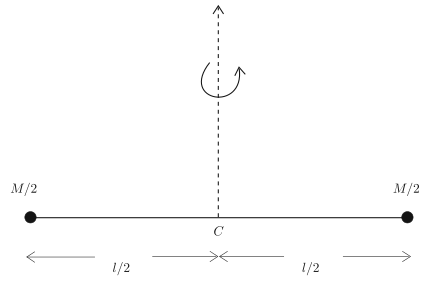
Figure 6.28 shows the simplest possible rigid body: two point masses, each of mass , fixed at the ends of a light rod of length . The rod itself is assumed to have negligible mass — it serves only to keep the two masses at a fixed separation. A vertical dashed line through the centre C marks the axis of rotation, and a curved arrow around that axis indicates the direction of rotation. The distance from the centre to each mass is .
The physical idea is foundational. When you rotate this rod about its centre, each mass moves in a circle of radius . The total mass of the system is , and the centre of mass is exactly at C — the axis passes through the centre of mass. This is the cleanest case for introducing moment of inertia because there is no offset between the axis and the centre of mass, so the parallel-axis theorem is not needed.
The moment of inertia of a system of particles is defined as , where is the mass of the -th particle and is its perpendicular distance from the axis. For this figure, each mass contributes . Adding the two contributions:
This is the moment of inertia of two equal point masses at the ends of a light rod, about an axis through the centre perpendicular to the rod. The factor comes directly from the geometry: each mass is at half the rod length, so the square of that distance gives , and the two masses together give .
A common mistake is to write here. That formula is for a continuous uniform rod of mass and length about its centre. Figure 6.28 is not a uniform rod — it is two discrete masses at the ends. The two situations give different results because the mass distribution is different. …