Physics · Ch 6 — System of Particles and Rotational Motion
Motion of Centre of Mass
Motion of Centre of Mass
Motion of the Centre of Mass
When we studied the centre of mass of a system of particles, we defined it as a weighted average position. But why is this point so special? The real power of the centre of mass concept emerges when we look at how it moves — and the answer turns out to be remarkably simple.
Consider a system of particles. Each particle has a mass , a position vector , and is acted upon by some net force . The centre of mass position is defined as:
where is the total mass of the system.
To find how the centre of mass moves, we differentiate this equation with respect to time. The velocity of the centre of mass is:
So the centre of mass velocity is simply the total momentum of the system divided by the total mass. This is already useful, but the real insight comes from differentiating once more — the acceleration of the centre of mass:
Now, from Newton's second law, , where is the net force on the -th particle. This net force has two contributions: external forces (from sources outside the system) and internal forces (from other particles within the system). So:
Here comes the crucial simplification. By Newton's third law, internal forces between any two particles are equal and opposite. When we sum over all internal forces in the entire system, every action-reaction pair cancels out. Therefore:
This leaves us with the fundamental equation for the motion of the centre of mass:
where is the total external force acting on the system.
This is a profound result. It says that the centre of mass of a system moves exactly as if the entire mass of the system were concentrated at that point, and all external forces were acting directly on that single point. The internal forces — no matter how complicated — have absolutely no effect on the motion of the centre of mass.
The centre of mass of a system moves as if it were a single particle of mass under the influence of the net external force. Internal forces cancel out completely and do not affect the CM motion.
Implications and Special Cases
When no external force acts: If , then , which means . The centre of mass moves with constant velocity (or remains at rest). This is the law of conservation of momentum at the system level — the total momentum is conserved.
When external forces are present: The centre of mass accelerates exactly as a single particle would under the same net external force. This is why, when you throw a wrench spinning in the air, its centre of mass follows a smooth parabola (like a point particle under gravity), even though every other point on the wrench traces a complicated, wobbling path. …
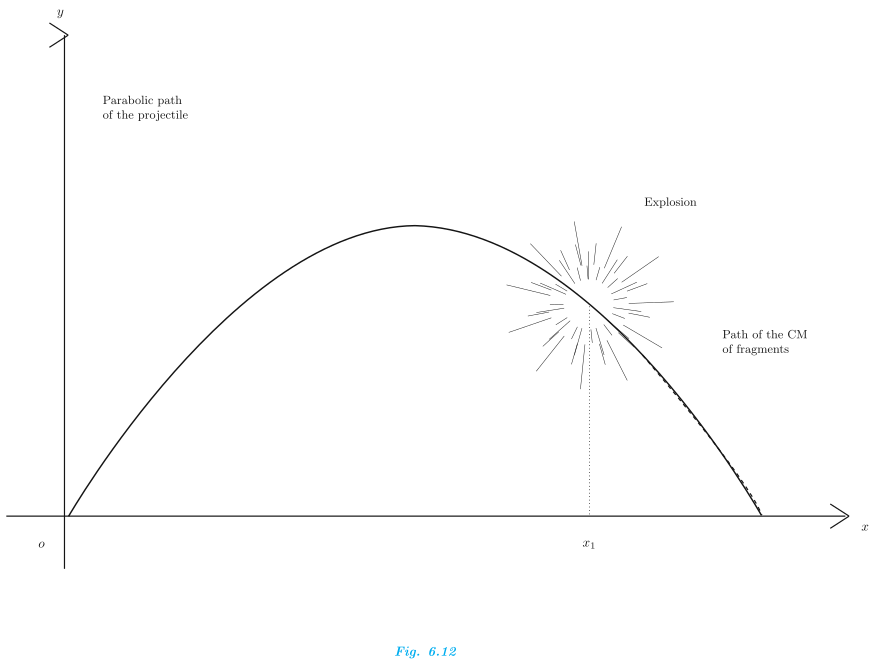
Drawn by us to help you understand the concept clearly, and verified to make sure it's accurate. For exams, practice from your NCERT textbook's own diagram.
The figure shows a single parabolic arc drawn on a standard – coordinate grid. The curve begins at the origin O, rises to a peak, and then descends. At some point along the descending branch — not necessarily the apex — a starburst symbol marks the location of an explosion. After that point, the original solid curve becomes a dashed curve that continues the same parabola all the way down to the -axis at . The dashed portion represents the path of the centre of mass of all the fragments after the explosion.
The physical idea is this: when a projectile explodes in mid-air, the only external force acting on the system is gravity. The explosion is an internal force — the fragments push on each other, but they cannot change the motion of the system’s centre of mass. So the centre of mass continues exactly as if the projectile had never broken apart. It follows the same parabola it would have followed had it remained intact.
The textbook uses this figure to introduce the central result of Section 6.3: the motion of the centre of mass of a system is determined solely by the net external force. For a system of particles, the centre of mass position vector is
where is the total mass, is the mass of the -th particle, and is its position vector. Differentiating twice gives the equation of motion for the centre of mass:
The internal forces cancel in pairs (Newton’s third law), so only the external forces appear. In the projectile case, the only external force is gravity , so
This is exactly the same equation as for a single particle under gravity. Hence the centre of mass follows the same parabola — the dashed curve in the figure — regardless of any internal explosions. …