Economics · Ch 15 — Human Capital Formation in India
Introduction
Introduction
Alfred Marshall — on the value of education spending
"...the wisdom of expending public and private funds on education is not to be measured by its direct fruits alone. It will be profitable as a mere investment, to give the masses of people much greater opportunities than they can generally avail themselves of. For by this means many, who would have died unknown, are enabled to get the start needed for bringing out their latent abilities."
— Alfred Marshall
What has driven human progress more than anything else is our ability to store knowledge and pass it on to others, through speech, songs and formal teaching. But raw knowledge is not enough; people also need training and skill to do work efficiently.
A trained, educated worker can do more than an untrained one. Because of this greater skill, the educated worker earns a higher income and adds more to the nation's output. This is why education matters for economic growth.
The value of education is not only that it raises earnings. It brings other benefits that people prize highly:
- It gives a person better social standing and self-respect.
- It helps one make wiser choices in life.
- It supplies the knowledge needed to understand how society is changing.
- It encourages new ideas and innovation.
An educated workforce also makes it easier for a country to take up and use new technologies. For all these reasons, economists have argued that a nation should keep expanding educational opportunities, because doing so speeds up its development.
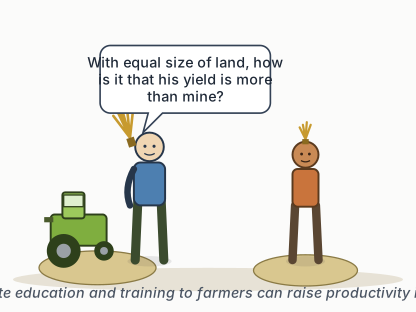
Drawn by us to help you understand the concept clearly, and verified to make sure it's accurate. For exams, practice from your NCERT textbook's own diagram.
Own-drawn recreation of NCERT Fig 4.1 (p.59), redrawn in our own style from the facts the real figure shows — not traced.
The rest of the chapter builds on this idea directly: it pins down what the terms Human Resource, Human Capital Formation and Human Development actually mean and how they connect, traces the link between investing in people and both economic growth and human development, asks why government spending on education and health matters so much, and takes stock of where India's own educational attainment currently stands.