Economics · Ch 15 — Human Capital Formation in India
Sources of Human Capital
Sources of Human Capital
Human capital is formed through deliberate investment, and this investment can flow through several different channels. The main sources are education, health, on-the-job training, migration and information.
Education. Investment in education is treated as the leading source of human capital. When a company buys capital goods, it does so to earn higher profits in future; in much the same way, when individuals and families spend on education they expect it to raise the person's future income. This is why education spending is seen as an investment in a human being, not merely as consumption.
Health. Health is as important for a nation's development as it is for an individual. A comparison makes the point: a healthy worker can work far better than a sick one. A labourer who falls ill and has no access to medical care is forced to stay away from work, and output is lost. Spending on health therefore builds human capital. Health expenditure takes several forms: preventive medicine such as vaccination, curative medicine (treatment during illness), social medicine which spreads health awareness, and the provision of clean drinking water and good sanitation. All of these raise the supply of a healthy, working labour force.
On-the-job training. Firms spend money to train their workers on the job. This may be done inside the firm under the supervision of a skilled worker, or by sending workers away for off-campus training. Because the firm bears the cost, it usually requires the trained worker to stay for a fixed period afterwards, so it can recover the benefit of the higher productivity the training created. Since the extra output produced is worth more than the cost of the training, such spending is a source of human capital.
Migration. People move in search of jobs that pay more than they could earn where they live. Within India, unemployment pushes people from villages to cities. Qualified professionals such as engineers and doctors sometimes migrate to other countries for higher salaries. Migration carries costs, the price of transport, a higher cost of living at the new place, and the psychological cost of settling in an unfamiliar social and cultural setting. But because the higher earnings at the destination more than cover these costs, spending on migration is also treated as a source of human capital.
Information. People spend to gather information about the job market and about markets for education and health, for example, what different jobs pay, whether an institution actually teaches employable skills, and at what cost. This information is needed both to decide where to invest in human capital and to use the human capital they already have efficiently. So spending to acquire such information is another source of human capital formation.
Box 4.1: Physical and Human Capital
Both forms of capital are the result of conscious investment decisions, but they differ in several ways:
- Who decides. Physical capital is chosen by an owner who weighs the expected returns and picks the best investment, so its formation is mainly an economic and technical process. Much human capital, by contrast, is built when the person, often a child, cannot yet judge what will maximise future earnings; parents, teachers, peers and society shape those decisions. Human capital formation is thus partly a social process and partly a conscious choice by its owner.
- Presence of the owner. A physical asset such as a bus can be used without its owner being present, but the driver, who holds the skill, must be there for the bus to run.
- Tangibility and sale. Physical capital is tangible and can be sold like any other good. Human capital is intangible, built into the mind and body of the person; it cannot be sold, only its services can, which is why the owner must be present at the workplace. Physical capital is separable from its owner; human capital is inseparable.
- Mobility. Physical capital moves freely between countries apart from trade restrictions, so it can even be imported. Human capital does not move freely, since nationality and culture restrict it; therefore a country must build human capital through its own policies and through spending by the state and individuals. …
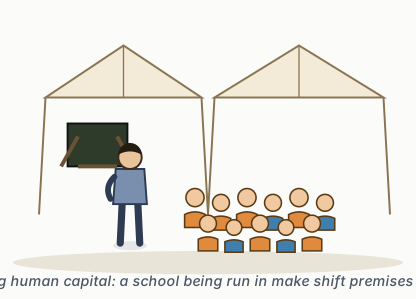
Drawn by us to help you understand the concept clearly, and verified to make sure it's accurate. For exams, practice from your NCERT textbook's own diagram.
Own-drawn recreation of NCERT Fig 4.2 …