Q.Construct a flow chart exhibiting sequential events of oogenesis.
You're viewing a preview — the full solution, concept, methods & PYQ mapping are locked.
Start your 14-day free trial to unlock the full solution →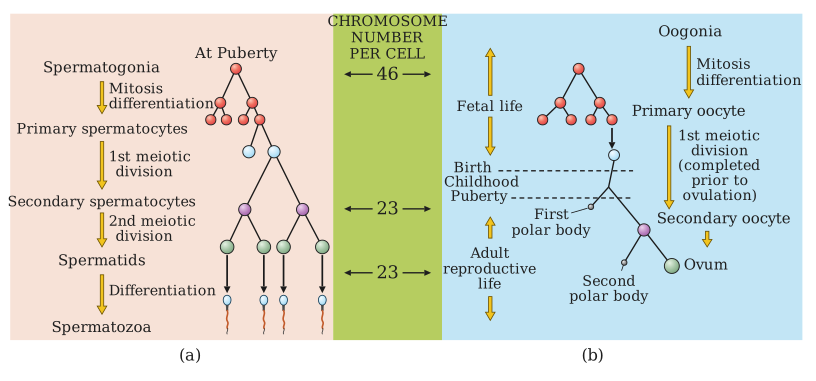
Oogenesis is the process of female gamete formation, beginning in the fetal stage, involving meiotic divisions that produce a single large ovum and smaller polar bodies, with key arrests and completions tied to puberty and fertilisation.
Oogenesis is the intricate process by which a mature female gamete, or ovum, is formed. Unlike spermatogenesis, which begins at puberty in males, oogenesis is initiated much earlier, during the embryonic development of the female fetus. This early start and the subsequent arrests in development are crucial features that distinguish it.
The sequential events of oogenesis can be understood as a developmental journey, starting before birth and culminating only upon fertilisation:
-
Initiation in Fetal Life:
- Within the fetal ovary, millions of gamete mother cells, called oogonia, are formed. It is important to note that no more oogonia are formed or added after birth. This finite number sets a fundamental difference from male gamete production.
- These oogonia then begin to divide and enter the prophase-I stage of meiotic division. At this point, they are temporarily arrested, meaning the division pauses. These cells are now termed primary oocytes.
- Each primary oocyte subsequently gets surrounded by a layer of granulosa cells, forming a structure known as a primary follicle.
-
From Birth to Puberty:
- A significant number of these primary follicles degenerate during the period from birth until puberty. This natural process of follicular atresia means that by the time a female reaches puberty, only about 60,000 to 80,000 primary follicles are left in each ovary.
-
At Puberty and Beyond (Monthly Cycle):
- With the onset of puberty, and during each menstrual cycle, a few primary follicles begin to mature.
- A primary follicle develops into a secondary follicle as it acquires more layers of granulosa cells and a new outer layer called the theca.
- The secondary follicle then transforms into a tertiary follicle. This stage is characterised by the appearance of a fluid-filled cavity called the antrum. The theca layer also differentiates into an inner theca interna and an outer theca externa.
- Within this tertiary follicle, the primary oocyte grows in size and completes its first meiotic division. This division is notably unequal, resulting in the formation of two haploid cells: a large secondary oocyte and a tiny first polar body. The secondary oocyte retains the bulk of the nutrient-rich cytoplasm from the primary oocyte, which is essential for early embryonic development. The first polar body may either degenerate or undergo further division.
- The secondary oocyte immediately proceeds to begin its second meiotic division but then arrests at metaphase-II. …
Unlock everything free for 14 days
- Full step-by-step solutions
- Concept-first explanations
- Methods, shortcuts & mistakes
- PYQ mapping + timed mock tests
Full access for 14 days. No credit card required.