Q.Explain with two examples each of the following: coordination entity, ligand, coordination number, coordination polyhedron, homoleptic and heteroleptic.
Concept understanding — Geometrical Isomerism Conditions
Geometrical Isomerism: The Intuition
Imagine you have two friends standing on opposite sides of a door. If the door is open, they can walk around and swap places easily — there's no real difference between who is on the left and who is on the right. But if the door is locked shut, they are stuck. One is permanently on the left side, the other on the right. That locked door creates two distinct arrangements: Friend A on the left, Friend B on the right versus Friend A on the right, Friend B on the left.
That locked door is the key idea behind geometrical isomerism.
In chemistry, molecules are three-dimensional. Atoms connected by a single bond can rotate freely — like an open door. But a double bond (or a ring structure) locks the atoms in place. If you have two different groups attached to each carbon of a double bond, you get two distinct spatial arrangements that cannot interconvert without breaking the bond. These are geometrical isomers (also called cis-trans or E-Z isomers).
The Precise Conditions
For a molecule to show geometrical isomerism, it must satisfy two conditions simultaneously:
Condition 1: There must be a restricted rotation around a bond — typically a carbon-carbon double bond (C=C) or a ring structure.
Condition 2: Each of the two atoms (or groups) involved in that restricted rotation must have two different substituents attached to it.
Let's unpack each.
Condition 1: Restricted Rotation
A single bond (C−C) allows free rotation — the atoms spin around the bond axis like a wheel. So no geometrical isomers exist there. A double bond (C=C) has a pi (π) bond that locks the molecule flat. Rotation would break the π bond, which requires a lot of energy (about 250–270 kJ/mol). At room temperature, this rotation simply does not happen.
Rings (like cyclopropane, cyclobutane, etc.) also restrict rotation because the ring is a closed loop — atoms cannot rotate past each other without breaking the ring.
Condition 2: Two Different Substituents on Each End
This is the "different groups" rule. Look at each carbon of the double bond (or each ring carbon involved). If both carbons have two different groups attached, geometrical isomers exist. If even one carbon has two identical groups, there is only one possible arrangement.
A common mistake: students check only one carbon. Both carbons must have two different substituents. If one carbon has two identical groups (like two hydrogens), the molecule is identical in both arrangements — no isomerism.
How to Check: A Step-by-Step Method
Take any molecule with a double bond. Follow these steps:
- Identify the double bond (or ring). Mark the two carbon atoms involved.
- List the two groups attached to the first carbon. Are they different from each other? If yes, proceed. If no → no geometrical isomerism.
- List the two groups attached to the second carbon. Are they different from each other? If yes → geometrical isomerism exists. If no → no geometrical isomerism.
If the two groups on a carbon are identical, the molecule is symmetric about that carbon. Flipping the other side gives the same molecule — no isomers.
Examples to Cement the Idea
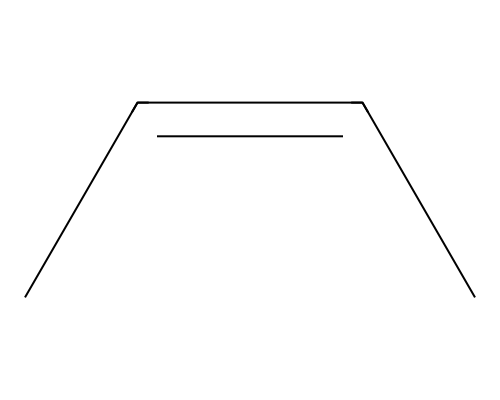
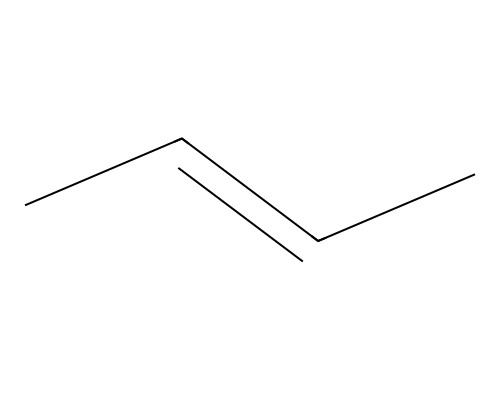
Example 1: But-2-ene (CH3CH=CHCH3)
- Carbon 1 of the double bond: attached to CH3 and H → different ✓
- Carbon 2 of the double bond: attached to CH3 and H → different ✓
Result: Two geometrical isomers exist — cis (both methyl groups on the same side) and trans (methyl groups on opposite sides).
Example 2: 1,2-Dichloroethene (ClCH=CHCl)
- Carbon 1: attached to Cl and H → different ✓
- Carbon 2: attached to Cl and H → different ✓
Result: cis and trans isomers exist.
Example 3: 1,1-Dichloroethene (Cl2C=CH2)
- Carbon 1: attached to Cl and Cl → identical ✗
Result: No geometrical isomerism. Both doubly-bonded carbons carry two identical substituents (H and H on one, Cl and Cl on the other in 1,1-dichloroethene) — geometrical isomerism requires each double-bond carbon to carry two DIFFERENT groups, and neither one here does. The molecule is the same no matter how you look at it.
Example 4: Cyclopropane-1,2-dicarboxylic acid (a ring)
- The ring restricts rotation.
- Carbon 1: attached to COOH and H → different ✓
- Carbon 2: attached to COOH and H → different ✓
Result: cis and trans isomers exist (both carboxylic acid groups on same side vs opposite sides of the ring).
The Naming: cis-trans vs E-Z
For simple cases where the two identical groups are on the same side (like both methyl groups), we use cis (same side) and trans (opposite sides). But when all four substituents are different, cis-trans fails — you need the E-Z system (based on priority rules from Cahn-Ingold-Prelog). That's a separate topic, but the condition for geometrical isomerism remains the same.
Geometrical isomerism requires:
- Restricted rotation (double bond or ring)
- Two different substituents on each of the two atoms involved
If both conditions hold, the molecule exists as two distinct spatial isomers that differ in physical properties (melting point, boiling point, polarity) and often in biological activity.
The conditions required for geometrical isomerism are covered in both the NCERT/CBSE Class 11 Organic Chemistry and Class 12 Coordination Compounds chapters, and ‘conditions for geometrical isomerism’ is a commonly searched important-question topic for board exams, JEE Main and NEET. Applying these two conditions correctly to both alkenes and coordination complexes is a skill tested across multiple competitive-exam chemistry sections.
Why this formula?
Geometrical Isomerism: Why the Conditions Hold
Geometrical isomerism (also called cis-trans or E-Z isomerism) arises when atoms or groups are arranged differently in space around a rigid part of a molecule — typically a double bond or a ring. The key is that rotation is restricted, so the spatial positions become fixed and distinct.
Let’s break down why the conditions are what they are.
1. The Core Requirement: Restricted Rotation
For two molecules to be geometrical isomers, they must have the same connectivity but different spatial arrangement due to a barrier to rotation.
- Double bonds (C=C): The π-bond locks the two carbons in place — rotation requires breaking the π-bond (energy ~250 kJ/mol), so it doesn’t happen at room temperature.
- Rings (e.g., cycloalkanes): The ring structure physically prevents free rotation about C–C single bonds within the ring.
Why this matters: Without restricted rotation, the molecule would freely interconvert between arrangements — no distinct isomers exist.
2. Condition 1: Two Different Groups on Each Carbon (for C=C)
Consider a general alkene:
C=C
Each carbon must have two different substituents (not counting the other carbon of the double bond).
Why?
- If one carbon has two identical groups (e.g., both H), then swapping the groups on that carbon produces the same molecule — no isomerism.
Example:
- 1,2-dichloroethene (ClHC=CHCl): Each carbon has H and Cl (different) → geometrical isomers exist.
- 1,1-dichloroethene (Cl2C=CH2): One carbon has two Cl (identical) → no geometrical isomers.
Formal condition:
For a C=C bond, geometrical isomerism is possible iff each doubly bonded carbon bears two different substituents.
3. Condition 2: For Rings — Similar Logic
In a ring (e.g., cyclopropane, cyclohexane), the ring itself restricts rotation. Here, geometrical isomerism occurs when two substituents on different ring carbons can be on the same side (cis) or opposite sides (trans).
Why?
- The ring is a closed loop — you cannot rotate one carbon relative to another without breaking bonds.
- If the two substituents are on different carbons, their relative orientation (same side / opposite sides) is fixed.
Condition:
- The ring must have at least two substituents (could be same or different) on different carbons.
- If both substituents are on the same carbon, swapping them doesn’t change the molecule (no isomerism).
Example:
- 1,2-dimethylcyclopropane: Two methyl groups on adjacent carbons → cis and trans isomers exist.
- 1,1-dimethylcyclopropane: Both methyls on same carbon → no geometrical isomerism.
4. The E-Z Notation (Why It’s Needed)
When the four substituents on a C=C are all different, cis-trans naming fails. The Cahn-Ingold-Prelog priority rules assign E (opposite sides) or Z (same side).
Why this works:
- Priority is based on atomic number (higher = higher priority).
- Compare the two groups on each carbon — if the higher priority groups are on the same side → Z (German zusammen = together); if opposite → E (entgegen = opposite).
Key insight: The condition remains the same — each carbon must have two different groups — but the naming becomes unambiguous.
5. Summary of Conditions (Exam-Ready)
| Structure | Condition | Why? |
|---|---|---|
| C=C double bond | Each carbon must have two different substituents | Otherwise, swapping groups gives same molecule |
| Ring (e.g., cycloalkane) | At least two substituents on different carbons | Ring prevents rotation; same-side/opposite-side are distinct |
| General | Restricted rotation (double bond or ring) | Without it, free rotation makes isomers identical |
6. Common Exam Pitfall
Don’t confuse:
- Geometrical isomerism ≠ optical isomerism (chirality).
- A molecule can have geometrical isomers even if it has no chiral centre.
- For rings: cis and trans are geometrical isomers only if the substituents are on different carbons.
Final takeaway: The conditions exist because restricted rotation creates a fixed spatial arrangement, and different substituents ensure that swapping positions actually changes the molecule. Without either, you get the same compound — not an isomer.
The key idea is that each term describes a specific structural feature of a coordination compound. Here is the breakdown with two examples for each.
Coordination entity – the central metal ion bonded to a fixed set of ligands, written inside square brackets.
- [Co(NH3)6]3+
- [Fe(CN)6]4−
Ligand – an ion or molecule that donates a lone pair to the metal.
- NH3 (ammine)
- Cl− (chlorido)
Coordination number – the number of ligand donor atoms directly bonded to the metal.
- In [Ni(CO)4], coordination number = 4.
- In [Fe(CN)6]3−, coordination number = 6.
Coordination polyhedron – the spatial arrangement of the donor atoms around the metal.
- Tetrahedral: [Ni(CO)4]
- Octahedral: [Co(NH3)6]3+
Homoleptic complex – all ligands are identical.
- [Cu(NH3)4]2+
- [Fe(CN)6]4−
Heteroleptic complex – at least two different types of ligands.
- [Co(NH3)5Cl]2+
- [Pt(NH3)2Cl2]
The six terms are defined with two examples each as shown above.
This question asks for definitions and two examples each of six fundamental coordination chemistry terms. The key is to understand each term's precise meaning in the context of a coordination compound, then pick clear, distinct examples that illustrate the concept without overlap.
The Concept: Building Blocks of Coordination Compounds
Coordination chemistry is the study of compounds formed between a central metal atom/ion and surrounding molecules or ions called ligands. Think of it like a solar system: the metal is the sun, and the ligands are planets held in orbit by coordinate bonds. Each term below describes a different aspect of this structure.
Let's work through each term systematically, with two well-chosen examples for each.
1. Coordination Entity
A coordination entity is the electrically charged or neutral species that contains the central metal atom/ion bonded to a fixed number of ligands. It's the "core" of the coordination compound, often written inside square brackets in formulas.
Example 1: [Co(NH3)6]3+ — This is a cationic coordination entity where cobalt(III) is surrounded by six ammonia ligands.
Example 2: [Fe(CN)6]4− — This is an anionic coordination entity where iron(II) is bonded to six cyanide ligands.
The coordination entity can be positive, negative, or neutral. For example, [Ni(CO)4] is a neutral coordination entity.
2. Ligand
A ligand is an ion or molecule that donates a pair of electrons to the central metal atom/ion to form a coordinate bond. Ligands are Lewis bases — they have at least one lone pair of electrons available for donation.
Example 1: NH3 (ammonia) — A monodentate ligand that donates through the nitrogen lone pair. It forms complexes like [Cu(NH3)4]2+.
Example 2: EDTA4− (ethylenediaminetetraacetate ion) — A hexadentate ligand that can donate through six donor atoms (two N and four O atoms). It forms very stable complexes, like [Co(EDTA)]−.
| Ligand Type | Denticity | Example |
|---|---|---|
| Monodentate | 1 | Cl−, H2O, NH3 |
| Bidentate | 2 | en (ethylenediamine), ox2− (oxalate) |
| Polydentate | >2 | EDTA4− (hexadentate) |
3. Coordination Number
The coordination number of a central metal atom/ion is the total number of ligand donor atoms directly bonded to it. It is NOT the number of ligands — a bidentate ligand counts as 2 toward the coordination number.
Example 1: In [Ag(NH3)2]+, the coordination number of Ag⁺ is 2 (two monodentate NH₃ ligands, each donating one atom).
Example 2: In [Co(en)3]3+, the coordination number of Co³⁺ is 6 (three bidentate en ligands, each donating two N atoms, so 3×2=6).
A common mistake: counting the number of ligands instead of donor atoms. For [Co(en)3]3+, there are 3 ligands but the coordination number is 6. Always count donor atoms, not ligand molecules.
4. Coordination Polyhedron
The coordination polyhedron is the geometric arrangement of the ligand donor atoms around the central metal atom/ion. It describes the spatial shape formed by joining the positions of the donor atoms.
Example 1: Octahedral — In [Co(NH3)6]3+, the six NH₃ ligands occupy the six vertices of a regular octahedron around Co³⁺. Bond angles are 90°.
Example 2: Tetrahedral — In [Ni(CO)4], the four CO ligands occupy the four vertices of a tetrahedron around Ni(0). Bond angles are approximately 109.5°.
Common coordination polyhedra and their coordination numbers:
- Linear: CN = 2
- Square planar: CN = 4
- Tetrahedral: CN = 4
- Octahedral: CN = 6
5. Homoleptic Complex
A homoleptic complex is one in which the central metal atom/ion is bonded to only one type of ligand. All ligands are identical.
Example 1: [Cu(NH3)4]2+ — Only ammonia ligands are present. The complex is homoleptic.
Example 2: [Fe(CO)5] — Only carbonyl (CO) ligands are present. This is a homoleptic carbonyl complex.
The word "homoleptic" comes from Greek: homo (same) + leptos (taken). So it literally means "taken from the same" — all ligands are the same.
6. Heteroleptic Complex
A heteroleptic complex is one in which the central metal atom/ion is bonded to two or more different types of ligands.
Example 1: [Co(NH3)5Cl]2+ — Contains both ammonia and chloride ligands. Two different ligand types make it heteroleptic.
Example 2: [Pt(NH3)2Cl2] — Contains both ammonia and chloride ligands. Even though there are two of each, the presence of two different ligand types makes it heteroleptic.
Don't confuse "heteroleptic" with "mixed valence" or "polynuclear." Heteroleptic simply means multiple ligand types, regardless of how many metal centers are present.
The two examples for each term are: Coordination entity — [Co(NH3)6]3+ and [Fe(CN)6]4−; Ligand — NH3 and EDTA4−; Coordination number — 2 in [Ag(NH3)2]+ and 6 in [Co(en)3]3+; Coordination polyhedron — octahedral in [Co(NH3)6]3+ and tetrahedral in [Ni(CO)4]; Homoleptic — [Cu(NH3)4]2+ and [Fe(CO)5]; Heteroleptic — [Co(NH3)5Cl]2+ and [Pt(NH3)2Cl2].
Defining Coordination-Chemistry Terms — Method: Definition-Then-Example
Method Name
Precise Definition, Then Two Distinct Examples
Steps
- State the precise definition of the term first, in terms of the central metal atom/ion and its bonded ligands — never start with an example, since a vague definition is where most marks are lost.
- Identify the structural feature the term describes — is it about the whole species (coordination entity), a single donor group (ligand), a count (coordination number), a shape (coordination polyhedron), or the variety of ligands present (homoleptic/heteroleptic)?
- Recall one clear, standard NCERT-level example that unambiguously demonstrates the term.
- Recall a second, genuinely different example (different metal and/or different ligand set) so the answer shows real understanding, not just memorised repetition.
- Cross-check consistency: make sure the same complex is not reused for two different terms unless that reuse is the point (e.g. using [Co(NH3)6]3+ again to illustrate "octahedral" after already using it for "coordination entity" is fine and expected).
Examples for Key Coordination Chemistry Terms
1. Coordination Entity
A coordination entity is an ion or molecule containing a central metal atom bonded to surrounding ligands.
| Example | Formula | Explanation |
|---|---|---|
| Hexaaquacopper(II) ion | [Cu(H2O)6]2+ | Central Cu²⁺ with six water ligands |
| Tetrachloronickelate(II) ion | [NiCl4]2− | Central Ni²⁺ with four chloride ligands |
2. Ligand
A ligand is an ion or molecule that donates a lone pair to the central metal atom.
| Example | Formula | Donor atom(s) |
|---|---|---|
| Water | H2O | Oxygen (O) |
| Ammonia | NH3 | Nitrogen (N) |
3. Coordination Number
The coordination number is the number of ligand donor atoms directly bonded to the central metal.
| Example | Complex | Coordination Number |
|---|---|---|
| Tetrahedral | [Ni(CO)4] | 4 |
| Octahedral | [Co(NH3)6]3+ | 6 |
4. Coordination Polyhedron
The coordination polyhedron is the geometric shape formed by the donor atoms around the central metal.
| Example | Complex | Polyhedron |
|---|---|---|
| Tetrahedral | [Ni(CO)4] | Tetrahedron |
| Octahedral | [Co(NH3)6]3+ | Octahedron |
5. Homoleptic vs Heteroleptic
| Type | Definition | Example |
|---|---|---|
| Homoleptic | All ligands are identical | [Co(NH3)6]3+ (only ammonia) |
| Heteroleptic | Two or more different types of ligands | [Co(NH3)4Cl2]+ (ammonia + chloride) |
Key exam tip: Give the definition in your own precise words before the
examples — an answer that opens straight with "for example..." without ever
stating the definition loses easy marks even if the examples are correct.
Common Mistakes When Defining Coordination-Chemistry Terms
Students lose marks on this question not because the chemistry is hard, but
because the six terms get mixed up with each other. Here are the most
frequent slips and how to avoid them.
Mistake 1: Confusing "Ligand" with "Coordination Entity"
The error: Treating the whole formula (including counter ions) as the
"coordination entity," or calling a single ligand the "coordination entity."
How to avoid:
- The coordination entity is only what sits inside the square brackets — the central metal atom/ion plus the ligands directly bonded to it (e.g. [Co(NH3)6]3+).
- A ligand is just one of the individual donor species bonded to the metal (e.g. NH3 is one ligand within that coordination entity).
- Any ion sitting outside the brackets (like Cl− in [Co(NH3)6]Cl3) is neither the coordination entity nor a ligand — it is a counter ion.
Mistake 2: Counting Ligands Instead of Donor Atoms for Coordination Number
The error: Assuming coordination number always equals the number of
ligand molecules/ions present.
How to avoid:
- Coordination number = number of ligand donor atoms bonded to the metal, not the number of ligand species.
- A monodentate ligand contributes 1 to the coordination number; a bidentate ligand (like en) contributes 2.
- Example: [Co(en)3]3+ has only 3 ligand molecules but a coordination number of 6 (3 × 2 donor atoms).
Mistake 3: Assuming Coordination Number Fixes the Coordination Polyhedron
The error: Thinking coordination number 4 always means tetrahedral, or
that coordination number 6 always means octahedral.
How to avoid:
- Coordination number 4 can be tetrahedral (e.g. [Ni(CO)4]) or square planar (e.g. [PtCl4]2−) — the coordination number alone does not decide the shape.
- Coordination polyhedron is the actual geometric arrangement of donor atoms; it must be stated/derived separately from the coordination number.
Mistake 4: Miscounting Ligand Types for Homoleptic/Heteroleptic
The error: Calling a complex "heteroleptic" just because it has more
than one ligand, even if all the ligands are of the same type.
How to avoid:
- Homoleptic = bonded to only one kind of ligand, no matter how many copies (e.g. [Fe(CO)5] — five CO ligands, still homoleptic).
- Heteroleptic = bonded to two or more different kinds of ligands (e.g. [Co(NH3)5Cl]2+ — ammine and chlorido are different ligand types).
- Count types of ligand, not the total number of ligand molecules.
Mistake 5: Giving Vague or Duplicate Examples
The error: Reusing the same complex for two different terms, or giving
an example that is not actually a valid, well-known coordination compound.
How to avoid:
- Pick two distinct, standard NCERT-level examples for each term so the answer clearly demonstrates understanding rather than repetition — e.g. [Co(NH3)6]3+ and [Fe(CN)6]4− for coordination entity; [Ni(CO)4] (tetrahedral) and [Co(NH3)6]3+ (octahedral) for coordination polyhedron.
Quick Revision Table
| Term | Common Mistake | Correct Understanding |
|---|---|---|
| Coordination entity | Confused with the whole formula | Only the species inside [ ] |
| Ligand | Confused with the coordination entity | One donor species bonded to the metal |
| Coordination number | Counted ligands, not donor atoms | Sum of donor atoms from all ligands |
| Coordination polyhedron | Assumed fixed by coordination number alone | The actual 3-D shape (e.g. CN=4 can be tetrahedral or square planar) |
| Homoleptic/heteroleptic | Counted ligand molecules, not ligand types | Based on number of different types of ligand |
Final tip: Define each term precisely first, then attach two clean,
distinct examples — don't let the six terms blur into one another.
- CBSE 2026Set ANNUAL1 markQ.Draw the structure of geometrical isomers of [Co(NH3)4Cl2].
›Reveal solutionSolution
[Co(NH3)4Cl2]+ is an octahedral complex of the type [MA4B2], which shows cis-trans geometrical isomerism depending on the relative positions of the two identical Cl ligands.
The complex [Co(NH3)4Cl2]+ has an octahedral geometry with 4 NH3 and 2 Cl- ligands around the central Co(III) ion. For an [MA4B2] type octahedral complex, two arrangements of the two B (Cl) ligands are possible:
- cis-isomer: the two Cl- ligands occupy adjacent positions on the octahedron, with a Cl-Co-Cl bond angle of 90 degrees. (Structure: picture an octahedron with NH3 on four positions and the two Cl ligands on two adjacent corners.)
- trans-isomer: the two Cl- ligands occupy opposite positions on the octahedron, directly across from each other, with a Cl-Co-Cl bond angle of 180 degrees. (Structure: the two Cl ligands sit at the top and bottom apex positions, with all four NH3 ligands in the square equatorial plane.)
These two forms are geometrical (cis-trans) isomers - same connectivity/formula, but different spatial arrangement of ligands, and are not interconvertible without breaking bonds.
✓Final answerTwo geometrical isomers exist: cis-[Co(NH3)4Cl2]+ (Cl ligands at 90 degrees to each other) and trans-[Co(NH3)4Cl2]+ (Cl ligands at 180 degrees, opposite each other).
- CBSE 2026Set ANNUAL1 markMCQQ.Which complexes do not show geometrical isomerism?(a) Square planar complexes(b) Tetrahedral complexes(c) Octahedral complexes(d) All of the above
›Reveal solutionSolution
Geometrical (cis/trans, fac/mer) isomerism requires ligand positions that are not all equivalent/adjacent; a tetrahedral geometry has no such distinction, so it alone among these never shows geometrical isomerism.
-
(a) Square planar complexes (e.g. [Pt(NH3)2Cl2], type MA2B2) do show cis–trans geometrical isomerism, since two positions can be adjacent (cis, 90∘) or opposite (trans, 180∘).
-
(c) Octahedral complexes (types MA4B2, MA3B3, etc.) do show both cis–trans and facial–meridional (fac/mer) geometrical isomerism, since some positions are adjacent and some are directly opposite.
-
(b) Tetrahedral complexes: all four coordination positions are geometrically equivalent and mutually adjacent — there is no pair of ligand sites at 180∘ to each other. Any two ligand arrangements that look different on paper are actually superimposable by rotation, so a genuine cis/trans (or fac/mer) distinction cannot exist. (Tetrahedral complexes with four different unidentate ligands can show optical isomerism instead, which is a separate phenomenon from geometrical isomerism.)
-
(d) 'All of the above' is therefore false, since square planar and octahedral complexes do show geometrical isomerism.
✓Final answer(b) Tetrahedral complexes
-
- CBSE 2025Set ANNUAL1 markQ.Draw structures of geometrical isomers of [Fe(NH3)2(CN)4]−.
›Reveal solutionSolution
This octahedral MA2B4 complex can arrange its two identical NH3 ligands either adjacent to each other (cis) or directly opposite each other (trans), giving two geometrical isomers.
Identifying the isomerism
[Fe(NH3)2(CN)4]− is an octahedral complex of the general type [MA2B4], where A=NH3 (2 ligands) and B=CN− (4 ligands). This type of complex shows cis–trans (geometrical) isomerism depending on the relative positions of the two A (NH3) ligands.
cis-isomer: Picture an octahedron with the six positions labelled +x,−x,+y,−y,+z,−z. In the cis isomer, the two NH3 ligands occupy adjacent positions, i.e. at 90∘ to each other (e.g. one NH3 at +z and the other at +x), with the four CN− ligands occupying the remaining four positions (−z,−x,+y,−y).
trans-isomer: In the trans isomer, the two NH3 ligands occupy diametrically opposite positions, i.e. at 180∘ to each other (e.g. one at +z and the other at −z), with all four CN− ligands occupying the equatorial plane (+x,−x,+y,−y).
(In a 2-D sketch, both isomers are drawn as an octahedron outline with Fe at the centre: the cis form shows the two NH3 labels on two adjacent vertices, and the trans form shows them on two vertices directly across from each other, with CN labelling the remaining four vertices in both cases.)
✓Final answerTwo geometrical isomers exist: cis-[Fe(NH3)2(CN)4]− (the two NH3 ligands mutually adjacent, 90∘ apart) and trans-[Fe(NH3)2(CN)4]− (the two NH3 ligands mutually opposite, 180∘ apart), with CN− occupying the remaining coordination positions in each case.
- CBSE 2024Set ANNUAL1 markMCQQ.Which kinds of isomerism are exhibited by octahedral Co(NH3)4Br2Cl ?(a) Geometrical and ionization(b) Geometrical and Optical(c) Optical and ionization(d) Geometrical only
›Reveal solutionSolution
Co(NH3)4Br2Cl is written as [Co(NH3)4Br2]Cl; being an octahedral MA4B2-type complex it shows cis-trans (geometrical) isomerism, and because Cl and Br can swap places inside/outside the coordination sphere it also shows ionization isomerism.
Formula analysis: cobalt is in the +3 oxidation state; 4 NH3 (neutral) and 2 Br- occupy the coordination sphere (charge = 3 - 2 = +1), balanced by one Cl- as the counter ion outside the sphere: [Co(NH3)4Br2]+ Cl-.
Geometrical isomerism: this is an octahedral complex of type MA4B2 (4 identical NH3 and 2 identical Br in the sphere). The two Br ligands can be mutually cis (adjacent, 90 degrees apart) or trans (opposite, 180 degrees apart), giving cis- and trans-tetraamminedibromidocobalt(III) chloride. (Note: MA4B2 does not show optical isomerism, because both cis and trans forms possess a plane of symmetry.)
Ionization isomerism: this arises when a ligand and the counter ion can exchange places, giving isomers that ionise to give different ions in solution. Here, [Co(NH3)4Br2]Cl (which gives Cl- in solution, tests positive with AgNO3) is an ionization isomer of [Co(NH3)4BrCl]Br (which gives Br- in solution, tests positive with AgNO3 differently) - both have the same overall composition Co(NH3)4Br2Cl but different ions in solution.
Since both types of isomerism apply here (and optical does not, since cis-MA4B2 has a mirror plane), the correct choice is geometrical and ionization.
✓Final answer(a) Geometrical and ionization.
- CBSE 2024Set ANNUAL1 markMCQQ.Assertion [A] : Complexes of MX6 and MX5L type [X and L are unidentate] do not show geometrical isomerism. Reason [R] : Geometrical isomerism is not shown by the complexes of coordination number 6.(a) Both [A] and [R] are true and [R] is the correct explanation of [A].(b) Both [A] and [R] are true, but [R] is not the correct explanation of [A].(c) [A] is true, but [R] is false.(d) [A] is false, but [R] is true.
›Reveal solutionSolution
MX6 and MX5L complexes genuinely show no geometrical isomerism, but that is NOT because coordination number 6 in general excludes geometrical isomerism — many other CN-6 complexes (e.g. MX4L2, MX3L3) do show it.
[A] For an octahedral complex MX6 (all six ligands identical) there is only one possible spatial arrangement, and for MX5L (five identical + one different) the single different ligand can occupy any of the six equivalent octahedral positions — again only one distinct structure results. So neither shows geometrical isomerism. [A] is TRUE.
[R] However, it is false to generalise that coordination number 6 as such never shows geometrical isomerism. Octahedral complexes of type MX4L2 (cis/trans isomers), MX3L3 (facial/meridional isomers), and MX2L2L2 (various geometrical arrangements) are classic, well-known examples of geometrical isomerism at coordination number 6. So [R] as a blanket statement is FALSE.
✓Final answer(c) [A] is true, but [R] is false.
- CBSE 2024Set ANNUAL1 markMCQQ.The existence of two different coloured complexes with composition of [Co(NH3)4Cl2]+ is due to(a) linkage isomerism(b) geometrical isomerism(c) coordination isomerism(d) ionization isomerism
›Reveal solutionSolution
[Co(NH3)4Cl2]+ has two possible spatial arrangements of the two Cl− ligands on the octahedron (cis and trans) — geometrical isomerism — giving violet (cis) and green (trans) forms.
The complex [Co(NH3)4Cl2]+ is octahedral with formula type [MA4B2] (4 NH3 + 2 Cl around Co3+). Two distinct, non-interconvertible spatial arrangements are possible:
- cis-[Co(NH3)4Cl2]+: the two Cl ligands occupy adjacent (90°) positions — this isomer is violet.
- trans-[Co(NH3)4Cl2]+: the two Cl ligands occupy opposite (180°) positions — this isomer is green.
Both isomers have the same molecular formula, the same donor atoms, and the same metal oxidation state (+3) — only the spatial arrangement of ligands differs. Because the ligand geometry around the metal differs, the crystal-field splitting and hence the d–d transition energies (and so the colour absorbed/observed) differ between the two forms. This is the defining signature of geometrical (cis–trans) isomerism, not a difference in connectivity or ionisation.
Why the other options are wrong: (a) Linkage isomerism needs an ambidentate ligand (e.g. −NO2/−ONO) — none is present here. (c) Coordination isomerism requires both a complex cation and complex anion exchanging ligands — this is a single cationic complex with a simple counter-ion. (d) Ionisation isomerism arises when a ligand and the counter-ion exchange places (giving different ions in solution) — here what's inside vs. outside the coordination sphere is fixed; only the spatial layout of the two Cl ligands changes.
✓Final answer(b) Geometrical isomerism (cis-violet vs trans-green forms)
- CBSE 2023Set ANNUAL1 markQ.Draw the geometrical isomers of [Co(NO2)3(NH3)3]. (½+½=1)
›Reveal solutionSolution
[Co(NO2)3(NH3)3] is an octahedral complex of the type MA3B3, which exhibits two geometrical isomers — facial (fac) and meridional (mer) — depending on how the two sets of three identical ligands are arranged relative to each other.
In an octahedral complex MA3B3 (here M=Co3+, A=NO2−, B=NH3), simple cis–trans naming does not apply since there are three ligands of each type; instead the isomers are called facial (fac) and meridional (mer):
fac-[Co(NO2)3(NH3)3]: Picture an octahedron with vertices labelled 1–6 (1,2,3 forming the top triangular face; 4,5,6 the bottom face). All three NO2− ligands occupy one triangular face (positions 1, 2, 3 — mutually cis, each at 90∘ to the other two), while all three NH3 ligands occupy the opposite triangular face (positions 4, 5, 6). The three like ligands thus form a triangular "face" of the octahedron on each side.
mer-[Co(NO2)3(NH3)3]: The three NO2− ligands instead occupy three positions that lie in one plane passing through the metal centre — e.g. positions 1 (top), 2 (equatorial), and 4 (bottom), so that two of the three NO2− groups are mutually trans (180∘ apart) while the third is cis to both. The three NH3 ligands occupy the remaining three positions, also lying along that same meridian plane on the other side.
(Since a text/JSON answer cannot render a diagram directly: in fac-, looking down any one of the C3 axes of the octahedron shows all three NO2− on the near face; in mer-, one NO2−–Co–NO2− angle is 180∘ and the third NO2− sits at 90∘ to both.)
✓Final answerTwo geometrical isomers exist: fac-isomer (three NO2− on one triangular face, three NH3 on the opposite face) and mer-isomer (two NO2− groups mutually trans, the third cis to both, with NH3 similarly arranged on the meridian).
- CBSE 2020Set 56/2/11 markQ.What type of isomerism is shown by the complex [Co(NH3)5NO2]Cl2?
›Reveal solutionSolution
The complex [Co(NH3)5NO2]Cl2 exhibits linkage isomerism because the NO2− ligand can coordinate through either the nitrogen atom (−NO2, nitro) or the oxygen atom (−ONO, nitrito), giving two distinct isomers.
Why This Question Tests a Key Concept
This problem isn't just about memorising a name — it's about recognising that a ligand can bind in more than one way. The NO2− ion is an ambidentate ligand: it has two different donor atoms (N and O) that can form a coordinate bond with the central metal ion. That single fact is the entire foundation of linkage isomerism.
ImportantLinkage isomerism arises only when an ambidentate ligand coordinates through different atoms. The complex must have the same molecular formula but differ in which atom of the ligand is bonded to the metal.
Step-by-Step Reasoning
-
Identify the coordination sphere and counter ions
The formula is [Co(NH3)5NO2]Cl2. The square brackets enclose the coordination sphere: Co3+ (cobalt in +3 oxidation state) surrounded by five NH3 ligands and one NO2− ligand. The two Cl− ions are outside the brackets — they are counter ions, not directly bonded to cobalt.
-
Recognise the ambidentate nature of NO2−
The nitrite ion can bind through:
- Nitrogen atom: forming a nitro complex, [Co(NH3)5(NO2)]2+
- Oxygen atom: forming a nitrito complex, [Co(NH3)5(ONO)]2+
Both have the same overall formula [Co(NH3)5NO2]Cl2, but the connectivity differs.
-
Check for other isomerism types
- Geometrical isomerism requires different spatial arrangements of ligands (e.g., cis/trans in square planar or octahedral complexes). Here, all five NH3 are identical, and the sixth position is occupied by NO2− — there is no possibility of different geometric arrangements.
- Optical isomerism requires chirality (non-superimposable mirror images). This complex has no chiral centre or plane of asymmetry.
- Ionisation isomerism would involve exchange of ligands with counter ions (e.g., [Co(NH3)5Cl]NO2), but here the Cl− ions are clearly outside the coordination sphere and the NO2− is inside — no such exchange is possible without changing the formula.
-
Confirm linkage isomerism
Since the only variable is which atom of NO2− bonds to cobalt, and both possibilities yield distinct compounds with different properties (e.g., colour, reactivity), this is a textbook case of linkage isomerism.
TipA quick way to spot linkage isomerism: look for a ligand with two different donor atoms (like NO2−, SCN−, CN−, or CO). If the ligand is inside the coordination sphere and the rest of the complex is symmetric, linkage isomerism is almost certainly the answer.
Watch outA common mistake is to confuse linkage isomerism with ionisation isomerism. Remember: linkage isomerism changes which atom of the same ligand is bonded; ionisation isomerism swaps a ligand with a counter ion. Here, Cl− is outside the bracket and NO2− is inside — no swap occurs.
✓Final answerThe complex [Co(NH3)5NO2]Cl2 shows linkage isomerism due to the ambidentate NO2− ligand.
-
- CBSE 2018Set ANNUAL1 markQ.Explain with an example the ionisation isomerism in complex compounds.
›Reveal solutionSolution
Ionisation isomers have identical formulae but produce different ions in solution by interchanging a ligand inside the coordination sphere with the counter-ion; e.g. [Co(NH3)5Br]SO4 and [Co(NH3)5SO4]Br.
Ionisation isomerism occurs when the counter-ion (the ion outside the coordination sphere) can itself act as a ligand and thus exchange places with a ligand inside the coordination sphere. The two isomers have the same overall formula but ionise to give different ions in solution.
Example:
- [Co(NH3)5Br]SO4 -> [Co(NH3)5Br]2+ + SO4^2- (gives sulphate ion; gives white ppt with BaCl2).
- [Co(NH3)5SO4]Br -> [Co(NH3)5SO4]+ + Br- (gives bromide ion; gives pale-yellow ppt with AgNO3).
Because the free ions in solution differ, the two are distinct compounds.
✓Final answerIonisation isomers: same formula, different ions in solution; e.g. [Co(NH3)5Br]SO4 (free SO4^2-) vs [Co(NH3)5SO4]Br (free Br-).
- CBSE 2018Set 56/11 markQ.Write the coordination isomer of [Cu(NH3)4][PtCl4].
›Reveal solutionSolution
Interchanging ligands between the two complex ions gives the coordination isomer [Pt(NH3)4][CuCl4].
Concept. Coordination isomerism (a CBSE Class-12 coordination-compounds topic) occurs in salts where both the cation and the anion are complex ions; the ligands can be distributed differently between the two metal centres.
Why. In [Cu(NH3)4][PtCl4], the NH3 ligands are on Cu and the Cl− ligands are on Pt. Exchanging the ligand sets produces a genuinely different compound with the same overall formula.
Steps. Move all four NH3 to platinum and all four Cl− to copper.
✓Final answer[Pt(NH3)4][CuCl4]
- CBSE 2017Set ANNUAL1 markMCQQ.Which complex exhibit geometrical isomerism?(a) [MnBr4]2+(b) [Pt(NH3)3Cl]+(c) [PtCl2(P(C2H5)3)2](d) [Fe(H2O)5NO]2+
›Reveal solutionSolution
Geometrical (cis-trans) isomerism requires at least two different pairs of ligands arranged around a square planar or octahedral centre in more than one distinguishable way; only the MA2B2 square planar complex among the options qualifies.
Checking each option:
-
[MnBr4]²⁻: tetrahedral geometry (Mn²⁺, d⁵, weak field with 4 identical Br⁻ ligands). Tetrahedral complexes of the type MA4 do not show geometrical isomerism, since all four positions are equivalent.
-
[Pt(NH3)3Cl]⁺: square planar, type MA3B (3 identical NH3 + 1 Cl). With only one different ligand, there is only one possible spatial arrangement — no cis-trans isomerism possible.
-
[PtCl2(P(C2H5)3)2]: square planar, type MA2B2 (2 Cl + 2 PEt3). The two identical Cl ligands can be adjacent (cis) or opposite (trans) to each other, giving two distinct geometrical isomers — this does show geometrical isomerism.
-
[Fe(H2O)5NO]²⁺: octahedral, type MA5B (5 identical H2O + 1 NO). With only one different ligand, there is only one possible position for it — no geometrical isomerism.
✓Final answer(c) [PtCl2(P(C2H5)3)2]
-
🎓Unlock everything free for 14 days
- ✓Full step-by-step solutions
- ✓Concept-first explanations
- ✓Methods, shortcuts & mistakes
- ✓PYQ mapping + timed mock tests
Full access for 14 days. No credit card required.