Q.Which of the following compounds
(b)
You're viewing a preview — the full solution, concept, methods & PYQ mapping are locked.
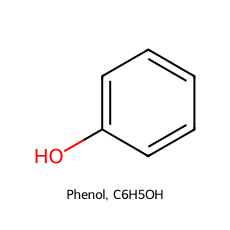
Start your 14-day free trial to unlock the full solution →The key idea is that NaBr/H₂SO₄ generates HBr in situ, which reacts with alcohols via an Sₙ1 or Sₙ2 mechanism to give alkyl bromides. Phenol (b) does not undergo this reaction because the C–O bond in phenol has partial double-bond character due to resonance with the aromatic ring, making it too strong to be broken by HBr under these conditions. The compound that will not react is ** (b) C₆H₅OH**.
Why this approach works
The mixture of NaBr and concentrated H₂SO₄ is a classic way to produce HBr gas in the reaction flask:
This HBr then acts as a strong acid and a source of nucleophilic bromide ions. For an alcohol to react, the –OH group must first be protonated to make it a better leaving group (water), and then Br⁻ attacks the carbon. This is an acid-mediated nucleophilic substitution of the alcohol's –OH group (not an addition reaction — Markovnikov's rule applies to additions across C=C double bonds and has no role here).
The critical factor is how easily the C–O bond breaks. In aliphatic alcohols like (a), the C–O bond is a simple single bond, easily cleaved after protonation. In phenol (b), the C–O bond is strengthened by resonance: the oxygen’s lone pairs are delocalised into the aromatic ring, giving the bond partial double-bond character. That makes it far more resistant to nucleophilic substitution.
Step-by-step reasoning
-
Identify the reagent system.
NaBr + H₂SO₄ generates HBr. H₂SO₄ also acts as a dehydrating agent and protonates the –OH group. So the effective reagent is HBr in acidic medium.
-
Consider compound (a): CH₃CH₂CH₂OH (propan-1-ol).
This is a primary aliphatic alcohol. The reaction proceeds via an Sₙ2 mechanism (or Sₙ1 if a carbocation can form, but here it’s primary so Sₙ2 dominates).
- Protonation:
- Nucleophilic attack by Br⁻:
This reaction is well-known and gives 1-bromopropane. So (a) will react.
- Consider compound (b): C₆H₅OH (phenol).
Phenol is an aromatic alcohol. The –OH group is directly attached to the benzene ring.
- The oxygen’s lone pairs are in conjugation with the π-system of the ring. This resonance stabilises the C–O bond, giving it significant double-bond character.
- Protonation of phenol gives C₆H₅OH₂⁺, but the positive charge on oxygen further destabilises the ring — and more importantly, the C–O bond is still too strong for Br⁻ to displace. …
Unlock everything free for 14 days
- Full step-by-step solutions
- Concept-first explanations
- Methods, shortcuts & mistakes
- PYQ mapping + timed mock tests
Full access for 14 days. No credit card required.