Q.Toluene reacts with a halogen in the presence of iron (III) chloride giving ortho and para halo compounds. The reaction is
🔒You're viewing a preview — the full solution, concept, methods & PYQ mapping are locked.
🔒 Start your 14-day free trial to unlock the full solution →Concept understanding — Nucleophilic Addition
Nucleophilic Addition – From Intuition to Precision
Imagine you have a molecule with a carbon–oxygen double bond — a carbonyl group (C=O). That oxygen is greedy for electrons; it pulls them away from carbon, leaving the carbon slightly positive (δ+) and the oxygen slightly negative (δ−). Now, if you bring a species that is rich in electrons (a nucleophile, meaning "nucleus-loving"), it will naturally be attracted to that electron-deficient carbon. The nucleophile attacks the carbon, the π bond breaks, and the oxygen picks up a proton (or some other electrophile) to become stable. That, in a nutshell, is nucleophilic addition.
The key idea: a nucleophile adds across a polar multiple bond (usually C=O or C≡N), breaking the π bond and forming two new sigma bonds.
The Precise Statement
Nucleophilic addition is a reaction in which a nucleophile (an electron-rich species) forms a sigma bond with an electrophilic carbon atom of a polar multiple bond (typically a carbonyl group, C=O, or a nitrile, C≡N), while the π bond breaks. The resulting intermediate then captures a proton (or another electrophile) to give a neutral product.
In general form:
RX2C=O+NuX−HX+RX2C(OH)Nu
The nucleophile (NuX−) attacks the carbonyl carbon; the oxygen becomes negatively charged; then a proton (HX+) from the medium attaches to the oxygen, yielding an alcohol.
Why It Happens – The Driving Force
The carbonyl carbon is electrophilic because:
- Oxygen is more electronegative than carbon, so the C=O bond is polarised: CXδ+=OXδ−.
- The π bond is weaker than a σ bond, so it can break relatively easily.
A nucleophile (like OHX−, CNX−, or NHX3) has a lone pair or a negative charge. It seeks positive centres. The attack forms a new σ bond, and the π electrons move entirely to oxygen, creating an alkoxide ion (RX2C−OX−). This intermediate is then quenched by a proton.
A common mistake: thinking the nucleophile attacks the oxygen. No — oxygen is already electron-rich; the nucleophile goes to the carbon because it is electron-deficient.
A Concrete Example – Addition of HCN to a Ketone
Take acetone (CHX3COCHX3) and hydrogen cyanide (HCN). In the presence of a base, CNX− (the nucleophile) attacks the carbonyl carbon:
CHX3COCHX3+CNX−CHX3C(OX−)(CN)CHX3
The alkoxide intermediate then picks up a proton from HCN (or from water) to give a cyanohydrin:
CHX3C(OX−)(CN)CHX3+HX+CHX3C(OH)(CN)CHX3
The product is acetone cyanohydrin. Notice: two new sigma bonds formed (C−CN and O−H), and the π bond is gone.
What Makes a Good Nucleophile?
Strong nucleophiles are usually negatively charged or have lone pairs:
- OHX−, CNX−, NHX2X−, CHX3OX−, HX− (from hydride reagents like NaBHX4 or LiAlHX4)
- Neutral but polarisable: NHX3, HX2O (weaker, but can add under acidic conditions) …
Why this formula?
Nucleophilic Addition: Why the Mechanism Works the Way It Does
Let's build this from first principles — understanding why nucleophilic addition happens, not just memorising the steps.
1. The Core Problem: Why Does Addition Happen at All?
A carbonyl group (C=O) has a polarised double bond:
- Oxygen is more electronegative than carbon → it pulls electron density toward itself.
- This creates a partial positive charge on carbon (δ+) and a partial negative charge on oxygen (δ−).
CXδ+=OXδ−
Key insight: The carbon is electron-deficient — it wants electrons. A nucleophile (Nu⁻) is electron-rich — it wants to give electrons. This is a natural match.
2. The Two-Step Mechanism (Why Two Steps?)
Step 1: Nucleophilic Attack (Slow, Rate-Determining)
The nucleophile donates its lone pair to the electrophilic carbonyl carbon.
NuX−+C=O[Nu−C−O]X−
Why this happens:
- The π bond between C and O breaks — the electrons move entirely to oxygen.
- Oxygen now has a full negative charge (alkoxide ion).
- The carbon changes from sp2 (trigonal planar) to sp3 (tetrahedral).
This step is slow because the π bond must break — it requires energy.
Step 2: Protonation (Fast)
The negatively charged oxygen picks up a proton (HX+) from the solvent or acid.
[Nu−C−O]X−+HX+Nu−C−OH
Why this happens:
- The alkoxide ion is a strong base — it wants to neutralise its charge.
- Protonation gives a stable neutral alcohol product.
3. The Key Formula: Rate Law Derivation
For a general nucleophilic addition:
NuX−+RX2C=Okproducts
The rate law comes from the slow step (Step 1):
Rate=k[Nu−][RX2C=O]
Why this form?
- The reaction is bimolecular — two species must collide with correct orientation.
- Doubling either concentration doubles the rate (first order in each).
- This is second order overall.
Exam tip: This is why nucleophilic addition is often called addition-elimination when followed by loss of a leaving group (like in acyl substitution), but here it's just addition.
4. Why the Tetrahedral Intermediate Forms (And Why It's Unstable)
The intermediate is tetrahedral (sp3 hybridised carbon):
- Bond angles: ~109.5°
- Four groups around carbon: Nu, R, R', O⁻
Why it's unstable:
- The negative charge on oxygen is high-energy.
- The tetrahedral geometry is sterically crowded (especially with bulky R groups).
- The intermediate collapses quickly — either back to starting materials or forward to product. …
The key idea is Electrophilic Aromatic Substitution. Toluene has an electron-donating methyl group that activates the ring toward electrophilic attack, directing the incoming halogen to the ortho and para positions.
- Iron(III) chloride generates the electrophile: Cl2+FeCl3→Cl++FeCl4−
- The Cl+ attacks the electron-rich benzene ring of toluene, forming a resonance-stabilized carbocation intermediate. …
Toluene undergoes electrophilic aromatic substitution with a halogen in the presence of FeCl₃. The halogen is activated by FeCl₃ to form an electrophile, which attacks the electron-rich benzene ring. The correct option is (ii).
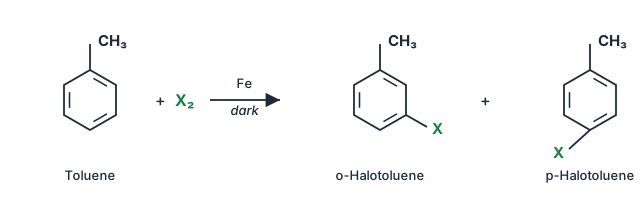
The key here is to recognise what kind of reagent a halogen becomes when mixed with a Lewis acid like FeCl₃. On its own, Cl₂ or Br₂ is not strongly electrophilic — it needs a "push" to become reactive toward an aromatic ring. FeCl₃ does exactly that: it polarises the halogen molecule, making one end strongly positive (the electrophile). This is a classic setup for electrophilic aromatic substitution, not addition or free-radical chemistry.
Let’s walk through the reasoning step by step.
-
Identify the reaction type from the reagents.
Toluene (methylbenzene) is an aromatic compound. Halogens (Cl₂, Br₂) do not normally add to aromatic rings under these conditions — they substitute. The presence of FeCl₃ (a Lewis acid) is a dead giveaway: it’s the catalyst used in the halogenation of aromatic rings. This is not a free-radical or nucleophilic process.
-
Understand the role of FeCl₃.
FeCl₃ coordinates with the halogen, say Cl₂, forming a complex like FeCl₄⁻ and Cl⁺ (or a highly polarised Cl–Cl bond). This generates a strong electrophile — a chlorine atom with a partial or full positive charge.
Cl2+FeCl3→Clδ+⋯FeCl4−
-
Why electrophilic substitution, not addition?
The aromatic ring is rich in π electrons. It attacks the electrophile (Cl⁺) to form a carbocation intermediate (the arenium ion). If addition occurred, the aromaticity would be permanently lost — but here, the intermediate loses a proton (H⁺) to restore the aromatic ring. That’s the hallmark of substitution: one H is replaced by Cl, and the ring remains aromatic.
-
Why ortho/para products?
Toluene has a methyl group, which is an activating, ortho/para-directing group. It donates electron density into the ring (hyperconjugation + inductive effect), making the ortho and para positions more nucleophilic. So the incoming halogen preferentially attacks those positions, giving a mixture of ortho- and para-halotoluene.
-
Eliminate the wrong options. …
Method: Identify Reaction Type by Reagent and Conditions
This is a reagent–condition mapping method. You match the given reagents and catalyst to a known reaction class from your syllabus.
Steps
-
Identify the reactants and catalyst
- Toluene (methylbenzene, C6H5CH3)
- Halogen (X2, e.g., Cl2 or Br2)
- Catalyst: iron(III) chloride (FeCl3)
-
Recall the role of FeCl3
FeCl3 is a Lewis acid. It polarises the halogen molecule:
FeCl3+Cl2→FeCl4−+Cl+
This generates an electrophile (Cl+).
-
Recognise the substrate
Toluene is an aromatic ring. Aromatic rings typically undergo substitution, not addition (addition would break aromaticity).
-
Match with reaction class
- Electrophile attacks the ring → electrophilic substitution
- The methyl group is ortho/para directing, so products are ortho and para halo-toluenes.
-
Eliminate other options …
Here are the common mistakes students make on this question, along with how to avoid each.
Mistake 1: Confusing "Nucleophilic" with "Electrophilic" based on the reagent (Halogen)
- The Mistake: Students see a halogen (Cl2, Br2) and immediately think "halogens are electronegative, so they attack positive centers — this must be nucleophilic." They then choose option (iv).
- Why it's wrong: In this specific reaction, the halogen (Cl2) is not the attacking species. The iron (III) chloride (FeCl3) acts as a Lewis acid catalyst. It polarizes the halogen molecule:
Cl2+FeCl3→Clδ+⋯FeCl4−
This generates a highly **electrophilic** chlorine species ($\text{Cl}^+$ or a polarized $\text{Cl}$-$\text{FeCl}_4$ complex). This positive/electron-deficient species attacks the electron-rich benzene ring.
- How to avoid: Always check the catalyst. FeCl3, AlCl3, FeBr3 are classic Lewis acid catalysts that generate an electrophile from the halogen. If you see these, the mechanism is electrophilic, not nucleophilic.
Mistake 2: Forgetting the "Rule of the Ring" (Aromaticity)
- The Mistake: Students treat toluene like an alkene and think the halogen adds across the double bond (addition reaction) or that a hydrogen is simply removed (elimination).
- Why it's wrong: Benzene rings are aromatic — they are unusually stable. An addition reaction (option (iii)) would destroy this aromatic stability, and no elimination (option (i)) occurs here either. The reaction preserves the aromatic ring by substituting a hydrogen atom with the halogen.
- How to avoid: Memorize the "Personality" of Benzene. Benzene loves substitution (to keep its aromaticity) and hates addition. Whenever you see a benzene ring reacting, first ask: "Does the product still have the ring?" If yes, it's substitution. For toluene specifically, the methyl group activates the ring, making electrophilic substitution even easier.
Mistake 3: Misidentifying the Reaction Type (Elimination vs. Substitution)
- The Mistake: Students see a hydrogen atom being replaced by a halogen and think "a bond is broken and a bond is formed — that's elimination" (option (i)) or "it's a free radical chain" (option (iii)).
- Why it's wrong:
- Elimination requires the loss of two atoms/groups from adjacent carbons to form a double bond. Here, only one atom (H) is replaced by one atom (Cl). No double bond is formed.
- Free radical reactions (like the side-chain chlorination of toluene with Cl2 and light/heat) happen on the alkyl side chain, not on the ring. The presence of FeCl3 and the ortho/para product pattern is a dead giveaway for an ionic, electrophilic mechanism on the ring. …
Showing the 12 most recent of 17 on this concept.
- CBSE 2026Set A1 markMCQQ.When chloroform reacts with acetone then which of the following is formed ?(a) Ethylene dichloride(b) Mesitylene(c) Chloretone(d) Chloral
›Reveal solutionSolution
Chloroform adds across the carbonyl of acetone to give chloretone, 1,1,1-trichloro-2-methyl-2-propanol.
Chloroform (CHCl3) in the presence of a base loses a proton and its CCl3 carbanion adds to the carbonyl carbon of acetone. The addition product is chloretone (also written chlorbutol), a well-known hypnotic/preservative.
…
- CBSE 2026Set ANNUAL1 markQ.Write True or False: Contrary to electrophilic addition reactions observed in alkenes, the aldehydes and ketones undergo nucleophilic addition reactions.
›Reveal solutionSolution
True - the polar C=O of aldehydes/ketones is attacked by nucleophiles.
In alkenes the C=C double bond is electron-rich, so it attracts electrophiles (electrophilic addition). In aldehydes and ketones the carbonyl C=O bond is polar: oxygen is electronegative and pulls electrons, leaving the carbonyl carbon partially positive (electron-deficient). Therefore th …
- CBSE 2025Set ANNUAL1 markQ.Passage: Aldehydes are generally more reactive than ketones in nucleophilic addition reactions due to steric and electronic reasons. Sterically, the presence of two relatively large substituents in ketones hinders the approach of nucleophile to carbonyl carbon than in aldehydes having only one such substituent. Electronically, aldehydes are more reactive than ketones because two alkyl groups reduce the electrophilicity of the carbonyl carbon more effectively than in former (i.e. than one alkyl group does). A nucleophile attacks the electrophilic carbon atom of the polar carbonyl group from a direction approximately perpendicular to the plane of sp2 hybridised orbitals of carbonyl carbon. The hybridisation of carbon changes from sp2 to sp3 in this process and a tetrahedral alkoxide intermediate is produced. This intermediate captures a proton from the reaction medium to give the electrically neutral product.(b) What product is formed when CH3CHO reacts with NaHSO3? Give chemical equation.
›Reveal solutionSolution
Bisulfite ion adds across the carbonyl of acetaldehyde to give a crystalline addition compound.
Acetaldehyde undergoes nucleophilic addition with saturated sodium bisulphite solution: the bisulphite ion (HSO3−) acts as the nucleophile, attacking the carbonyl carbon and forming a tetrahedral addition compound, which is a white crystalline solid (the 'bisulphite addition product'):
CH3CHO+NaHSO3→CH3CH(OH)SO3Na
…
- CBSE 2025Set A1 markQ.Write True or False: Ketones containing carbonyl group.
›Reveal solutionSolution
By definition, a ketone is a carbonyl compound in which the C=O group is bonded to two carbon (alkyl/aryl) groups.
The carbonyl group (a carbon doubly bonded to oxygen, >C=O) is the functional group common to aldehydes, ketones, and carboxylic acids. In a ketone, this carbonyl carbon is attached to two other carbon atoms (R–CO–R′), unlike an aldehyde, where the carbonyl carbon is attached to at least one hydr …
- CBSE 2025Set ANNUAL1 markMCQQ.Which of the following is not a characteristic of carbonyl compounds?(a) They have a polarized C=O bond.(b) They undergo nucleophilic addition reactions.(c) They show geometric isomerism.(d) They can be reduced to alcohol.
›Reveal solutionSolution
Geometric (cis-trans) isomerism about a C=O needs two distinguishable groups on BOTH ends of the double bond, but the oxygen end carries only a lone pair on a single atom, so plain aldehydes/ketones cannot show it.
Carbonyl compounds genuinely have a polarized C=O bond (a), readily undergo nucleophilic addition at the electrophilic carbonyl carbon (b), and can be reduced to alcohols (d) — all true. But geometric (cis–trans) isomerism requires restricted rotation about a double bond WITH two different substituents on each doubly-bonded atom; in a simple aldehyde/ketone (>C=O), the oxygen end carries only a lone pair (not tw …
- CBSE 2024Set 56/1/11 markMCQQ.The formation of cyanohydrin from an aldehyde is an example of: (A) nucleophilic addition (B) electrophilic addition (C) nucleophilic substitution (D) electrophilic substitution
›Reveal solutionSolution
Cyanohydrin formation involves the cyanide ion (CNX−) attacking the electrophilic carbonyl carbon of an aldehyde — a textbook case of nucleophilic addition. The answer is (A).
Why this is nucleophilic addition
The carbonyl group (C=O) in aldehydes is polarized: oxygen is more electronegative than carbon, so the carbon carries a partial positive charge (δ+) and becomes electron-deficient. This makes it a prime target for nucleophiles — species that are electron-rich and "love" positive centers.
When we treat an aldehyde with a source of cyanide ion (typically HCN or NaCN), the CNX− acts as a nucleophile. It donates its electron pair to the carbonyl carbon, and the π-bond of the carbonyl breaks, with both electrons moving onto the oxygen. The result? A new C−CN bond forms, and we add two groups across the original double bond — the hallmark of an addition reaction.
The key distinction: nothing leaves the molecule. In substitution reactions, one group replaces another; here, we're simply adding to the existing structure.
Step-by-step mechanism
- Generation of the nucleophile In aqueous or alcoholic medium, HCN dissociates (or NaCN provides) the cyanide ion:
HCNHX++CNX−
The CNX− is a strong nucleophile with a lone pair on carbon.
- Nucleophilic attack on the carbonyl carbon The cyanide ion attacks the electrophilic carbonyl carbon of the aldehyde:
R−CHO+CNX−R−CH(OX−)−CN
The π-electrons of the C=O bond shift entirely onto oxygen, forming an alkoxide intermediate (OX−).
- Protonation of the alkoxide The negatively charged oxygen picks up a proton from the medium (from HCN, water, or the solvent):
R−CH(OX−)−CN+HX+R−CH(OH)−CN
This gives the final cyanohydrin, which contains both a hydroxyl group (−OH) and a nitrile group (−CN) on the same carbon. …
- CBSE 2024Set 56/3/11 markMCQQ.Consider the following reaction : p-Chlorobenzyl chloride (4-Cl-C6H4-CH2-Cl) KCN ? The major product of the reaction is : (A) 4-(cyanomethyl)benzonitrile — benzene ring bearing -CH2-CN and a ring -CN (NC-) group para to it (B) 4-chloromethyl-benzonitrile — benzene ring bearing -CH2-Cl and a ring -CN (NC-) group para to it (C) 4-chlorobenzyl cyanide — benzene ring bearing -CH2-CN with a ring -Cl para to it (D) benzene ring bearing -CH2-CN, with a ring -Cl and a ring -CN on adjacent positions
›Reveal solutionSolution
Cyanide ion is a strong nucleophile and displaces only the reactive benzylic chlorine by SN2; the aromatic (aryl) C–Cl is inert under these conditions. The major product is 4-chlorobenzyl cyanide — option (C).
The molecule 4-chlorobenzyl chloride, Cl–C6H4–CH2–Cl, has two very different C–Cl bonds, and the whole question turns on telling them apart.
- The benzylic C–Cl is highly reactive. The −CH2Cl carbon is a primary, benzylic position. Its SN2 transition state is stabilised by the adjacent aromatic ring, so cyanide readily displaces this chlorine:
Cl–C6H4–CH2Cl+CN−→Cl–C6H4–CH2CN+Cl−
-
The aryl C–Cl is essentially inert. In an aryl chloride the C–Cl carbon is sp2 and the bond has partial double-bond character from resonance with the ring, so it is short and strong. There is no SN2 at an aromatic carbon, and an aryl cation is far too unstable for SN1. Nucleophilic aromatic substitution (SNAr) would need strong electron-withdrawing groups (e.g. −NO2) ortho/para to the chlorine to stabilise the Meisenheimer intermediate; a weakly withdrawing −CH2CN group does not provide that, so the ring chlorine survives.
-
Result. Only the benzylic chlorine is replaced, giving 4-chlorobenzyl cyanide — a benzene ring carrying −CH2CN with the ring −Cl still para to it. …
- CBSE 2024Set A11 markMCQQ.Nucleophilic attack on carbonyl carbon atom changes its hybridization from :(a) sp to sp2(b) sp2 to sp3(c) sp3 to sp2(d) sp to sp3
›Reveal solutionSolution
Nucleophilic addition changes the carbonyl carbon from sp2 to sp3 — option (b).
In a carbonyl group >C=O the carbon is sp2 hybridised and planar (trigonal, ~120°). When a nucleophile attacks the electrophilic carbonyl carbon, the C=O π bond breaks and a new σ bond forms; the carbon now has four …
- CBSE 2024Set D1 markMCQQ.Chloretone is formed when chloroform reacts with(a) Formaldehyde(b) Acetaldehyde(c) Acetone(d) Benzaldehyde
›Reveal solutionSolution
Chloroform + acetone -> chloretone.
Chloroform (CHCl3) adds across the carbonyl group of acetone (in presence of base) to give chloretone, chemically 1,1,1-trichloro-2-methyl-2-propanol, (CH3)2C(OH)CCl3, which is used as a hypnotic/sedative:
…
- CBSE 2024Set ANNUAL1 markMCQQ.Change occurs in hybridisation state of carbonyl carbon in nucleophilic addition reaction is -(a) sp2 to sp(b) sp to sp2(c) sp2 to sp3(d) sp3 to sp2
›Reveal solutionSolution
Nucleophilic addition converts the planar, trigonal carbonyl carbon into a tetrahedral carbon, so its hybridisation changes from sp2 to sp3.
In an aldehyde/ketone, the carbonyl carbon is sp2 hybridised: it forms three sigma bonds (to O and to two other groups) that lie in one plane, plus a pi bond to oxygen, with bond angles close to 120 degrees. …
- CBSE 2023Set 56/2/11 markMCQQ.Which of the following is most reactive in nucleophilic addition reactions ? (A) HCHO (B) CH3CHO (C) CH3COCH3 (D) CH3COC2H5
›Reveal solutionSolution
Nucleophilic addition to carbonyls is controlled by steric hindrance and electronic effects; formaldehyde (HCHO) has the least steric hindrance and strongest electrophilic carbon, making it the most reactive. The correct option is (A).
Nucleophilic addition to a carbonyl group (C=O) is the fundamental reaction of aldehydes and ketones. A nucleophile attacks the electrophilic carbonyl carbon, and the key question is: what makes that carbon more or less attractive to an incoming nucleophile? Two factors dominate: steric hindrance around the carbonyl carbon, and electronic effects (inductive and hyperconjugative) that stabilise or destabilise the carbonyl.
Let’s examine each compound in the list.
-
Steric hindrance
The nucleophile must physically approach the carbonyl carbon. If bulky groups are attached to it, they block the path.
- In HCHO (formaldehyde), the carbonyl carbon is attached to two hydrogen atoms — the smallest possible substituents. There is almost no steric barrier.
- In CH3CHO (acetaldehyde), one hydrogen is replaced by a methyl group. That methyl is larger than hydrogen, so approach is slightly hindered.
- In CH3COCH3 (acetone), both substituents are methyl groups. The carbonyl carbon is now flanked by two bulky groups, making it significantly more crowded.
- In CH3COC2H5 (butanone, or ethyl methyl ketone), one methyl is replaced by an ethyl group — even bulkier. This is the most sterically hindered of the four.
So purely on steric grounds, reactivity order is: HCHO>CH3CHO>CH3COCH3>CH3COC2H5.
-
Electronic effects
Alkyl groups are electron-donating via the inductive effect (+I) and hyperconjugation. They push electron density toward the carbonyl carbon, making it less electrophilic (less positive). More alkyl groups = more electron donation = lower reactivity toward nucleophiles.
- HCHO has zero alkyl groups — the carbonyl carbon is the most electron-deficient.
- CH3CHO has one alkyl group — slightly less electrophilic.
- CH3COCH3 and CH3COC2H5 each have two alkyl groups, so they are the least electrophilic. (The ethyl group is slightly more electron-donating than methyl, but the difference is small; both are much less reactive than HCHO.) …
-
- CBSE 2023Set 56/3/11 markMCQQ.The reactivities of the carbonyl compounds HCHO (I), CH3CHO (II) and CH3COCH3 (III) towards nucleophilic addition reaction decreases in the order: (A) III > II > I (B) I > II > III (C) II > III > I (D) I > III > II
›Reveal solutionSolution
The reactivity of carbonyl compounds toward nucleophilic addition is governed by steric hindrance and electronic effects. Formaldehyde (I) is the most reactive, followed by acetaldehyde (II), and then acetone (III). The correct order is I > II > III, which corresponds to option (B).
Nucleophilic addition to a carbonyl group is one of the most fundamental reactions in organic chemistry. The carbonyl carbon is electrophilic because oxygen is more electronegative and pulls electron density away, leaving the carbon partially positive. A nucleophile attacks this carbon, forming a tetrahedral intermediate.
But why do different carbonyl compounds react at different rates? Two factors matter here: steric hindrance and electronic effects.
Steric hindrance: The nucleophile must physically approach the carbonyl carbon. If the carbon is surrounded by bulky groups, the approach is blocked, and the reaction slows down. Formaldehyde has two small hydrogen atoms attached to the carbonyl carbon — almost no hindrance. Acetaldehyde has one methyl group and one hydrogen — moderate hindrance. Acetone has two methyl groups — maximum hindrance among these three.
Electronic effects: Alkyl groups are electron-donating (through hyperconjugation and inductive effect). More alkyl groups attached to the carbonyl carbon mean more electron density pushed toward that carbon, making it less electrophilic (less positive). This also slows down nucleophilic attack. Formaldehyde has no alkyl groups, so its carbonyl carbon is the most electrophilic. Acetaldehyde has one methyl group, so it's less electrophilic. Acetone has two methyl groups, making it the least electrophilic.
Both factors — steric and electronic — work in the same direction here. So the order is clear.
Let's walk through it step by step.
-
Identify the carbonyl compounds and their substituents.
- (I) HCHO: formaldehyde — two H atoms on the carbonyl carbon.
- (II) CH₃CHO: acetaldehyde — one CH₃ and one H.
- (III) CH₃COCH₃: acetone — two CH₃ groups.
-
Consider steric hindrance.
The nucleophile must approach the carbonyl carbon from above or below the plane. In formaldehyde, the two H atoms are tiny — no obstruction. In acetaldehyde, the methyl group is larger than H, so it partially blocks one side. In acetone, two methyl groups crowd the carbon from both sides, making approach difficult.
So steric hindrance increases: I < II < III.
Since more hindrance means slower reaction, reactivity due to sterics: I > II > III.
-
Consider electronic effects.
Methyl groups donate electrons via hyperconjugation and the inductive effect. More electron donation makes the carbonyl carbon less δ⁺, so less attractive to nucleophiles.
Formaldehyde: no donation → most δ⁺. …
-
🎓Unlock everything free for 14 days
- ✓Full step-by-step solutions
- ✓Concept-first explanations
- ✓Methods, shortcuts & mistakes
- ✓PYQ mapping + timed mock tests
Full access for 14 days. No credit card required.