Q.(a) Give reasons for the following:
You're viewing a preview — the full solution, concept, methods & PYQ mapping are locked.
Start your 14-day free trial to unlock the full solution →Concept understanding — Group 15 Nitrogen Family
The Nitrogen Family – From Air to Metal
Think about the air you breathe. Nearly 78% of it is nitrogen gas — colourless, odourless, and so unreactive that it just sits there. Now imagine a grey, shiny solid that glows in the dark. That's phosphorus. And then there's arsenic, once used as a poison; antimony, used in fireproofing; and bismuth, a heavy metal with a rainbow oxide layer.
These five elements — nitrogen, phosphorus, arsenic, antimony, bismuth — make up Group 15 of the periodic table. They start as a gas, become a non-metal, then a metalloid, and finally a metal. That's the single most important pattern: metallic character increases as you go down the group.
The Common Thread: Five Valence Electrons
Every element in Group 15 has the electron configuration in its outermost shell. Five valence electrons means they need three more to complete an octet — hence the common oxidation state of −3 (as in , ammonia, or , phosphine).
But because the pair can also be lost or shared, you get +3 (e.g., , ) and +5 (e.g., , ). The +5 state becomes less stable as you go down — bismuth hardly ever shows +5 because its 6s electrons are too tightly held (the inert pair effect).
The Downward Trend: From Gas to Metal
| Property | N | P | As | Sb | Bi |
|---|---|---|---|---|---|
| Nature | Non-metal | Non-metal | Metalloid | Metalloid | Metal |
| State at room temp | Gas | Solid (white/red) | Solid | Solid | Solid |
| Electronegativity | 3.0 | 2.1 | 2.0 | 1.9 | 1.8 |
| Ionisation enthalpy | High | ↓ | ↓ | ↓ | Lowest |
Why does metallic character increase? As you go down, atomic size increases. The valence electrons are farther from the nucleus and more shielded. They become easier to lose (lower ionisation enthalpy) and harder to gain. So the elements start behaving less like electron-grabbers (non-metals) and more like electron-donors (metals). …
(a) vapour paramagnetic (2 unpaired e); N–N weaker than P–P (small-N lone-pair repulsion); thermodynamically less stable than ; Cu + dil./conc. → NO / .
(b) ; square planar; strongest oxidiser; oxide acidity falls ; decolourises acidified .
(i) Sulphur vapour is paramagnetic
Solid sulphur is (all electrons paired, diamagnetic), but at high temperature it forms molecules, isoelectronic with . Molecular-orbital filling places two unpaired electrons in the degenerate antibonding orbitals, so (and hence sulphur vapour) is paramagnetic.
(ii) N–N weaker than P–P
The N atom is very small, so in an N–N single bond the non-bonding lone pairs and bonding electrons on the two adjacent atoms are close together and repel strongly, weakening the bond (~159 kJ mol). P atoms are larger, so this repulsion is much less and the P–P bond is stronger (~213 kJ mol).
(iii) Ozone less stable than oxygen
The decomposition is spontaneous; has a positive enthalpy of formation ( kJ mol) and O–O bond order 1.5 versus 2 in , so it is thermodynamically less stable and readily reverts to .
(a) vapour paramagnetic (2 unpaired e); N–N weaker than P–P (small-N lone-pair repulsion); thermodynamically less stable than ; Cu + dil./conc. → NO / .
(b) ; square planar; strongest oxidiser; oxide acidity falls ; decolourises acidified .
Gases with copper and nitric acid
(Alternative) Part (a)
(i) Disproportionation of
Phosphorus (+3) is oxidised to +5 in and reduced to −3 in .
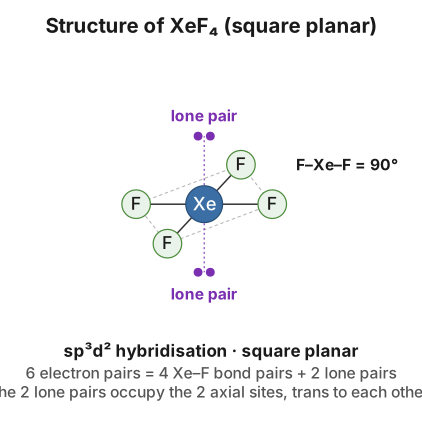
(ii) Structure of
Xe uses spd hybridisation with 4 bonding pairs and 2 lone pairs. The two lone pairs occupy opposite (axial) positions of the octahedron, leaving the four F atoms in a plane → square planar (F–Xe–F = 90°).
(Alternative) Part (b): Accounting
(i) a strong oxidising agent …
Unlock everything free for 14 days
- Full step-by-step solutions
- Concept-first explanations
- Methods, shortcuts & mistakes
- PYQ mapping + timed mock tests
Full access for 14 days. No credit card required.