Q.Out of and , which one complex is
You're viewing a preview — the full solution, concept, methods & PYQ mapping are locked.
Start your 14-day free trial to unlock the full solution →The key is the ligand field strength: is a weak field ligand (high spin, outer orbital, paramagnetic), while is a strong field ligand (low spin, inner orbital, diamagnetic). Thus is paramagnetic and high spin; is more stable and an inner orbital complex.
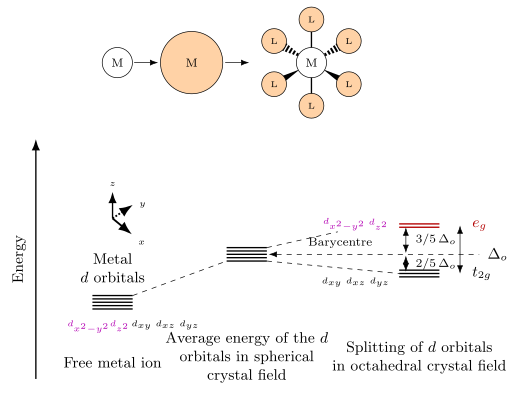
Let's start with the central idea. The properties of a coordination complex — whether it's paramagnetic or diamagnetic, high spin or low spin, inner or outer orbital — all hinge on one thing: how the ligands split the d-orbitals of the metal ion. This splitting is called Crystal Field Splitting, and its magnitude ( for octahedral complexes) depends on the nature of the ligand. Some ligands (like ) cause a small splitting; others (like , ethylenediamine) cause a large splitting. That difference decides everything.
We have cobalt in both complexes. Atomic number 27 means the ground state electron configuration is . But in a complex, the metal is in an ionic state. Let's find the oxidation state of Co in each.
1. Determine the oxidation state of Co in each complex
- For : Fluoride ion () has a charge of . Six fluorides give . The overall charge is . Let the oxidation state of Co be . Then:
So Co is in the oxidation state.
- For : (ethylenediamine) is a neutral ligand (no charge). Three neutral ligands contribute . The overall charge is . So:
Again, Co is in the oxidation state.
Both complexes contain .
2. Write the d-electron configuration of
Cobalt atom: . Removing three electrons (to get ) means we remove the two 4s electrons and one 3d electron. So has configuration.
So we have a ion in an octahedral field in both cases. The difference will come from the ligand strength.
3. Recall the Crystal Field Splitting for in octahedral geometry
In an octahedral field, the five d-orbitals split into two sets: the lower-energy (three orbitals) and the higher-energy (two orbitals). The energy gap is .
For a ion, there are two possible arrangements:
- High spin (weak field): If is small, electrons prefer to occupy all five orbitals singly before pairing. So the configuration is — four electrons in (one pair) and two unpaired in . Total unpaired electrons = 4.
- Low spin (strong field): If is large, electrons pair up in the lower orbitals before occupying . So the configuration is — all six electrons paired in . Total unpaired electrons = 0.
For octahedral:
Weak field (high spin): — 4 unpaired electrons, paramagnetic.
Strong field (low spin): — 0 unpaired electrons, diamagnetic.
4. Identify the ligand field strength
- (fluoride) is a weak field ligand. It lies near the end of the spectrochemical series (low ). So will be high spin.
- (ethylenediamine) is a strong field ligand. It is a chelating ligand (bidentate) and lies high in the spectrochemical series (large ). So will be low spin.
The spectrochemical series (partial): .
is to the left (weak), is to the right (strong). This is a quick reference for such problems.
5. Answer each part
- Paramagnetic complex Paramagnetism arises from unpaired electrons. (high spin, ) has 4 unpaired electrons — paramagnetic. (low spin, ) has all electrons paired — diamagnetic. So the paramagnetic complex is .
- More stable complex …
Unlock everything free for 14 days
- Full step-by-step solutions
- Concept-first explanations
- Methods, shortcuts & mistakes
- PYQ mapping + timed mock tests
Full access for 14 days. No credit card required.