Q.(a) Account for the following:
You're viewing a preview — the full solution, concept, methods & PYQ mapping are locked.
Start your 14-day free trial to unlock the full solution →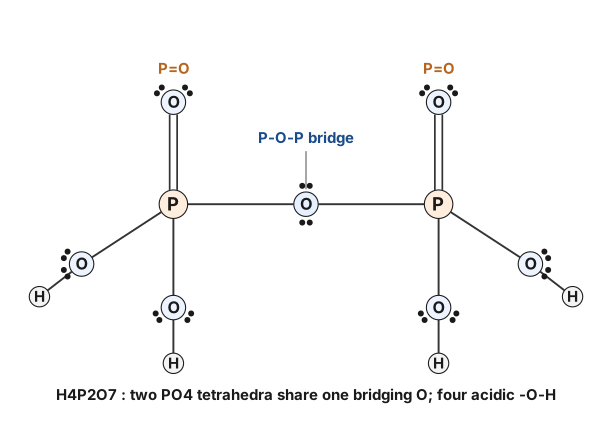
Part (a): (i) inert-pair effect + falling electronegativity make −3 rarer down group 15; (ii) weaker H–E bonds and more stable conjugate bases raise acidity ; (iii) reactivity from weak F–F bond and polar labile Cl–F bonds; (b) XeF₂ linear, H₄P₂O₇ two bridged PO₄ tetrahedra. Part (b): F₂ oxidises water in the dark; white P = P₄, red P = polymeric; ; H₂S is a better reductant than H₂O; acidity .
Part (a)
(i) Tendency to show −3 decreases from N to Bi. The −3 state needs the atom to gain three electrons. Down group 15 atomic size rises and electronegativity falls sharply (N 3.0 → Bi 2.0), so the pull on extra electrons weakens. The inert-pair effect (the pair is reluctant to engage in bonding for heavy elements) makes As, Sb, Bi favour +3/+5 instead; Bi shows essentially no −3 chemistry.
(ii) Acidic character increases . Acidity depends on how easily the H–E bond ionises. Bond strengths fall H–O (464) > H–S (347) > H–Se (276) > H–Te (238 kJ mol⁻¹) because orbital overlap worsens with the larger central atom. Weaker bonds release more readily, and the bigger conjugate base () disperses charge better. So is neutral while acidity rises to .
(iii) . has the weakest halogen bond (lone-pair repulsion in the tiny molecule) and highest electronegativity → extremely reactive. The interhalogen has polar, weak, labile Cl–F bonds and a T-shape that readily delivers fluorine, so it exceeds , whose strong, non-polar Cl–Cl bond makes it least reactive of the three.
(b) Structures.
- (i) — 5 electron pairs on Xe (2 bonds + 3 lone pairs) in a trigonal-bipyramidal set; the 3 lone pairs take equatorial sites, giving a linear molecule, F–Xe–F = 180°. …
Unlock everything free for 14 days
- Full step-by-step solutions
- Concept-first explanations
- Methods, shortcuts & mistakes
- PYQ mapping + timed mock tests
Full access for 14 days. No credit card required.