Q.(a) Although both and have hybridisation yet is paramagnetic and is diamagnetic. Give reason. (Atomic no. of Ni = 28)
You're viewing a preview — the full solution, concept, methods & PYQ mapping are locked.
Start your 14-day free trial to unlock the full solution →The magnetic behaviour difference arises from the ligand field strength: weak-field Cl⁻ leaves Ni²⁺ with two unpaired electrons (paramagnetic), while strong-field CO forces pairing in Ni⁰ (diamagnetic). For a ion, gives high-spin with 5 unpaired electrons; gives low-spin with 1 unpaired electron.
Part (a): Why is paramagnetic but is diamagnetic
The key is not just hybridisation — it’s the electronic configuration of the metal and the strength of the ligand field.
Step 1: Determine the oxidation state and -electron count for each complex.
-
In , each Cl⁻ has a −1 charge. Let Ni have oxidation state :
.
Ni (atomic number 28) has ground-state configuration .
Ni²⁺ loses the two 4s electrons: .
-
In , CO is a neutral ligand. Let Ni have oxidation state :
.
Ni⁰ has configuration — but in complexes, the 4s electrons often move to 3d, giving .
CO is a strong field ligand (high up in the spectrochemical series). It causes significant pairing of electrons. Cl⁻ is a weak field ligand (low in the spectrochemical series) and does not force pairing.
Step 2: Apply crystal field theory for tetrahedral geometry.
Both complexes are tetrahedral ( hybridisation). In a tetrahedral field, the orbitals split into two sets:
- Lower energy: set ()
- Higher energy: set ()
The splitting energy is , which is roughly of (octahedral splitting). Because is small, tetrahedral complexes are almost always high-spin — except when the ligand is extremely strong.
Step 3: Fill electrons for (Ni²⁺, , weak field).
For in a tetrahedral field, the filling follows Hund’s rule since is small:
- The set (lower) gets 2 electrons (paired).
- The set (higher) gets 6 electrons — but with 8 total, we place 2 in (paired) and 6 in (4 paired, 2 unpaired).
Result: Two unpaired electrons → paramagnetic.
Step 4: Fill electrons for (Ni⁰, , strong field).
CO is such a strong field ligand that it forces complete pairing. For Ni⁰, the effective configuration is :
- All five orbitals are completely filled (2 electrons each).
- No unpaired electrons.
Result: Zero unpaired electrons → diamagnetic.
A common mistake is to think both complexes have the same configuration. They don’t — Ni is in different oxidation states. Always check the oxidation state first.
For tetrahedral complexes, paramagnetism is the norm unless the metal has a configuration (like Zn²⁺, Cd²⁺, or Ni⁰ here) or a very strong field ligand forces pairing — which is rare in tetrahedral geometry.
Part (b): Electronic configuration of in octahedral field
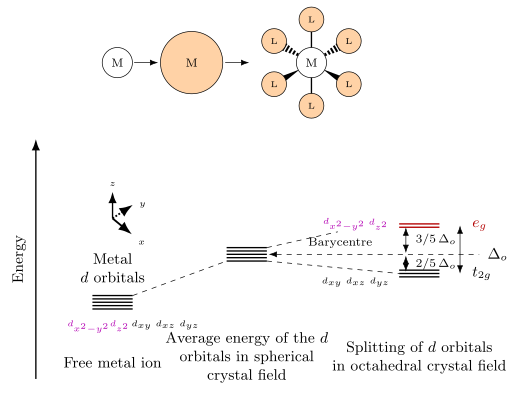
In an octahedral field, the orbitals split into:
- Lower energy: set () — three orbitals
- Higher energy: set () — two orbitals
The splitting energy is . The pairing energy is the energy cost to put two electrons in the same orbital.
Case (i): (weak field ligand) …
Unlock everything free for 14 days
- Full step-by-step solutions
- Concept-first explanations
- Methods, shortcuts & mistakes
- PYQ mapping + timed mock tests
Full access for 14 days. No credit card required.